Updated: March 11, 2026
Even the Mangroves Pray in Green—On a Sundarban Tour, You’ll See What They Mean
The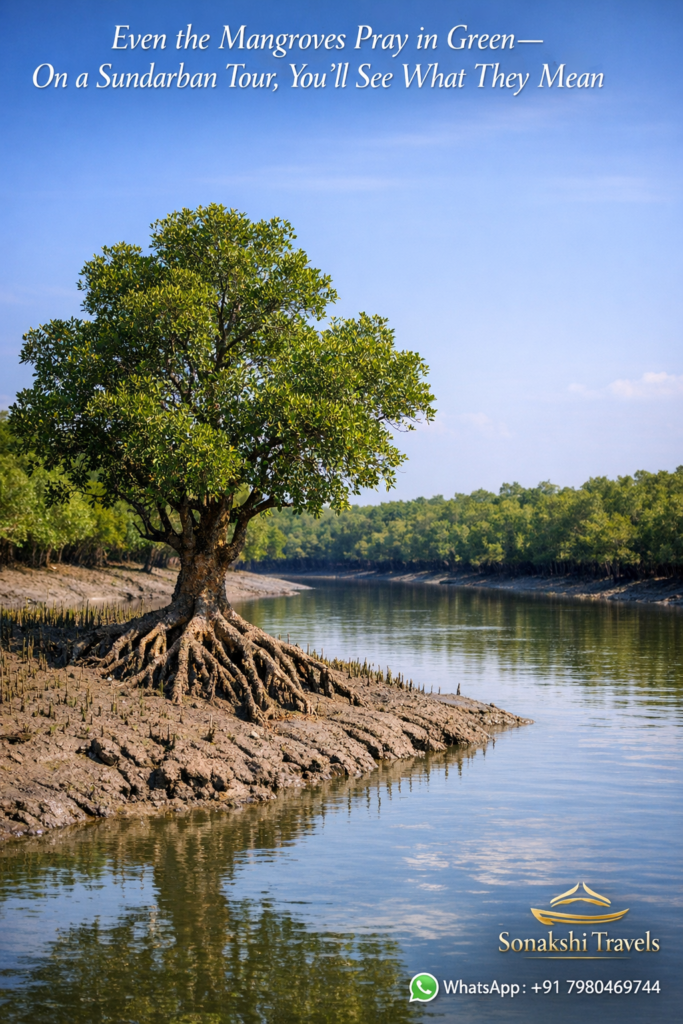 re are landscapes that impress through scale, and there are landscapes that persuade through rhythm. The Sundarban belongs to the second kind. A Sundarban tour does not reveal itself in one dramatic instant. It works slowly, almost ceremonially, through tide, silence, texture, and recurrence. Water does not merely pass the mangrove banks; it returns to them, withdraws from them, and returns again, as though the forest and the river are engaged in a conversation older than memory. To stand before such a place is to sense that the green around you is not decorative. It is deliberate. It feels ordered, attentive, and strangely reverent.
The title may sound poetic, yet the feeling behind it is grounded in close observation. In the Sundarban, the mangroves lift their roots from mud in forms that resemble hands, fingers, and clustered gestures rising toward air and light. Their leaves catch changing brightness with a softness that seems almost devotional. Their persistence against salinity, tidal pressure, and unstable ground gives the entire forest an unusual moral presence. One begins to feel that this is not simply vegetation surviving in difficult conditions, but a living discipline practiced in green. That is why so many travelers come away from a Sundarban tour package with the sense that they have not merely seen a place. They have witnessed a form of patience made visible.
The Meaning of Green in a Tidal Forest
In many forests, green appears as abundance. In the Sundarban, green appears as endurance. The leaves are not set against mountain mist or rich inland rain-fed soil. They emerge from a contested edge where land and water are never fully settled. The earth is soft, saline, and unstable. The channels widen and narrow with tidal authority. The atmosphere carries moisture, silt, and movement. Under such conditions, every rooted thing has had to negotiate survival with extraordinary intelligence. To see the mangroves closely is to understand that their green is not softness alone. It is a record of adaptation, pressure, and response.
This gives a Sundarban tourism experience a depth that ordinary sightseeing rarely achieves. The eye first enjoys the beauty of the forest’s layered tones—olive, deep green, river-shadowed green, sunlit green—but the mind soon begins asking what those colors represent. They represent labor without haste. They represent life learning how to remain upright where certainty is impossible. The mangrove is never arrogant. It does not dominate its environment. It studies the environment, adjusts to it, bends with it, and still remains itself. That quiet strength is one reason the forest so often feels spiritual even when nothing explicitly religious is present.
Prayer, after all, is not only speech. Prayer can also be repetition, humility, orientation, and endurance. The mangroves repeat their forms across miles of mudbank and channel. They bow to the tide without surrendering their hold. They turn sunlight into sustenance in a place where the ground itself can betray stability. Seen this way, the green world of the Sundarban resembles a long act of disciplined attention. On a serious Sundarban travel guide level, this is what makes the forest so psychologically singular: it produces not only visual admiration, but reflection.
Why Silence Feels Different Here
Silence in the Sundarban is not emptiness. It is layered restraint. One hears water pressing against the boat, wind moving through leaves, distant birdcall, the soft friction of current against muddy edges, and sometimes the sudden break of sound that reminds you how alert the whole environment remains. Yet beneath these sounds lies an unusual quietness of mind. The forest seems to reduce internal noise. Thoughts that were hurried before arrival begin to slow. The body becomes more attentive to interval. A pause between two sounds feels meaningful. A turn in the channel feels like the completion of a sentence.
This is where the emotional force of a Sundarban eco tourism setting becomes clear. Eco tourism in its true sense is not merely about visiting a sensitive environment. It is about learning how to perceive within one. The Sundarban teaches this through restraint. It does not overwhelm with constant visual spectacle. Instead, it refines the traveler’s attention. A slight movement in the branches matters. The pattern of roots at the bank matters. The difference between still water and water under hidden current matters. The place educates perception by asking the traveler to notice more and demand less.
That is why many visitors describe the forest in spiritual language even when they arrive with no such expectation. The stillness is not theatrical. It is structural. The environment requires stillness because it is organized by delicate balances—between salt and freshwater influence, between exposure and shelter, between growth and erosion, between concealment and revelation. When a landscape is built by such balances, it tends to affect the human mind in the same way. It does not invite domination. It invites listening.
The Mangrove as a Moral Form
The mangrove is among the most remarkable plant systems in the world because it thrives where ordinary assumptions of rooted life would fail. It tolerates salinity, stabilizes vulnerable shorelines, filters sediment, shelters juvenile aquatic life, and creates biological structure in terrain that would otherwise be far more exposed. But beyond these ecological functions lies something that human beings instinctively respond to at a symbolic level. The mangrove is useful without display. It protects without announcing protection. It holds the edge together without appearing monumental.
For this reason, a Sundarban travel package centered on real observation often leaves a deeper impression than louder, more obviously dramatic journeys. Here, grandeur is not vertical. It is relational. Roots rise through mud to manage breath where oxygen is limited. Branch systems learn to inhabit brackish uncertainty. Leaves continue their green work under conditions that would discourage less specialized life. The forest’s beauty is inseparable from its discipline. What you admire aesthetically, you also admire ethically. The place seems to embody steadiness under pressure.
When people say the mangroves appear to pray, they may in fact be responding to this ethic. The forest enacts an order of life that does not separate beauty from resilience. Nothing is ornamental alone. The roots are strange and elegant because they are necessary. The channels are beautiful because they are living arteries. The green canopy feels calm because it is the visible outcome of countless adaptive negotiations. Seen this way, the forest becomes less like scenery and more like instruction.
Movement Without Hurry
One of the most distinctive truths of a Sundarban nature tour is that movement here rarely feels rushed, even when the tide itself is powerful. The channels curve rather than declare. Banks emerge and disappear according to tidal logic. Boats progress not through conquest of distance, but through cooperation with water. This manner of movement affects thought. Modern life often trains perception to seek climax, speed, and immediate arrival. The Sundarban offers another pattern: approach, delay, partial revelation, and return.
Such movement has a psychological consequence. It restores proportion. The traveler begins to understand that not everything meaningful appears quickly. In the tidal forest, form emerges through patience. A line of roots becomes visible only when the light shifts. A particular density of foliage reveals itself only when viewed from the proper angle. Even the emotional understanding of the place grows gradually. At first the forest may seem quiet. Later it begins to feel intelligent. Later still, it feels solemn. By then the green no longer seems passive. It feels watchful, almost meditative.
This is also why the region can take on such a powerful atmosphere during a Sundarban luxury tour or a deeply observed private journey. Comfort, when properly arranged, does not distract from the forest; it can create the stillness needed to notice it properly. The more uninterrupted the attention, the more the place reveals its structure of quiet meanings. The river then becomes not just a route, but a medium of understanding.
Reading the Forest as Gesture
There is a reason the Sundarban so often invites metaphor. Its forms resemble gestures. Pneumatophores rise from mud like clustered fingers. Curved branches lean over channels like protective arms. Dense green margins seem to gather inward as though holding counsel. Mudbanks, half-submerged and half-exposed, resemble thresholds rather than edges. None of this means the forest was made for human symbolism. It means the human imagination, when confronted with repeated and meaningful natural forms, begins to interpret them through familiar emotional language.
On a carefully observed Sundarban private tour, this interpretive process becomes stronger because there is time to dwell in one scene long enough for meaning to gather. The forest does not merely pass by as a sequence of views. It accumulates presence. You begin to feel that the green margins of the channel are not static backgrounds, but active participants in the atmosphere of the place. They receive light, absorb silence, frame movement, and define the psychological temperature of the journey.
This can be especially striking when the river surface grows calm enough to reflect fragments of the mangrove line. Then the forest seems doubled—once in leaf and root, and once in water. Reflection deepens the sense of prayer within the landscape. What stands above is repeated below. The visible world appears to contemplate itself. Such moments are not constant, which is precisely why they matter. The Sundarban teaches value through transience. Meaning comes, brightens, and withdraws, much like the tide itself.
Ecology and Reverence Belong Together
To speak of prayer in the Sundarban is not to abandon science. In fact, the closer one looks at the ecology, the more understandable the reverence becomes. Mangrove systems are globally significant because they store carbon efficiently, reduce erosion, buffer shorelines, support fisheries, and sustain intricate food webs. In the Sundarban, these functions are carried out at a scale and complexity that demand respect. The forest is not only beautiful; it is biologically consequential. It performs immense environmental labor while appearing serene.
This is where a deeper Sundarban trip package should ideally lead the mind—not toward generic admiration, but toward informed wonder. Wonder becomes stronger, not weaker, when grounded in ecological truth. Knowing that the green before you is engaged in shoreline defense, carbon capture, habitat formation, and salinity negotiation makes the visible world more meaningful. The forest’s calm surface conceals intense functional sophistication. That hidden labor resembles prayer in another sense: essential work done without spectacle.
A serious traveler therefore does not experience the Sundarban only as scenery. The place is a living infrastructure of resilience. Each mangrove stand participates in maintaining a precarious equilibrium. Each root zone influences the shape of the bank. Each patch of vegetation contributes to habitat and shelter. Reverence becomes appropriate not because the forest is mysterious alone, but because its material functions are so profound. Beauty here has consequences.
The Human Mind Inside Tidal Time
The Sundarban changes the traveler’s sense of time. Inland life is governed largely by clocks, schedules, and fixed surfaces. The tidal forest operates by recurrence, interval, and negotiation. Water levels alter the appearance of place. Exposed mud becomes covered. A bank that seemed near feels distant after a turn. The same channel can appear different within hours because light, tide, and reflection have altered its expression. This fluidity unsettles rigid habits of attention and replaces them with something more responsive.
That is one reason a thoughtful Sundarban travel experience often feels restorative. Restoration here is not created by entertainment. It comes from realignment. The mind is drawn out of mechanical repetition and into ecological rhythm. One begins to watch rather than merely scan. One begins to wait rather than demand. One begins to perceive that silence can be active, that repetition can deepen meaning, and that slowness can sharpen awareness rather than dull it.
This altered temporality also explains why the forest can feel prayerful without ever becoming sentimental. Prayer requires a relation to time different from ordinary efficiency. It involves pause, repetition, inward attention, and endurance. The Sundarban trains these same capacities through environment alone. Its channels delay arrival. Its sounds emerge from distance. Its green margins ask for contemplation. By the time the traveler notices this, the forest has already begun its quiet work on the mind.
When Privacy Deepens Perception
There are moments when the inward quality of the landscape becomes even more pronounced, especially during a Sundarban luxury private tour or a carefully paced river journey with fewer interruptions. Privacy does not make the forest more beautiful, but it can make the traveler more available to beauty. Without crowd noise, constant conversation, or hurried transitions, the relationship between viewer and landscape becomes more intimate. The eye settles longer. The ear distinguishes more. The mind forms a subtler understanding of the green world around it.
In such conditions, the Sundarban begins to feel less like a destination and more like a presence. The mangroves no longer appear as repeated botanical units. They appear as a collective body holding the river’s edge in disciplined silence. Their green mass becomes legible as intention—ecological intention, certainly, but also emotional intention in the way humans receive it. The forest seems to be doing something with its stillness. It is not vacant. It is composed.
For couples, families, or reflective travelers, this composed silence often becomes the defining memory. A channel turning under soft light. A bank lined with roots that seem to rise in mute appeal. Water carrying reflections that tremble and re-form. These are not loud memories, but enduring ones. They remain because they entered the mind through attention, not shock.
The Green That Teaches Humility
Perhaps the deepest meaning of the title lies here: the mangroves appear to pray because they teach humility without humiliation. They are not weak, yet they bend. They are not static, yet they remain. They do not possess the dramatic prestige of mountain forests, yet they perform vital labor on a fragile edge of land and sea. To witness them is to encounter a form of life that survives by relation, not domination. This is a lesson many modern environments no longer communicate clearly.
On a true Sundarban tour packages experience shaped by observation rather than distraction, that lesson becomes unforgettable. You begin by seeing green. You continue by noticing pattern. You end by recognizing discipline. The forest’s beauty then ceases to be superficial. It becomes expressive of a deeper order. The mangroves “pray” not because they resemble a human ritual in any literal sense, but because they embody constancy, submission to larger rhythms, and a quiet form of praise enacted through continued life.
That is why the Sundarban lingers in memory long after departure. It does not leave behind only images of river and forest. It leaves a changed understanding of what calm can be. Calm, in this place, is not the absence of struggle. It is struggle transformed into balance. Green is not decorative. It is earned. Silence is not empty. It is full of relation. And prayer is not merely spoken. Sometimes it is rooted, tidal, and leaf-lit—rising from mud in thousands of breathing forms, teaching the traveler that reverence can exist in the architecture of life itself.
To see this clearly is one of the finest gifts of the Sundarban. The forest does not ask to be conquered, summarized, or consumed. It asks to be read with patience. When that patience is given, the channels, roots, reflections, and quiet expanses begin to say something unmistakable. They say that endurance can be graceful. They say that resilience can be beautiful. They say that even on unstable ground, life can turn toward light with a devotion so complete that it appears, from a respectful distance, like prayer in green.