Updated: March 12, 2026
What is Included in a Sundarban Private Tour?
To ask what is included in a private journey through the delta is to ask more than what is listed on a booking page. In the Sundarban, inclusion is not merely a commercial matter. It is a question of how the landscape is entered, how privacy is arranged, how movement is paced, how meals and rest are integrated into the rhythm of the rivers, and how the forest is experienced without unnecessary crowding or confusion. A well-designed Sundarban private tour is therefore defined not only by exclusivity, but by the quality of attention it makes possible.
Unlike a standard shared departure, a private journey is typically structured around control, continuity, and atmosphere. The boat, the guidance, the pace of observation, the order of the day, and the texture of hospitality are arranged for one party rather than for a mixed group of unrelated travelers. This changes the experience profoundly. Silence becomes more available. Conversation becomes more meaningful. Observation becomes less interrupted. Meals, rest, and river movement acquire a more deliberate character. In that sense, what is included in a private tour is both visible and invisible: accommodation, boat use, food service, and guiding are visible inclusions, while calm, autonomy, and interpretive depth are equally important but less easily listed.
The first inclusion is privacy of movement
The most immediate feature included in a private arrangement is private use of the travel environment itself. This usually means that the travelers are not sharing their core experience with unrelated guests. Whether the journey is arranged through a dedicated vessel, a reserved section, or an individually organized riverside stay with controlled access to boat excursions, the principle remains the same: movement belongs to the travelers themselves. That privacy changes the emotional structure of the delta. The Sundarban is a place of intervals, half-seen shifts, soft sound, and long stretches of water-bound attention. Such a landscape is felt more completely when one is not constantly adjusting to the habits, voices, or expectations of strangers.
For this reason, many travelers who choose a private format are not simply looking for luxury in a decorative sense. They are seeking coherence. They want the forest to be encountered with fewer interruptions. They want family members to remain together without social fragmentation. Couples may want quiet companionship. Photographers may want a stable observational rhythm. Older travelers may want comfort without the pressure of group timing. Thus, one of the most valuable elements included in a Sundarban private tour package is the right to experience the delta at a controlled human scale.
The second inclusion is a dedicated river experience
In the Sundarban, the river is not merely a route. It is the medium through which the forest is understood. A private tour generally includes a dedicated boating experience shaped around the needs of the booking party. This may take the form of a reserved vessel, curated cruise hours, flexible pauses for observation, and more personalized use of deck space. Because the Sundarban is a riverine forest rather than a land-based sightseeing destination, the quality of the boat experience is central to the quality of the entire journey.
A private boat environment offers practical as well as psychological advantages. Seating is less congested. Movement on deck is easier. Families with children can organize themselves more comfortably. Elderly guests can occupy preferred resting positions. Conversation with the guide becomes more direct. Quiet moments remain quiet. Even the visual act of looking outward changes when one is not competing for position. A thoughtfully arranged Sundarban private boat tour therefore includes more than transport. It includes spatial ease, observational continuity, and a stronger sense that the rivers are being read rather than merely crossed.
When the arrangement is designed at a higher level, the boating element may also resemble a private Sundarban river cruise in character. This does not mean artificial spectacle. Rather, it suggests smoother service, better seating, cleaner meal presentation, more settled intervals of movement, and a sense that the river journey itself has been curated as an experience of refinement. In the delta, refinement is not excess. It is the removal of friction.
Accommodation or onboard comfort is also part of inclusion
A private tour often includes a reserved stay environment, and this is one of the clearest distinctions between a generic departure and a carefully arranged journey. Depending on the format, travelers may be given a dedicated room category, a more intimate riverside lodging atmosphere, or a high-comfort boat arrangement linked to a premium package structure. The important point is that accommodation is not treated as a separate afterthought. It is part of the interpretive design of the journey itself.
When private travel is organized with a premium standard, the stay component may align with the expectations associated with a Sundarban luxury tour. In such cases, inclusion typically extends to better-maintained rooms, more controlled dining arrangements, calmer service patterns, and a generally more composed transition between forest movement and personal rest. The Sundarban can be mentally rich and sensorially dense. After long hours of watching channels, mudbanks, birdlines, tide marks, and mangrove edges, travelers benefit from returning to a space that is orderly, restful, and quiet.
In some cases, travelers specifically seek a Sundarban luxury resort atmosphere or a branded hospitality experience associated with more polished service standards. Although individual configurations differ, the logic remains constant: accommodation is included not merely for sleeping, but for restoring attention. The delta asks much from the senses. Rest is part of responsible design.
Food and hospitality are not minor inclusions
Meals are among the most underestimated elements of a private tour. In reality, food service strongly shapes the emotional tone of the journey. A good private arrangement typically includes planned meals, refreshments, and dining coordination designed around the river schedule and the needs of the specific party. This matters because the Sundarban is experienced through duration. One does not merely arrive, look, and leave. One moves, waits, notices, listens, returns, and resumes. Food provides rhythm within that sequence.
In a well-managed private environment, hospitality tends to become more personal. Dietary preferences can be handled more thoughtfully. Meal timings can be coordinated with rest and cruise flow. Families may eat more comfortably together. Couples may enjoy more uninterrupted dining time. Older guests may find the experience less hurried. In premium formats, what is included is not lavish abundance for its own sake, but order, cleanliness, timing, and attentiveness. These qualities matter greatly in a landscape where physical infrastructure is secondary to coordination.
Thus, inclusion in a private journey should always be understood broadly. It includes nourishment, certainly, but also mood. A meal served well in the delta supports calm. A chaotic meal breaks it. The difference is not trivial.
Naturalist guidance and interpretive support are central inclusions
Many travelers assume that inclusion means objects and services alone. In the Sundarban, one of the most important inclusions is interpretive intelligence. The forest rarely reveals itself through constant dramatic events. It must be read through signs: bird movement, crab activity, mud textures, changing salinity patterns, exposed roots, silence in one channel and agitation in another, the behavior of light on tidal water, and the relation between stillness and possible life. Without informed interpretation, much of this remains visually present but mentally unformed.
A strong private arrangement generally includes access to more direct guide interaction. Because the group is self-contained, questions may be asked without hesitation, answers may become more detailed, and explanation may be adapted to the interests of the travelers. Children may receive simplified ecological interpretation. Photography-focused guests may want behavioral cues. General leisure travelers may want a clearer account of what they are seeing and why it matters. A serious Sundarban travel guide function is therefore often embedded within the structure of a good private package, even when it is not always described in those exact terms.
This is especially important when the journey includes wildlife observation. A private format does not guarantee sightings, but it often improves the quality of noticing. The guide can respond more specifically to the attentional needs of the group. Instead of speaking to a crowd, the guide can read the mood of the travelers and interpret the forest at an appropriate pace. In the Sundarban, knowledge is not an accessory. It is part of the experience itself.
Wildlife observation is included as an organized mode of attention
When people hear the phrase wildlife safari, they often imagine immediate drama. The Sundarban works differently. Here, wildlife is frequently perceived through pattern, patience, and indirect evidence. A private journey usually includes structured opportunities for observing the living environment of the delta from the water, through creek edges, mudbanks, mangrove fronts, exposed flats, and quieter channel zones where behavior may be noticed more carefully.
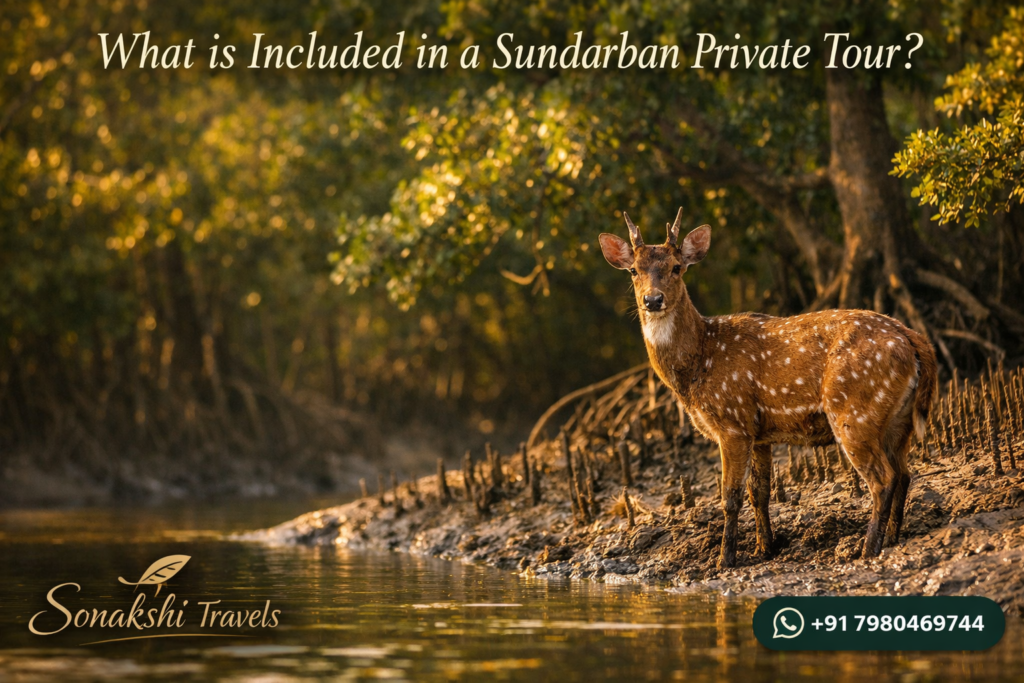
This is why a private package is often associated with phrases such as Sundarban private wildlife safari or Sundarban private safari tour. The deeper meaning of those phrases lies not in spectacle, but in controlled observation. Travelers are given the conditions in which wildlife signs may be perceived with fewer disturbances. Birdlines may be followed more attentively. Reptilian stillness near the bank may be noticed sooner. Deer movement on the edge of the vegetation may be easier to track when the human environment on board remains composed.
From an ecological perspective, this matters because the Sundarban is not a stage built for tourist certainty. It is a dynamic estuarine forest shaped by tide, sediment, salinity, concealment, and adaptation. Wildlife belongs to this logic of partial visibility. A private tour includes the chance to meet that logic with greater seriousness. Even when a dramatic sighting does not occur, travelers often leave with a stronger sense of the forest’s behavioral complexity. That is a meaningful inclusion in itself.
The pace of the day is usually more personalized
Another significant element included in a private arrangement is personalization of rhythm. This does not mean limitless flexibility in every technical sense, but it does mean that the sequence of the experience can be better aligned with the needs of the travelers. Shared group departures often require broad compromise. A private structure, by contrast, can better accommodate comfort, rest intervals, family dynamics, and conversational preference.
That is why such journeys are sometimes described as a Sundarban customized private tour or a Sundarban personalized travel package. These phrases should not be understood as marketing decoration alone. They indicate a practical shift in how the day is inhabited. One group may prefer long quiet stretches on deck. Another may want more interpretive conversation. A family may need smoother meal transitions and simpler pacing. A couple may want intimacy and reduced noise. A multi-generational party may need a balance between curiosity and physical ease. Personalization is not a luxury added after the fact. It is part of what the private category fundamentally includes.
In the best cases, the experience becomes a true Sundarban tailor-made tour, not because the forest can be controlled, but because the human side of the journey can be arranged with intelligence. The delta remains wild. The arrangement becomes humane.
Private tours often include stronger suitability for families and couples
Not every traveler enters the Sundarban with the same emotional aim. Some want concentration and silence. Some want family cohesion. Some want romance without theatricality. Some want children to experience the forest without the strain of crowds. A private format usually includes a structure better suited to these differences. This is why travelers often search for a Sundarban family private tour or a Sundarban couple private tour. The appeal lies not only in exclusivity, but in appropriateness.
For families, inclusion means more manageable space, easier supervision, more coherent meal arrangements, and less exposure to the unpredictable habits of unrelated groups. For couples, inclusion means the restoration of atmosphere. The Sundarban is naturally intimate when allowed to remain quiet. Water, distance, soft bird calls, mangrove silhouettes, and evening stillness create a rare emotional setting. A private arrangement preserves that setting more effectively than a crowded social environment can.
This also explains why some travelers connect the private category with a more elevated or romantic frame, including expectations related to a Sundarban luxury honeymoon package or a premium nature-centered retreat. The essential inclusion here is emotional architecture. The arrangement protects the mood required for intimacy, reflection, and unhurried shared attention.
Luxury, when included, is usually expressed as calm efficiency
The word luxury is often misunderstood in landscapes of ecological seriousness. In the Sundarban, luxury should not mean excess layered over fragility. It should mean clarity, comfort, and reduced friction. When a package includes luxury elements, those elements generally appear through cleaner hospitality, better maintenance, more settled dining, stronger privacy, improved rest spaces, and a more composed boating environment. This is the logic behind a properly designed Sundarban luxury tour package.
In that sense, a Sundarban luxury private tour does not oppose the wildness of the delta. It creates the right human conditions for perceiving that wildness without unnecessary discomfort or noise. Likewise, terms such as luxury Sundarban cruise, luxury Sundarban river cruise, and Sundarban private luxury boat point toward an experience where the traveler’s side of the equation is smoothed, so that the forest’s side can be encountered more fully.
Good luxury in the Sundarban is therefore subtractive rather than excessive. It removes crowding, confusion, poor timing, disorder, and avoidable fatigue. What remains is a more focused relation between traveler and environment.
Booking support and organizational coherence are also part of inclusion
Although the private tour is ultimately experienced on water and at rest, it is made possible by planning discipline. A quality operator generally includes coordination, scheduling coherence, staffing continuity, and service accountability within the private arrangement. Travelers may not always see these elements directly, yet they shape the experience from beginning to end. Private travel fails when the behind-the-scenes organization is weak.
For this reason, inclusion often extends beyond physical deliverables into the realm of responsible curation. Travelers choosing to book Sundarban private tour options are not simply reserving a room or seat. They are entrusting a sequence of services to an organizer capable of maintaining quality across hospitality, navigation, communication, and ecological sensitivity. Whether one approaches the journey through a recognized Sundarban travel agency or a specialized best Sundarban tour operator, what is included in the strongest sense is confidence that the experience will remain coherent from one stage to the next.
What a private Sundarban experience truly includes
When all of these elements are considered together, the answer becomes clearer. What is included in a private journey through the Sundarban is not merely a list of services, though services matter greatly. It includes privacy of movement, dedicated river access, calmer accommodation, organized meals, interpretive guidance, wildlife-oriented observation, personal rhythm, family or couple suitability, and—where relevant—an elevated standard of hospitality associated with premium travel. It may also include the atmosphere of a Sundarban private mangrove cruise, the quiet refinement of a private Sundarban eco tour, or the psychological ease expected from a carefully managed Sundarban custom travel package.
Yet the deepest inclusion remains difficult to summarize in commercial language. A private tour includes the possibility of sustained attention. It includes the freedom to notice the delta without social clutter. It includes a more intimate relation to water, silence, mud, birdcall, shadow, and distance. It includes time in which the Sundarban may remain itself rather than being overwhelmed by the human crowd. In a landscape where meaning often arrives slowly, that is perhaps the greatest inclusion of all.
For travelers seeking not just movement through the forest, but a more deliberate and refined Sundarban travel experience shaped by privacy, ecological seriousness, and quiet comfort, the private format offers a distinct answer. It includes what is necessary for the body, what is supportive for the mind, and what is respectful to the landscape. In the Sundarban, that balance is the true measure of inclusion.