Why a Sundarban Private Luxury Journey Is Defined by Silence, Safety, and the Courage to Travel Deep Into the Wild
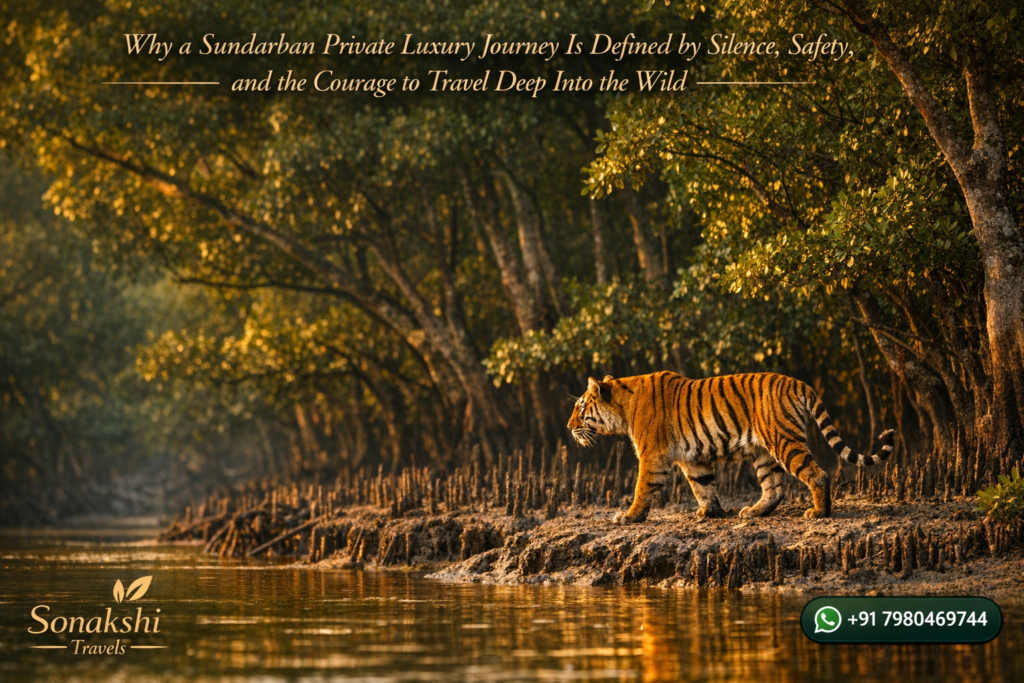
The Sundarban is often spoken of as a destination of mystery, wildlife, and tidal beauty, yet those descriptions only begin to explain its true character. This is not a landscape that reveals itself through speed, noise, or the ordinary language of tourism. It is a region of moving water, mangrove shadow, animal presence, changing light, and ecological tension. To travel here well is not simply to book a trip. It is to enter a living delta where every decision about pace, privacy, comfort, and safety changes the meaning of the experience itself.
For that reason, the idea of a Sundarban private tour or Sundarban luxury tour should never be reduced to convenience alone. In a destination shaped by uncertainty and natural intelligence, privacy is not merely an indulgence, luxury is not just visual refinement, and safety is not a background formality. These elements work together to create a deeper form of travel: one that allows the guest to feel the forest more carefully, move through it more responsibly, and understand its beauty without disturbing its essential mood.
A truly memorable Sundarban tour experience is therefore built on synthesis. It must combine wilderness immersion with protection, comfort with humility, and exclusivity with environmental awareness. When these elements are aligned, the journey becomes something greater than sightseeing. It becomes an encounter with a rare and unstable geography, one that demands patience, rewards quiet attention, and leaves a lasting impression precisely because it cannot be consumed in a superficial way.
The Real Meaning of Premium Travel in the Sundarban
Premium travel in the Sundarban is unlike premium travel in urban or resort-centered destinations. Here, quality is not proved by excess. It is proved by design. A well-curated journey offers the traveler space, stillness, logistical confidence, and interpretive depth. The emphasis shifts away from spectacle and toward access—access to silence, to cleaner movement through the waterways, to uninterrupted observation, and to a more intimate understanding of the delta’s emotional and ecological rhythm.
This is why the language of premium travel in the Sundarban often carries a deeper implication than it does elsewhere. A traveler who chooses a more refined journey is not simply choosing better service; that traveler is choosing the conditions necessary to perceive the forest properly. The difference may lie in a more carefully arranged boat experience, more deliberate hospitality, smaller group movement, quieter surroundings, and the psychological ease that comes from knowing the day has not been overloaded with noise and confusion. Such an approach transforms the journey from a rushed excursion into a reflective river passage through one of the world’s most distinctive wetland ecosystems.
That sense of refinement is captured powerfully in the idea of a Sundarban premium tour through the heart of nature, where the value of the journey is rooted not in ornament but in the quality of immersion. In this context, Sundarban premium tour is best understood as a carefully structured balance of comfort and awareness. The traveler feels protected, but not separated from the wild. The amenities support perception rather than distracting from it.
This distinction matters for SEO-driven travel communication as well. Many travelers searching for a Sundarban luxury private tour are not merely comparing facilities. They are searching for assurance that the experience will feel meaningful, safe, and rare. The language of luxury in this setting must therefore remain connected to authenticity. The Sundarban resists decorative exaggeration. Its true grandeur lies in mudbanks lit by early sun, distant bird calls over wide tidal water, the disciplined movement of boats, and the charged stillness of a mangrove horizon where nothing can be predicted with certainty.
Why Privacy Changes the Entire Character of the Journey
Privacy in the Sundarban is not a small operational detail. It changes the psychology of travel. In crowded formats, travelers often experience the delta through interruption—voices, competing expectations, rushed schedules, fragmented attention, and the subtle pressure of moving according to someone else’s rhythm. In a private setting, by contrast, the environment can be approached with calm intention. Observation deepens. Conversation becomes more meaningful. Silence regains its value.
A Sundarban private tour package allows the landscape to speak in its own tone. Families can move without pressure. Couples can experience the waterways without crowd noise. Wildlife enthusiasts can maintain longer attention spans. Thoughtful travelers, photographers, and nature lovers can remain fully present rather than socially distracted. Privacy, in this sense, is not merely about isolation. It is about preserving the emotional and sensory conditions required for real immersion.
This quality is reflected in the evocative idea of a Sundarban private tour where mystery floats. The phrase suggests something essential about the delta: it is a place where atmosphere matters as much as itinerary. Mystery is not created artificially. It rises naturally from shifting creeks, unfinished horizons, hidden movement, and the awareness that this watery forest contains more than can ever be fully seen. A private format protects that mystery. It prevents the journey from becoming merely performative.
There is also a practical reason privacy matters. Smaller, more controlled movement often produces better coordination and calmer decision-making. Travel in the Sundarban is not only about what one sees; it is about how one moves. A private structure allows timings, rest intervals, meals, and observational pauses to align more naturally with the needs of the travelers. This improves both comfort and safety while preserving dignity and personal pace.
For travelers who seek emotional resonance rather than crowd-driven entertainment, the Sundarban private tour becomes an ideal format. It creates room for contemplation, for uninterrupted river watching, and for the subtle forms of wonder that do not survive in a noisy group atmosphere. In a place defined by tides and caution, privacy is one of the most intelligent ways to travel well.
Luxury in the Delta Is Built on Calm, Not Excess
The word luxury is often misunderstood when applied to remote ecological destinations. In the Sundarban, it should not suggest artificial glamour, unnecessary display, or a detachment from the landscape. True Sundarban luxury tour design is quieter and more serious than that. It is built on restful accommodation, disciplined logistics, thoughtful food service, dependable planning, and a sense of emotional ease that allows the traveler to remain open to the environment rather than burdened by discomfort.
This is why the finest versions of Sundarban luxury tour package design feel almost invisible in their excellence. They remove friction. They allow the guest to focus on the forest, the river, the soundscape, and the unfolding mood of the day. Better hospitality does not compete with nature; it supports a more meaningful encounter with it. The experience becomes elegant because it is measured, composed, and humane.
Thematic expressions of this idea can be seen in narratives such as a luxury Sundarban tour experience that reveals the wild and the wonderful. The phrasing is significant. It does not oppose wilderness and comfort; it connects them. That is the real achievement of a well-planned journey in the delta. The traveler is not forced to choose between ecological seriousness and personal ease. Instead, the journey is designed so that comfort becomes the foundation for deeper attention.
Such a perspective also helps distinguish serious travel brands from generic package marketing. To promise luxury in the Sundarban is to promise intelligent hospitality, not theatrical indulgence. It means the traveler can wake early without strain, dine without chaos, rest without anxiety, and explore without feeling exposed to avoidable disorganization. The best journeys preserve the rawness of the region while removing the needless difficulties that would otherwise reduce the traveler’s ability to appreciate it.
When this form of luxury is achieved, the delta does not feel domesticated. It feels more legible. The traveler begins to notice things that rushed or uncomfortable travel often hides: the geometry of exposed roots, the tension between still water and implied animal movement, the difference between open river and narrow creek, the changing emotional weight of morning mist and afternoon glare. Luxury, then, becomes a discipline of enabling perception.
Safety Is Not Separate From the Experience but Central to It
One of the most important realities of the Sundarban is that beauty and risk coexist. This is a living wildlife landscape, not a decorative backdrop. Any honest interpretation of the region must acknowledge this fact. The waterways, mudbanks, dense vegetation, and presence of wild animals demand a culture of alertness. That is why safety should never be treated as a secondary topic in Sundarban travel writing. It is part of the very structure of trust that allows the journey to be enjoyed at all.
A serious traveler does not want false reassurance. What inspires confidence is the visible presence of systems, awareness, and disciplined conduct. Safe movement in the Sundarban depends on practical intelligence: route awareness, trained handling of boat operations, respect for regulated zones, careful traveler guidance, and a clear understanding that human curiosity must always remain subordinate to ecological limits. In such an environment, safety is not fear-driven restriction. It is responsible coexistence.
This is why a thoughtful article on safety measures on Sundarban boat tours to avoid man-animal conflict speaks to the deeper seriousness of the destination. The phrase itself reveals a vital thematic layer: the purpose of safety is not only to protect travelers, but also to respect the boundary between human presence and wildlife space. Ethical tourism in the Sundarban depends on exactly this principle.
For premium and private travelers, this issue becomes even more significant. They are not merely paying for a better atmosphere. They are investing in confidence—confidence that the journey has been planned by people who understand the terrain, the behavioral logic of wildlife-sensitive zones, and the importance of precaution in a fragile estuarine ecosystem. In this sense, Sundarban boat tour safety is inseparable from brand credibility.
Moreover, the presence of safety does not diminish adventure. On the contrary, it makes adventure more meaningful. When the traveler knows that movement is being handled with seriousness and knowledge, attention can return to the environment itself. Fear gives way to alert appreciation. The forest feels powerful, not chaotic. The experience becomes memorable because it is conducted within a framework of respect.
The Sundarban Calls to Travelers Who Want More Than Tourism
Not every traveler is suited to the Sundarban, and that is precisely part of its appeal. This is not a destination for passive consumption. It attracts those who are willing to exchange ordinary tourism habits for patience, curiosity, and emotional openness. The delta asks its visitors to slow down, observe, listen, and accept that meaning may arrive through atmosphere rather than event.
That is why the image of the traveler matters so much in Sundarban storytelling. The ideal guest is not simply affluent or adventurous. The ideal guest is attentive. Such a person may appreciate comfort, but does not require artificial distraction. Such a person may desire privacy, but also understands responsibility. Such a person may seek beauty, but is prepared to find it in mud, silence, distance, tide, and suspense.
This sensibility is especially clear in the notion of a Sundarban private tour for fearless dreamers. The phrase is compelling because it joins imagination with courage. The Sundarban does not reward reckless behavior, but it does reward emotional bravery—the willingness to enter a landscape that cannot be fully controlled and therefore cannot be experienced superficially. Dreamers are drawn to its beauty; the fearless are prepared to meet its ambiguity.
From a content strategy perspective, this is one of the most powerful thematic directions available in Sundarban travel content. It elevates the journey beyond itinerary-based marketing and speaks directly to aspirational intent. Many users searching for Sundarban private tour packages are not only comparing prices or inclusions. They are searching for a form of travel that feels intimate, unusual, and transformative. They want a journey that feels unlike standard leisure tourism. The Sundarban is uniquely positioned to meet that desire because it is a place where vulnerability and wonder exist side by side.
When travel writing captures this deeper truth, it becomes more authoritative and more emotionally persuasive. It stops selling only a package and begins articulating a philosophy of travel. That philosophy is rooted in quiet courage, ecological respect, and the desire to encounter the world in a less mediated form.
Why the Finest Sundarban Journeys Feel Transformative
At its highest level, a thoughtfully designed Sundarban luxury private tour does something rare. It restores seriousness to travel. It reminds the traveler that a journey can still be shaped by environment rather than entertainment, by attention rather than consumption, by structure rather than noise. In the Sundarban, one does not conquer the landscape or decode it completely. One enters it carefully, reads fragments of it, and leaves with a deeper sense of how much remains beyond human command.
This is the quality that makes the region unforgettable. It is not only the idea of wildlife, nor only the romance of the river, nor only the prestige of private movement. It is the fusion of all these elements into a coherent experience of place. The traveler feels sheltered but not insulated, privileged but not dominant, comfortable but still alert to the living power of the delta. That balance is extraordinarily difficult to achieve, and when it is achieved, the result is not ordinary tourism. It is profound travel.
For those shaping content around the Sundarban, the lesson is equally clear. The strongest narratives will not isolate luxury, safety, privacy, or adventure as separate selling points. They will show how these forces interact. They will present the Sundarban not as a checklist destination, but as a delicate convergence of mystery, comfort, discipline, and ecological awe. In such storytelling, the destination becomes more than marketable. It becomes meaningful.
Ultimately, the finest journey through the Sundarban is one that respects the wild without romanticizing danger, offers comfort without diluting authenticity, and creates privacy without severing the traveler from the atmosphere of the place. That is why the most compelling Sundarban luxury tour is also a lesson in restraint, awareness, and emotional depth. The forest does not need embellishment. It needs the right kind of traveler—and the right kind of journey to reveal what it has been quietly holding all along.