Sundarban Private Tour Checklist: 25 Things Your Package Should Include Before You Pay
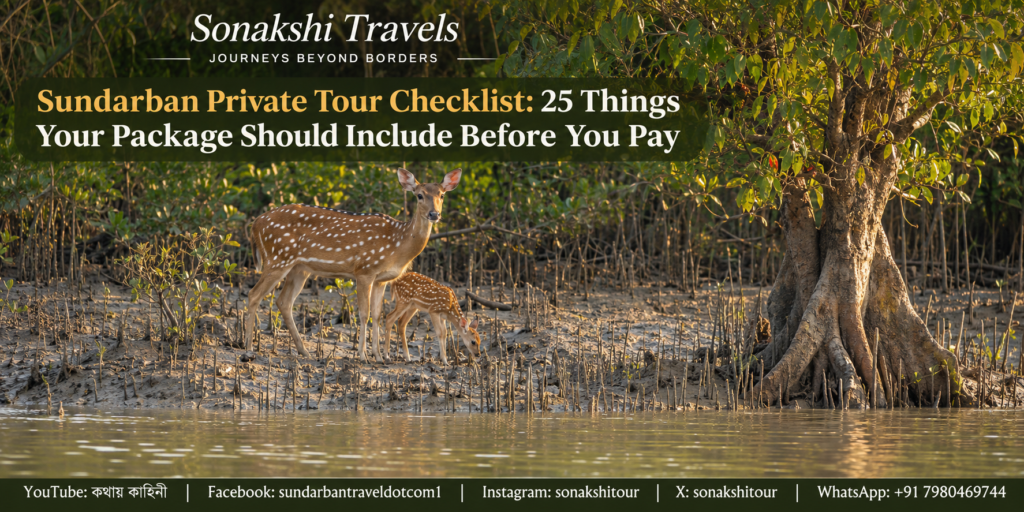
Booking a Sundarban private tour should be an exciting decision, not a guessing game about what your money will cover. Yet two packages described as “private” can offer remarkably different experiences. One might include a dedicated boat, private Kolkata transfers, a complete meal plan and coordinated forest-entry arrangements. Another may provide only a private hotel room while sightseeing takes place on a shared vessel. Without examining the inclusions carefully, travellers can pay a premium for services they never actually receive.
The Indian Sundarbans require particularly thoughtful planning. Tidal rivers, remote boarding points, regulated forest access and boat-based sightseeing create practical considerations that are less common at conventional holiday destinations. A well-organised private journey can provide privacy and convenience, but every important arrangement should be confirmed before payment.
This comprehensive checklist identifies 25 essential matters to examine before selecting a Sundarban private tour package. It covers transport, vessel exclusivity, boat safety, guides, forest permissions, sightseeing routes, accommodation, food, pricing and cancellation terms. The purpose is not to suggest that every package must include every optional luxury. Instead, it is to ensure that the services you require are clearly identified, appropriately priced and confirmed in writing.
Use the checklist to compare quotations, communicate with operators and avoid unpleasant surprises after arriving at the jetty.
Commercial disclosure: This article contains promotional references to travel websites associated with Sonakshi Travels. Travellers should compare available options independently and verify the exact services and booking conditions before purchasing.
Why a Private Sundarban Tour Needs a Detailed Checklist
In most holiday destinations, travellers can independently arrange local taxis, sightseeing tickets and restaurant visits. The Sundarbans operate differently. Tourist movement through protected areas depends on boats, authorised access and operational coordination.
The Sundarban Tiger Reserve states that tourists entering the reserve must use registered boats. It also identifies the requirement for ecotourism guides accompanying tourist vessels.
This means that a credible private tour requires more than a hotel booking and a driver. The operator must coordinate several connected services while respecting conservation rules and the practical realities of the region.
When comparing a Sundarban private tour, examine the individual services behind the advertised description. The following 25 checks provide a consistent way to evaluate them.
Part One: Private Transport and Journey Arrangements
1. Confirm the Exact Pickup and Drop-Off Locations
A genuinely convenient private package should specify where the journey begins and ends. If pickup is offered from Kolkata, confirm whether the vehicle will collect you from your home, hotel, railway station or airport, rather than an unspecified common meeting point.
Provide the complete address and ask about access restrictions, additional collection charges and the expected return location. For families travelling with children or elderly passengers, door-to-door coordination can be a meaningful advantage.
Before paying: Obtain written confirmation of both pickup and drop-off addresses, together with any applicable transport exclusions.
2. Verify Whether the Road Vehicle Is Exclusively Reserved
A private transfer should not unexpectedly become a shared journey with unrelated passengers. Ask whether the vehicle is assigned only to your travelling group and whether additional pickups are planned.
Also confirm the vehicle category. Four adults carrying substantial luggage may require a different arrangement from a couple travelling with small bags. Air conditioning, appropriate seating capacity and reasonable luggage space should be discussed before finalising the booking.
Before paying: Confirm private vehicle use, passenger capacity, luggage arrangements and whether the operator may substitute the vehicle.
3. Identify the Boarding Jetty and Transfer Procedure
A Sundarban tour generally involves changing from road transport to a boat. Godkhali and Dhamakhali are recognised boarding gateways, while Canning can serve as a railway access point before the onward road journey.
The correct jetty depends on the itinerary and operator’s arrangements. Do not assume that every package follows the same route or offers equivalent access to different sightseeing circuits.
Before paying: Ask for the boarding jetty’s name, meeting instructions, luggage-transfer arrangements and the person responsible for coordinating your arrival.
4. Check Whether the Travel Schedule Is Realistic
Early departures from Kolkata are common because the road journey, boarding formalities and river navigation require time. However, a convenient advertised departure does not automatically guarantee an early start to forest sightseeing.
Request approximate departure, arrival, boarding and return windows. Consider road traffic, tide, daylight and other operational factors. For a one-day tour, insufficient time on the water can significantly reduce the value of the experience.
Before paying: Distinguish total trip duration from actual boat cruising and permitted forest sightseeing time.
Part Two: Private Boat Facilities and Passenger Safety
5. Confirm Exclusive Use of the Safari Boat
The most important feature of a private Sundarban wildlife experience is usually the sightseeing vessel. A package should explicitly state whether the boat is chartered exclusively for the booked group or whether travellers are purchasing seats on a shared departure.
A private boat naturally carries its operating crew and required guide. Their presence does not make the tour shared. However, unrelated paying tourists should not be added without advance agreement.
Before paying: Request the following written confirmation: “The sightseeing boat will be reserved exclusively for our group throughout the agreed safari programme.”
6. Obtain the Boat’s Identity and Registered Capacity
A vessel’s appearance does not establish its safety or legal suitability. The Sundarban Tiger Reserve requires registered tourist boats and sets rules concerning their identification, operating arrangements and permitted passenger numbers.
Ask for the boat’s name and suitable identifying information. Confirm that the permitted capacity accommodates the full group, including passengers and relevant operating requirements. A larger boat may provide more space, but capacity, condition and suitability matter more than size alone.
Before paying: Verify that a properly registered vessel appropriate for your group is included in the quotation.
7. Check Life Jackets, Fire Safety and First Aid
Essential safety equipment should never be treated as an optional luxury. Official Sundarban Tiger Reserve regulations specify sufficient life jackets, a fire extinguisher, first-aid provisions and accessible waste bins on tourist boats.
Travellers should also ask how boarding assistance is provided and whether children have appropriately sized life jackets. Weather conditions may change during a cruise, so passengers should follow instructions from the captain and authorised personnel.
Before paying: Confirm the availability of suitable life jackets, first aid, firefighting equipment and a clear onboard safety briefing.
8. Inspect the Toilet, Seating and Observation Facilities
Many private safari journeys involve several continuous hours onboard. Comfortable seating, shade, ventilation and a usable toilet can greatly affect the experience, particularly for families and senior citizens.
An upper observation deck may improve visibility, but passengers should confirm whether access is permitted during navigation. Ask for recent photographs of the actual vessel rather than relying entirely on representative marketing images.
Before paying: Verify the toilet type, seating layout, shaded areas, deck facilities and whether the boat shown in photographs is the boat being booked.
9. Confirm Drinking Water, Charging and Onboard Essentials
A practical private boat should provide the facilities promised in the package description. Drinking water is particularly important in the warm and humid Sundarban climate.
Travellers may also value mobile charging, safe luggage storage and basic binoculars. These facilities vary by vessel and should be checked individually. Do not assume that an electrical charging point will operate continuously throughout the trip or that mobile connectivity will be reliable.
Before paying: Confirm drinking-water arrangements, charging availability and any additional facilities essential to your group.
Part Three: Forest Permissions, Guides and Safari Coverage
10. Verify Forest-Entry Permissions and Charges
Private boat ownership or charter does not provide unrestricted entry into protected forest areas. The operator must follow the applicable Sundarban Tiger Reserve entry process and use authorised tourist routes.
Ask who arranges the required permissions and how forest-related fees are treated in the quotation. Travellers should also confirm whether identification details must be supplied in advance. International visitors should check current documentation requirements separately with the relevant authority.
Before paying: Obtain confirmation that applicable forest-entry arrangements and clearly identified charges are included or separately itemised.
11. Ensure the Required Ecotourism Guide Is Arranged
The Sundarban Tiger Reserve states that tourist boats entering the reserve must carry an ecotourism guide. The guide contributes to visitor interpretation and helps ensure compliance with local regulations.
This required guide should not be confused with an optional specialist naturalist. Travellers interested in detailed bird identification, ecological research or English-language interpretation may need to request additional expertise.
Before paying: Check that the required guide is arranged, clarify who bears the associated cost and ask whether specialist guiding services are available.
12. Request a Realistic, Authorised Safari Itinerary
Not every advertised attraction can be visited during every Sundarban trip. Sajnekhali, Sudhanyakhali and Dobanki are recognised tourist locations, but the practical route depends on the allocated sightseeing time, permitted access and navigation conditions.
The official Sundarban Tiger Reserve places-to-visit guide describes these facilities and other visitor destinations.
Operators should distinguish confirmed itinerary locations from optional places that may be possible only when conditions permit.
Before paying: Request a written, day-by-day route indicating which destinations are planned, which are optional and which factors may cause changes.
13. Understand the Actual Number of Safari Days
A three-day package does not necessarily provide three complete days inside the protected tourism zone. The first day may involve lengthy road and river transfers, while the final day may require an early return journey.
Evaluate the total scheduled forest observation time rather than judging a programme only by its number of nights. A carefully planned itinerary can sometimes offer better value than a longer package containing substantial non-safari travel.
Before paying: Ask how much time is allocated to authorised forest cruising on each day and whether a full-day safari is genuinely included.
14. Confirm That Wildlife Sightings Are Never Guaranteed
The Sundarbans are home to Royal Bengal tigers, spotted deer, crocodiles, water monitors, birds and many other species. Nevertheless, animals remain free-ranging and sightings depend on natural behaviour, weather, tide and visibility.
Privacy can improve the atmosphere for patient observation, but it cannot control wildlife movements. Promises of guaranteed tiger sightings should be treated with caution.
UNESCO recognises the Sundarbans National Park for its exceptional mangrove ecology and biodiversity, not as a destination where individual animal encounters can be scheduled.
Before paying: Choose an operator that communicates realistic wildlife expectations rather than relying on sensational promises.
Part Four: Accommodation, Meals and Personal Comfort
15. Obtain the Actual Hotel Name and Room Category
Descriptions such as standard, deluxe, premium and luxury are used differently by different accommodation providers. A category label alone cannot establish the quality or facilities of a particular property.
Request the hotel’s name, room photographs, number of rooms, bedding configuration and facilities. Where applicable, confirm air conditioning, attached bathroom, hot water and electricity backup.
When evaluating a Sundarban private tour package, examine the accommodation promise alongside the other services.
Before paying: Obtain written confirmation of the property and room category, including the conditions governing substitutions.
16. Check Jetty Access and Accommodation Transfers
A comfortable room may still be inconvenient if reaching it involves repeated changes of transport, difficult steps or lengthy transfers from the boat.
Ask where the accommodation is located relative to the boarding jetty and planned sightseeing route. Travellers with elderly family members should discuss stairs, narrow gangways, uneven walking surfaces and assistance with luggage.
Before paying: Establish how guests travel between the boat and accommodation and whether additional transfers are included in the package price.
17. Request a Complete Meal Plan
Food is an important component of overnight and full-day boat journeys. However, the phrase “all meals included” may be interpreted differently by different operators.
Confirm the number of breakfasts, lunches, dinners and refreshments provided. Ask whether the first day’s breakfast is included and whether meals are served onboard or at the accommodation.
Where specific fish, prawns, chicken or vegetarian dishes are promised, verify the menu and whether substitutions depend on seasonal availability.
Before paying: Request a day-wise meal schedule with clear inclusions and any speciality-food charges.
18. Verify Dietary Customisation and Food Hygiene
Private arrangements may offer greater scope for individual dietary preferences, but flexibility should never be assumed without discussion.
Inform the operator about vegetarian, Jain, allergy-related or other requirements before booking. Explain any restrictions involving onion, garlic, seafood or particular ingredients. Food allergies should be communicated precisely, including concerns about cross-contact during preparation.
Travellers should also ask about drinking water, hygienic food handling and the person responsible for meal preparation.
Before paying: Obtain confirmation that important dietary needs can be accommodated and understand any limitations or extra costs.
Part Five: Service Quality, Pricing and Financial Protection
19. Clarify the Responsibilities of the Tour Manager and Crew
Tour manager, boat attendant, guide and naturalist are distinct roles. Some private packages include a dedicated tour manager, while others rely on a coordinator who manages arrangements from the jetty or office.
Determine who will meet your group, coordinate accommodation, supervise meals and respond to logistical concerns. Ask whether the same person remains accessible throughout the journey.
Before paying: Confirm the personnel included in the quotation, their principal responsibilities and the emergency contact arrangement.
20. Compare Package Pricing Against Actual Inclusions
Private tours often cost more per traveller because boat and transport charges are divided among fewer passengers. Nevertheless, a higher price is justified only when the services match the quotation.
Compare equivalent passenger counts, tour durations, boats, accommodation standards, meals and transport arrangements. A cheaper programme with a shared vessel may not be directly comparable to one with a fully reserved boat.
A complete Sundarban private tour package quotation should make the division between included and optional services easy to understand.
Before paying: Request an itemised total rather than relying solely on the advertised per-person or package price.
21. Check All Taxes, Exclusions and Additional Charges
A package quotation should identify the final payable amount and explain which expenses may fall outside it. Potential exclusions can include optional transport changes, specialised guiding, particular meals, accommodation upgrades or other services not originally requested.
Do not assume that all operators follow identical policies for forest charges, taxes, vehicle parking or unforeseen itinerary adjustments.
A transparent quotation should specify the agreed inclusions and exclusions before the traveller commits funds.
Before paying: Ask whether the amount quoted is final for the agreed services and obtain an itemised explanation of any possible additional charges.
22. Understand Advance Payments and Cancellation Conditions
Private arrangements may require an advance because vehicles, boats and rooms must be reserved for specific dates. The amount and payment schedule vary by operator.
Before transferring money, confirm the advance required, the deadline for paying the balance and whether the payment is refundable under different circumstances.
Cancellation terms should distinguish customer-initiated cancellation from changes caused by severe weather, official restrictions or service unavailability.
Before paying: Obtain written payment instructions, cancellation charges, refund procedures and rescheduling terms.
23. Confirm the Operator’s Identity and Booking Documentation
An attractive website or social media advertisement is not sufficient proof that a booking is secure. Verify the business name, contact information and identity of the party receiving your payment.
Ask for a formal quotation, payment acknowledgement and final booking confirmation. Travellers should retain copies of the itinerary, invoices and relevant conversations.
Online reviews may help identify patterns in customer experiences, but anonymous testimonials should not replace verification of the actual services being purchased.
Before paying: Confirm the contracting business, payment recipient and procedure for receiving a written booking acknowledgement.
24. Examine the Advantages and Limitations of Luxury Upgrades
A premium private package may provide improved accommodation, more comfortable transport and enhanced onboard service. These features can be valuable, particularly for travellers who prioritise privacy, convenience and individual attention.
However, upgrading accommodation does not necessarily increase permitted safari time, improve animal sighting probability or create unrestricted access to the forest.
When reviewing a Sundarban luxury tour, concentrate on verifiable facilities rather than unsupported luxury labels.
Before paying: Ask what each upgrade adds to the experience and whether those improvements justify the additional price for your group.
25. Obtain a Final Written Confirmation Before Departure
The last and most important check is ensuring that all essential promises appear in a single written confirmation. This document should identify the travel dates, passenger count, pickup point, road transport, boat arrangement, accommodation, meal plan, planned sightseeing and final amount payable.
It should also contain the operator’s contact details and relevant cancellation conditions.
Travellers researching general Sundarban travel arrangements should use destination information as a planning resource, while treating the final booking confirmation as the authoritative record of purchased services.
Before paying: Check every detail, resolve discrepancies and retain the completed confirmation for reference throughout the trip.
Private Versus Shared Packages: What Should You Compare?
Some travellers genuinely benefit from private touring, while others may be perfectly satisfied with a professionally organised shared departure. The important consideration is whether the package honestly describes its structure.
| Booking feature | Private arrangement | Shared arrangement | Essential verification |
|---|---|---|---|
| Safari boat | Reserved for the booked group | Passengers from different groups | Confirm exclusive boat use |
| Kolkata transfer | Dedicated vehicle if included | Shared vehicle or meeting point | Verify pickup and passenger arrangements |
| Meals | May allow agreed customisation | Usually follows a common menu | Request written meal details |
| Accommodation | Selected room category | Package-assigned room category | Confirm hotel and facilities |
| Itinerary | Some flexibility within permitted routes | Usually follows a group schedule | Check actual safari duration |
| Wildlife sightings | Never guaranteed | Never guaranteed | Avoid unrealistic promises |
| Total cost | Often higher for smaller groups | Operating costs distributed among travellers | Compare matching inclusions |
Practical Booking Advice: How to Use These 25 Checks
Begin by identifying the services that matter most to your group. Families may prioritise safe boarding, suitable accommodation and predictable meals. Couples may value exclusive boat use and convenient transfers. Photographers may focus on observation space, guide quality and actual time spent in permitted wildlife areas.
Next, collect comparable written quotations. Avoid evaluating packages solely on promotional photographs or headlines. Compare the vessel, itinerary, transport, accommodation and total payable amount using the same passenger count and travel dates.
Finally, distinguish essential inclusions from optional enhancements. Private boat use, appropriate safety facilities and valid forest-entry arrangements should be clear. Luxury accommodation upgrades or specialist interpretation may be selected separately according to budget and preference.
The best booking decision is one that minimises uncertainty while preserving realistic expectations about what responsible Sundarban tourism can provide.
Frequently Asked Questions
Does every Sundarban private tour include a dedicated boat?
No. Some packages provide private transport or accommodation but shared sightseeing. Confirm exclusive boat use explicitly if it is important to your booking.
Are forest-entry charges normally included?
Organised operators may coordinate the applicable entry process, but fee inclusions vary. Always check the quotation and request clarification about forest-related charges.
Can a private tour guarantee a Royal Bengal tiger sighting?
No. Tigers and other wildlife move naturally through the mangrove ecosystem. Private touring cannot guarantee sightings or authorise unrestricted access to protected habitats.
Is a one-day Sundarban trip suitable for a private group?
Yes, when the transport and sightseeing schedule is realistically planned. However, the road journey can consume a substantial portion of the day, so travellers should confirm actual boating and forest observation time.
What is the most important document before paying an advance?
A detailed written quotation or booking agreement is essential. It should identify the exact services, group size, dates, total price, payment schedule and cancellation terms.
Is a luxury tour always better than a standard private tour?
Not necessarily. Luxury upgrades may improve comfort, but they do not automatically increase safari access or wildlife observation opportunities. Choose the services that match your priorities.
Pay for Clearly Defined Services, Not Vague Promises
A carefully selected Sundarban private tour from Kolkata offers the opportunity to explore one of India’s most remarkable tidal landscapes with greater privacy, comfort and logistical convenience. However, the quality of the experience depends on the services actually arranged, not the language used to advertise them. However, the quality of the experience depends on the services actually arranged, not the language used to advertise them.
The 25 checks in this guide cover the essential stages of a private journey: Kolkata transfers, registered boat arrangements, safety, permits, guides, sightseeing, accommodation, meals, pricing and financial protection. Together, they provide a practical framework for comparing operators and identifying unanswered questions before committing money.
Request clear written confirmation, compare equivalent packages and avoid promises that conflict with conservation rules or realistic wildlife expectations. A responsible operator should be willing to explain precisely what is included, what is optional and which circumstances remain outside its control.
The most rewarding Sundarban trip begins with informed planning. When the essential arrangements are transparent, travellers can concentrate on the quiet waterways, distinctive mangrove forests and extraordinary natural environment that make the journey worthwhile.