Sundarban Private Tour for Foreign Guests: Why an Experienced Naturalist Matters
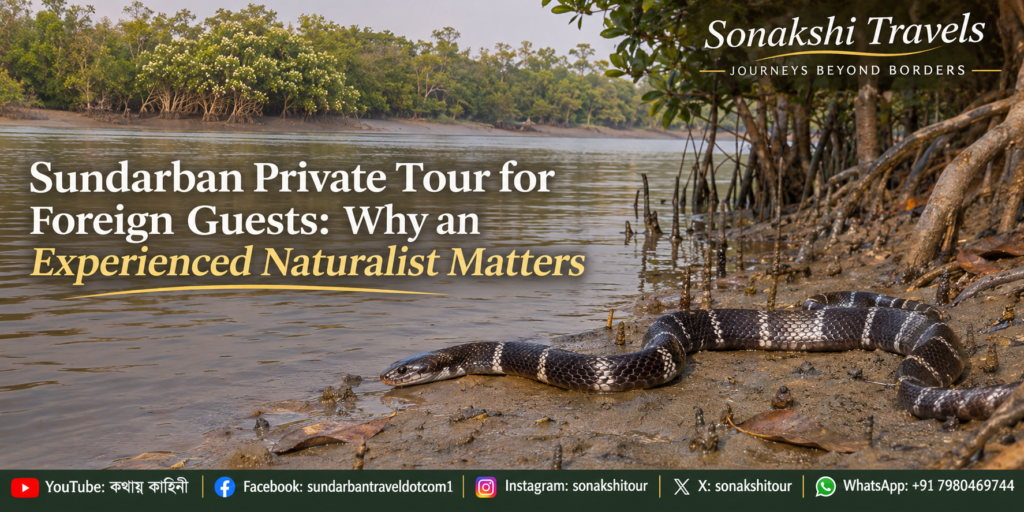
For international travellers visiting India’s Sundarbans for the first time, the experience can be both fascinating and unfamiliar. A broad tidal river may appear almost motionless, until a crocodile slips beneath the surface or a kingfisher suddenly leaves its perch. The mangrove forest often reveals itself gradually, through small movements, distant calls and details that an inexperienced visitor might easily overlook. This is where an experienced naturalist becomes particularly valuable. On a thoughtfully organised Sundarban private tour, a knowledgeable naturalist can turn a beautiful boat journey into a meaningful introduction to wildlife behaviour, mangrove ecology and the remarkable relationship between the forest and its waterways.
Many foreign guests arrive with photographs of Royal Bengal tigers in mind. They may also be interested in migratory birds, crocodiles, dolphins, unusual mangrove trees or the communities living near this enormous delta. Yet the Sundarbans is very different from familiar wildlife destinations built around open grasslands and vehicle-based safaris. Much of its natural life remains concealed behind vegetation or moves according to the changing tides.
An effective naturalist helps visitors understand what they are seeing, why it matters and how the ecosystem functions. More importantly, the best naturalists encourage realistic expectations. They do not promise extraordinary animal encounters. Instead, they help travellers appreciate the forest as a living ecological system, including during those quiet hours when no large animal appears.
Commercial disclosure: This independent-style travel article contains promotional references to Sonakshi Travels and associated Sundarban travel websites. Travellers should independently confirm the services, guiding qualifications, availability and booking conditions before making a reservation.
1. Why the Sundarbans Requires a Different Kind of Wildlife Guide
Wildlife watching in the Sundarbans is largely an exercise in patience and interpretation. Visitors move along authorised waterways, observing forested riverbanks from boats rather than exploring freely on foot. The landscape can look deceptively similar from one bend to the next, particularly to someone unfamiliar with mangrove vegetation.
According to the UNESCO World Heritage Centre, the Indian Sundarbans form part of the world’s largest mangrove forest system. Their ecological importance includes tidal processes, biological diversity and the habitats of threatened wildlife.
Understanding this environment requires more than identifying a few famous species. An experienced naturalist should be able to explain why particular plants grow in saline conditions, how tidal water influences animal movement and why some species are much harder to observe than others.
For a guest accustomed to African grassland safaris, for example, wildlife observation in dense mangrove channels may initially feel less dramatic. A naturalist can explain that poor visibility does not mean the environment lacks wildlife. In this habitat, mud marks, feeding activity, bird calls and brief glimpses through vegetation can be significant observations.
The result is a more rewarding experience because the visitor learns to recognise ecological activity rather than waiting only for spectacular sightings.
2. A Forest Guide and an Experienced Naturalist Are Not Necessarily the Same
One of the most important questions foreign travellers should ask concerns the difference between an authorised ecotourism guide and a specialist naturalist.
The Sundarban Tiger Reserve states that boats entering the reserve must carry an ecotourism guide. Official guide responsibilities include informing tourists about applicable rules and explaining aspects of the Sundarbans environment and ecology.
This required guiding arrangement should not be confused with an optional specialist service. A qualified local guide may already be an excellent wildlife interpreter. Some guides also possess extensive birding experience and strong English communication skills. Equally, an additional naturalist may offer a different level of specialist knowledge, depending on the person’s experience and expertise.
What Does the Authorised Forest Guide Do?
The authorised guide accompanies visitors as part of the regulated tourism arrangement. The guide helps communicate protected-area rules, supports responsible visitor conduct and shares local knowledge about the landscape and wildlife.
Foreign guests should confirm that the required guide is included in their booking and should never assume that hiring an independent wildlife expert removes this obligation.
What Can a Specialist Naturalist Add?
A specialist naturalist focuses more intensively on interpreting the environment. Depending on their professional background, they may provide detailed explanations of bird identification, animal behaviour, mangrove adaptations, ecological relationships and conservation issues.
For English-speaking international guests, the additional benefit may be clear, extended conversation about complex subjects without depending on brief translations.
The distinction is important because the title of naturalist alone does not establish professional competence. Travellers should ask about field experience, language proficiency, specific areas of expertise and whether the person will accompany the group throughout the planned safari.
3. Why English Communication Makes Such a Difference
For many international visitors, an English-speaking naturalist is valuable not simply because they can translate information, but because they can explain unfamiliar ideas clearly and answer questions as they arise.
Consider a visitor observing an unusual mangrove root structure. A brief explanation might identify the plant. A more detailed conversation could explore how specialised root structures help mangroves survive in waterlogged sediment, why tidal exposure matters and how different species adapt to different conditions.
Similarly, when a bird appears on a distant branch, an experienced interpreter might explain the features used to identify it, its preferred habitat and its feeding behaviour. The visitor can then apply that knowledge to later sightings.
Good communication also makes the experience more accessible to travellers whose first language is neither Bengali nor English. A patient naturalist can use straightforward terminology, visual references and short explanations instead of overwhelming guests with scientific vocabulary.
International travellers should nevertheless confirm language ability before booking. The phrase English-speaking guide can describe widely varying levels of fluency, and being conversational in English is not the same as being able to discuss specialised wildlife topics comfortably.
4. Understanding Mangrove Ecology: The Naturalist’s Greatest Contribution
The Sundarbans is not simply a forest growing beside the sea. It is a dynamic tidal landscape shaped by freshwater flows, saline water, sediment movement, seasonal weather and constantly changing riverbanks.
For visitors unfamiliar with mangrove ecosystems, many of its most interesting features are not immediately obvious.
Why Mangrove Roots Look So Unusual
Some mangrove plants possess exposed breathing roots or other specialised root structures associated with survival in saturated, oxygen-poor soils. These adaptations often attract the attention of visitors because they differ from the root systems of familiar inland trees.
A knowledgeable naturalist can explain the functions of these structures while distinguishing between different forms rather than suggesting that all mangrove trees have identical roots.
Understanding Sundari, Keora and Other Mangrove Plants
The Indian Sundarbans contain several characteristic mangrove species, including Sundari, Keora, Goran and Gewa. Recognising individual plants often requires attention to their leaves, bark, growth patterns and habitat.
An experienced naturalist should be able to identify familiar local species confidently while acknowledging when a distant or partially obscured specimen cannot be determined reliably.
This honesty is an important sign of expertise. Wildlife interpretation becomes less credible when every distant tree, bird or animal is identified with absolute certainty despite insufficient evidence.
Why the Tide Changes the Landscape
At different tidal stages, mudbanks become exposed or submerged, affecting where animals can feed, rest and move. Birds may exploit newly exposed feeding areas, while crocodiles and other aquatic wildlife use water and shoreline habitats according to their needs.
A naturalist can help guests understand these relationships without suggesting that the tide creates predictable wildlife sightings.
For foreign travellers, discovering these ecological connections often becomes one of the most memorable parts of a Sundarban tour.
5. Wildlife Identification: Seeing More Than the Bengal Tiger
The Royal Bengal tiger is the animal most closely associated with the Sundarbans. Its presence gives the forest international recognition, but responsible wildlife interpretation must extend far beyond one celebrated predator.
UNESCO identifies the Sundarbans as an important habitat for tigers, aquatic mammals, birds and reptiles. These species occupy different parts of the ecosystem and may be visible under very different circumstances.
Birdwatching with an Experienced Naturalist
Birdwatching offers considerable opportunities for learning during a boat-based journey. Kingfishers, herons, raptors, shorebirds and other species may be observed along suitable waterways and forest margins.
A skilled naturalist can draw attention to differences in bill shape, plumage, flight pattern and feeding behaviour. Rather than naming a bird immediately, they may encourage guests to notice particular features and reach an identification together.
This approach is particularly rewarding for international birdwatchers, who may encounter species unfamiliar from their home countries.
Understanding Crocodiles and Reptiles
Saltwater crocodiles and Asian water monitors are among the reptiles associated with the Sundarbans. A naturalist can explain the differences between these animals, their ecological roles and the importance of maintaining safe viewing distances.
Observation should always take place without attracting, feeding or deliberately disturbing wildlife.
Interpreting Mammal Sightings
Spotted deer and rhesus macaques may be observed in suitable forest habitats. Shy mammals, including wild cats and otters, can be much harder to encounter.
A knowledgeable naturalist helps guests recognise the difference between a species being present in the ecosystem and being regularly visible to tourists. This distinction prevents unrealistic expectations.
What About Dolphins?
The wider Sundarbans region supports important aquatic mammal habitats. However, dolphin distribution and sighting possibilities vary by species, water conditions and location.
A responsible naturalist should never claim that every dolphin species can be seen on an ordinary tourist route. When aquatic mammals are encountered, observations should be conducted without chasing or disturbing them.
The real benefit of expert interpretation is not a longer list of promised animals. It is a more accurate understanding of the wildlife that the landscape supports.
6. How a Naturalist Improves the Private Boat Safari Experience
One advantage of a private arrangement is the opportunity for focused discussion with the guide or naturalist. Instead of addressing unrelated groups with different interests, the interpreter can concentrate on the people travelling together.
A dedicated naturalist might spend more time discussing bird behaviour with enthusiastic birdwatchers or explaining mangrove adaptations to a family interested in ecology.
For guests arranging a Sundarban private tour, it is worthwhile to ask whether a specialist English-speaking naturalist can be included alongside the required forest guide.
Private travel may also provide opportunities for a quieter observation atmosphere. Nevertheless, the naturalist cannot control other boats, wildlife movement, forest regulations or the permitted duration of the safari.
Better Observation Through Patience
Professional wildlife interpretation often involves knowing when not to speak. A naturalist may briefly indicate an interesting movement and then allow guests to observe quietly.
Extended conversations can continue after an encounter rather than interrupting the moment itself.
This balance between explanation and silence is especially useful for photographers and visitors who appreciate nature without constant narration.
Realistic Route Planning
A naturalist familiar with the region can discuss how tides, daylight, weather and seasonal conditions influence opportunities for observation. However, route decisions must remain within authorised tourism areas and operating requirements.
No naturalist can promise entry into restricted waterways or arrange an unauthorised night safari simply because the booking is private.
7. Why a Naturalist Matters for Wildlife Photographers
International wildlife photographers frequently arrive with specific interests, such as photographing kingfishers, crocodiles, water monitors or atmospheric mangrove landscapes.
An experienced naturalist can help them understand the habitat and behaviour of potential subjects before the camera is raised. For example, recognising the difference between a bird actively hunting and one resting may help a photographer anticipate possible movement.
The naturalist may also explain why photographing a distant animal from a moving vessel requires patience, adequate equipment and realistic expectations.
Ethical interpretation is particularly important. Photographers should not expect a guide to lure animals, disturb nesting birds or request unsafe boat manoeuvres to improve a picture.
Specialist naturalist experience and photography expertise are not necessarily identical. Travellers who need technical photography support should confirm whether the chosen professional understands their photographic objectives.
A useful question is whether the naturalist has experience accompanying birdwatching or wildlife photography groups, rather than merely conducting general sightseeing tours.
8. A Naturalist Can Explain the Relationship Between Forest and Local Communities
The Sundarbans is both an important wildlife landscape and a region where local communities maintain complicated relationships with rivers, seasonal conditions and natural resources.
For foreign visitors, understanding this human dimension can provide important context. A responsible naturalist may explain how tidal conditions influence livelihoods, why conservation is challenging and how protected-area management seeks to balance ecological priorities with local realities.
Such explanations should be based on reliable knowledge and respect for residents. They should never romanticise hardship, exaggerate risks or present local communities merely as part of a tourist attraction.
Equally, a naturalist should distinguish scientific explanations from local stories, beliefs and traditions. Both may be meaningful, but they serve different purposes.
A guest interested in conservation might ask about habitat protection, erosion or human-wildlife conflict. The naturalist should discuss these subjects carefully, avoiding unsupported statistics and acknowledging that environmental management involves complex social and scientific questions.
This broader understanding helps visitors appreciate why the Sundarbans matters beyond its reputation as tiger habitat.
9. Choosing the Right Sundarban Private Tour Package with a Naturalist
Booking an experienced naturalist is a separate decision from selecting accommodation, transport and general tour comfort.
A Standard private journey may provide the same opportunity for specialist wildlife interpretation as a Deluxe or Premium holiday, provided the naturalist service is available and explicitly included.
Travellers exploring a Sundarban private tour package should therefore compare guide arrangements separately from accommodation descriptions.
A more expensive resort does not automatically provide a more experienced wildlife interpreter. Similarly, a simpler cottage does not prevent a traveller from enjoying excellent naturalist-led exploration.
Standard Accommodation with Specialist Interpretation
This combination may be attractive to travellers who prioritise biodiversity and learning over extensive resort facilities.
When planning the budget, consider whether investing in specialist guiding provides greater personal value than upgrading the hotel.
Deluxe Accommodation with a Dedicated Naturalist
Deluxe accommodation may offer a practical balance for foreign couples and small groups who appreciate comfortable facilities but want the wildlife experience to remain central.
However, the actual level of accommodation and the naturalist’s daily involvement should be confirmed in the quotation.
Premium Accommodation and Specialist Wildlife Services
A Sundarban luxury tour may combine upgraded resort accommodation with private transport and additional specialist services.
These elements should be evaluated independently. Premium accommodation is a hospitality choice; an experienced naturalist provides educational and interpretive value.
The comparison guide Private Sundarban Tour Packages: Standard, Deluxe or Premium—Which One Should You Choose? provides additional context for understanding accommodation categories.
Likewise, The Real Difference Between a Sundarban Private Tour and a Luxury Sundarban Tour explores how private arrangements and premium hospitality represent different aspects of a holiday.
10. Important Questions to Ask Before Hiring a Naturalist
Travellers should not rely solely on a promotional description such as expert guide, wildlife specialist or professional naturalist. These terms may cover very different levels of knowledge and experience.
Before confirming the service, ask the operator the following questions:
- Will the naturalist speak English comfortably throughout the safari?
- How much practical field experience does the naturalist have in the Indian Sundarbans?
- Does the person specialise in birds, mammals, mangrove ecology or general wildlife interpretation?
- Will the naturalist accompany the group for every agreed safari day?
- Is this specialist separate from the compulsory ecotourism guide?
- Can the operator explain the naturalist’s relevant qualifications or professional background?
- Will the naturalist help with species identification and conservation-related questions?
- Is the specialist service included in the package price or charged separately?
- What happens if the selected naturalist becomes unavailable?
- Can the itinerary accommodate particular learning or photographic interests within permitted routes?
For travellers with academic interests, it may be appropriate to request a person with relevant scientific training. For general nature enthusiasts, extensive field experience and excellent communication skills may be more valuable than a formal title alone.
The most reliable measure is whether the professional can explain the ecosystem accurately, communicate limitations honestly and encourage responsible observation.
11. International Visitor Logistics: Where Guidance Is Helpful
Foreign guests should also distinguish the responsibilities of a naturalist from those of the tour operator.
The naturalist’s primary contribution is wildlife and environmental interpretation. The operator should coordinate transport, accommodation, tourism permissions and relevant booking arrangements.
The Sundarban Tiger Reserve website identifies Kolkata as the nearest major city and describes road or rail connections towards boarding points such as Godkhali and Dhamakhali. Registered boats are used for entry into the reserve.
Foreign visitors should confirm the latest identification and permit requirements directly with their operator and the appropriate forest authorities. Different sections of the official Tiger Reserve website currently provide inconsistent statements about special permits for foreigners, so it would be unwise to rely on a general internet claim.
For a smooth arrival, a private transfer from an agreed Kolkata hotel or another suitable pickup location may be useful. Confirm the precise pickup arrangements, vehicle category and boat boarding point before departure.
Travellers should also ask whether the naturalist joins the group in Kolkata, at the boat boarding point or only during the authorised forest excursion.
These seemingly small details help prevent misunderstandings, particularly when international visitors are managing luggage, travel documents and unfamiliar local transport arrangements.
12. Why a Responsible Naturalist Never Guarantees Wildlife
One of the clearest signs of professionalism is a willingness to explain uncertainty.
A naturalist cannot guarantee tiger sightings, crocodile encounters, dolphin observations or particular photographic opportunities. Wildlife moves freely, and visibility depends on natural conditions beyond the control of a tour operator.
An experienced interpreter should be comfortable saying that a species is difficult to see, that identification is uncertain or that an interesting observation cannot be repeated on demand.
Responsible naturalists also help visitors understand protected-area rules. Noise, litter, wildlife feeding and inappropriate disturbance can damage the environment and affect animal behaviour.
The value of a naturalist lies partly in creating more informed, respectful visitors. Their responsibility is not to manufacture excitement but to make the genuine character of the Sundarbans understandable and engaging.
13. Frequently Asked Questions
Is an English-speaking naturalist compulsory for foreign visitors?
The Sundarban Tiger Reserve requires an ecotourism guide aboard boats entering the reserve. A separate specialist naturalist is not the same requirement. Foreign travellers should confirm the language skills and guiding arrangements included in their particular package.
Can a naturalist improve the chances of seeing a tiger?
Experienced professionals may help visitors understand tiger habitat, signs and behaviour, but they cannot guarantee a sighting or control animal movements. Their principal value is knowledgeable interpretation and responsible observation.
Is an experienced naturalist useful for first-time visitors?
Yes, particularly for travellers unfamiliar with mangrove ecosystems. A good naturalist can explain tidal ecology, wildlife identification and conservation issues in accessible language, making even quiet periods of the safari educational.
Should foreign birdwatchers hire a specialist naturalist?
Birdwatchers may benefit from a professional with strong regional identification skills. However, visitors should confirm that the selected naturalist has relevant birding experience rather than assuming every general wildlife guide is a specialist ornithologist.
Can I add a naturalist to a private tour with Standard accommodation?
Possibly, subject to operator availability and the selected package. Specialist interpretation and accommodation categories are separate services, so travellers can ask for a quotation that prioritises wildlife knowledge over hotel upgrades.
Does a specialist naturalist replace the official forest guide?
No. The required ecotourism guiding arrangements must still comply with Sundarban Tiger Reserve regulations. A separately hired naturalist may complement the authorised guide but should not be assumed to replace that role.
14. The Real Value of a Naturalist-Led Sundarban Journey
An experienced naturalist gives international visitors a different way to appreciate the Sundarbans. Rather than viewing the forest as a collection of animals waiting to be photographed, travellers begin to recognise the connections between tidal water, mangrove vegetation, birds, reptiles and other wildlife.
For some guests, the most satisfying moment may be identifying an unfamiliar kingfisher. Others may remember learning why a particular mangrove survives in saline mud or understanding the importance of a forest that protects both wildlife and coastal communities.
The exact experience will vary, but informed interpretation adds meaning that expensive accommodation alone cannot provide.
Travellers beginning their research may explore general Sundarban tour information before requesting a tailored itinerary. When comparing options, they should ask specifically about the naturalist’s experience, language ability, availability and the duration of the specialist service.
A carefully selected naturalist is not simply an additional person aboard the boat. The right professional helps foreign visitors understand what makes this extraordinary mangrove ecosystem different, why responsible wildlife tourism matters and how to appreciate the journey without expecting nature to perform on command.
For travellers who value learning as much as comfort, that understanding may become the most rewarding part of their Sundarban private tour.