Updated: 1 March 2026
Echoes of the Delta: My Private Boat Odyssey through the Sundarban
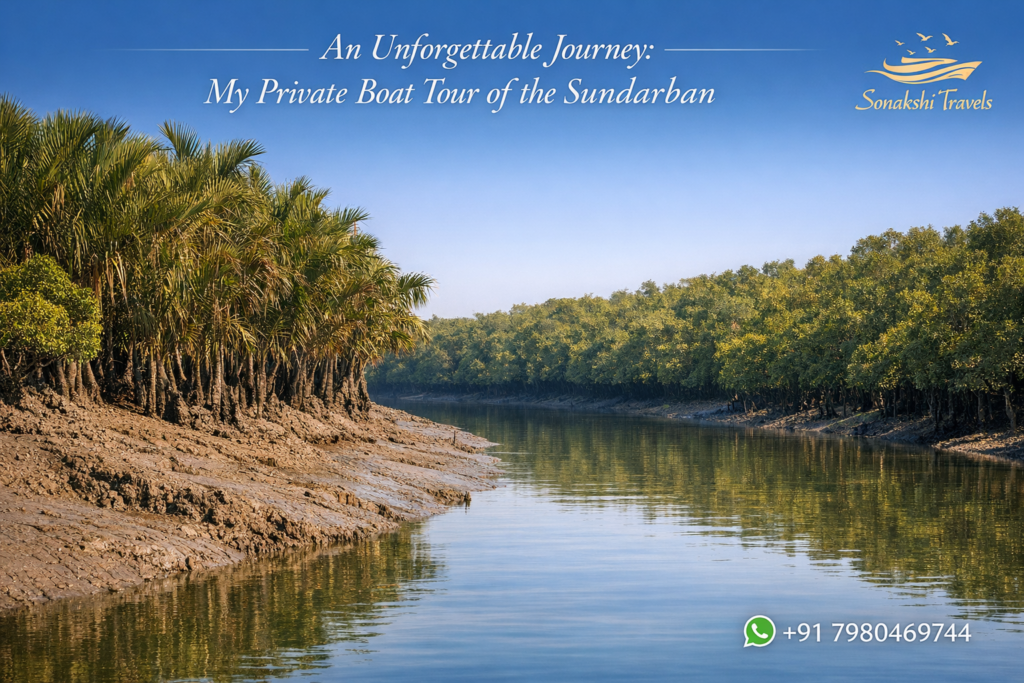
The sun had not yet conquered the sky. A silvery mist hovered like a veil over the Ganges Delta, and the forest whispered promises I had only ever heard in stories. I stood at the edge of a wooden dock in Godkhali, where land gives way to tides, staring into the green depth of the Sundarban. What unfolded over the next two days was not merely travel. It was a private encounter with a living system that breathes through water and silence.
Before I boarded, I reread a few contextual notes and operational descriptions on SundarbanTravel.com to align my expectations with the reality of a regulated, sensitive river landscape. That small act helped me treat the journey as field observation rather than entertainment, and it shaped every decision I made once the boat began to drift away from the jetty.
This was not a checklist experience. It was a deliberate decision to move through the delta slowly, without the noise and momentum of a crowd. I chose a private boat journey because I wanted intimacy with place—space to observe, to pause, and to absorb. In a landscape where every sound carries meaning, privacy becomes more than comfort; it becomes a method of understanding.
The Psychology of Entering a Tidal Forest
Stepping onto the boat felt like crossing a threshold between two mental states. On land, thoughts move quickly. Schedules press. Conversations overlap. But once the ropes were untied and the jetty receded, a different rhythm began to govern the mind. The water set the pace. The engine hummed softly, and the wide river opened ahead like a quiet corridor.
In environmental psychology, a consistent finding is that soft fascination—attention held gently by natural patterns—helps the mind recover from fatigue. A tidal forest intensifies that effect because the scene changes without demanding effort: light shifts on water, mangrove shadows stretch and fold, and the current rearranges floating leaves. On a private boat, this slow choreography stays uninterrupted, which allows attention to settle rather than scatter.
Within an hour, I noticed a measurable change in myself. Breathing slowed. The urge to record everything began to fade. I started to watch instead of collect. The delta does not reward hurried observation; it reveals itself gradually, like a conversation that only deepens when you stop trying to control it.
Design and Discipline: The Private Boat as a Floating Habitat
The boat was modest in appearance but precise in function. Built in traditional wooden form, it balanced stability with flexibility. The lower deck housed a small kitchen and a resting cabin. The upper deck offered open visibility across river bends and forest edges. Every structural detail served a purpose in a landscape where currents change direction and banks narrow without warning—conditions often described by operators when outlining a core Sundarban tour.
Silence as an Operational Choice
On a shared vessel, movement is dictated by group rhythm. Here, silence was a conscious practice. The captain reduced engine noise when entering narrow creeks. Conversations stayed low. Even footsteps were careful. This was not enforced as a rule; it emerged as a shared understanding that sound carries far across still water, and that sudden noise alters the behavior of birds and riverbank animals long before they are seen.
Wildlife in tidal forests is unusually responsive to vibration and disturbance. The guide explained that in confined channels, even minor increases in sound can change feeding patterns and cause birds to shift perches. In a private setting, operational decisions can be made instantly. If a kingfisher holds its position near the bank, the boat can drift rather than advance. If a ripple suggests hidden movement, we can wait without negotiation. Privacy becomes ecological sensitivity because it reduces both pressure and impatience.
The Crew as Knowledge Holders
The captain had navigated these channels for decades. He read currents by surface texture. Slight color changes in water signaled depth variation. The cook, working quietly below deck, timed meals to match the tide so that anchoring would not disturb the boat’s balance. The guide carried oral history rather than printed notes; his knowledge was not memorized, it was lived.
In a private journey, their expertise becomes personal instruction. Questions are answered without hurry. Stories unfold without interruption. The forest is interpreted not as spectacle but as system, and that difference matters because it changes how you look: you begin to notice relationships—between sound and movement, between current and shoreline, between patience and what the forest chooses to reveal.
The Mangrove Cathedral: Ecology Experienced at Human Scale
As we entered narrower channels, the architecture of mangroves became more visible. Their roots emerged above water like sculpted supports. These aerial roots are not decorative; they help the trees function in waterlogged soil by enabling gas exchange. The guide traced a line of pneumatophores with his finger, explaining how each vertical spike works like a breathing conduit when the mud is saturated.
Seen from a private boat at close range, this structure feels deliberate. The forest appears designed rather than grown. Light filters through layered leaves, creating patterns that shift with every ripple. Because there was no competition for space on deck, I could sit at the edge and observe subtle details—the steady work of crabs, the fine lines in bark, and the way the water carries leaf fragments in small, repeated spirals that hint at invisible currents.
There is a difference between seeing a forest from distance and inhabiting it from within. The latter requires proximity and controlled movement. A private vessel allows entry into creeks too narrow for larger groups, where branches lean close and reflections double the visual field. The sensation is immersive, almost architectural, as if you are moving through a living corridor that responds to your presence in real time.
Food as Cultural Continuity on Water
Midday arrived without announcement. The mist had dissolved, and sunlight lay flat across the river surface. We anchored in a quiet bend where the current slowed. The cook emerged with plates of rice, mustard hilsa, aloo posto, and sautéed greens. The aroma of mustard oil blended with saline air, making the meal feel inseparable from the landscape around us.
Eating on the deck created a bridge between river and region. The meal was not an add-on; it was cultural continuity carried afloat, the kind of detail that becomes clearer when you have time and space to understand what is included in a thoughtfully composed curated travel plan for Sundarban. In Bengal, food is conversation. Here, it became reflection. Each ingredient had local origin, and the pace was unforced—no buffet line, no time window, no pressure to finish.
Anthropologists often note that shared meals strengthen cohesion because they slow people into a common rhythm. On a small vessel, that effect intensifies. Crew and guest share the same limited space. Stories surface between bites. Laughter carries softly across water. The river remains close, and the mangroves stand in quiet attention, as if the forest is listening as much as we are.
Eye to Eye with the Wild: A Study in Attention
Late afternoon transformed the river into bronze. The guide had been scanning the tree line for hours. Wildlife sightings in mangrove ecosystems require disciplined attention. Unlike open grasslands, visibility is fragmented by roots, trunks, and shadow. Movement appears in parts—an ear, a tail, a brief shift in foliage—then disappears before the brain can assemble a complete picture.
When he whispered, “There,” the word carried weight. Across a patch of filtered light, a shape emerged—orange intersected with black. The tiger moved between Sundari trees with deliberate silence. There was no roar and no dramatic pause, only the clean fact of motion followed by disappearance, as if the forest had opened for a second and then closed again.
What made the moment profound was not duration but context. We were alone in that creek. No other engines intruded. No voices rose in excitement. The stillness allowed full absorption of what we were witnessing. A private setting reduces distraction, and without distraction the encounter becomes internal rather than performative.
Ecologically, the tiger’s presence signals a functioning food web. Apex predators shape prey behavior, and prey movement influences vegetation and riverbank patterns. To glimpse such an animal without forcing it to change course is rare. Privacy made non-interference possible. We did not chase. We did not reposition aggressively. We allowed the forest to resume, and the encounter remained respectful rather than extractive.
Nightfall: Sensory Recalibration in Darkness
As evening settled, the boat anchored in a sheltered inlet. Darkness in the delta is complete. Without urban light spill, the sky regains depth. Stars appeared gradually, then in clusters. The only sounds were tide movement, distant calls, and the soft crackle of a controlled fire on the bank—minimal elements that felt sufficient in a place where the environment provides its own structure.
At night, senses reorganize. Vision narrows; hearing sharpens. The guide pointed out how deer issue warning calls when sensing predators, and how those calls sometimes travel across water with surprising clarity. Inside the cabin, the faint scent of mud and salt entered through small windows, reminding me that even rest in the Sundarban is not separation from the landscape—it is a quieter form of participation.
Research on natural soundscapes suggests that continuous exposure to non-mechanical, patterned sounds can reduce cognitive load and support emotional regulation. Lying in the cabin, rocked gently by the tide, I understood this physically. Thoughts slowed into simple awareness. The river’s rhythm replaced internal noise, and the mind stopped searching for stimulus because the environment was already complete.
Privacy as Ethical Travel Practice
A private boat journey does not automatically guarantee responsible conduct. It demands intention. The crew emphasized waste control, quiet navigation, and respectful distance from wildlife. Supplies were minimal and reusable. Plastic was avoided. Anchoring points were chosen carefully to prevent damage to riverbanks, and small decisions—where to pause, how long to linger, when to drift—were treated as ethical choices rather than conveniences.
Because the group was small, responses were immediate. If an area felt sensitive, we altered course. If birds were nesting low along branches, we drifted wider. Ethical travel in fragile ecosystems often depends on flexibility, and flexibility becomes realistic when you are not negotiating with a large group’s competing expectations. That is one reason private travel can be a responsible format when it is approached with restraint.
Before departure, we bought provisions from local vendors and contributed to a small conservation initiative in a nearby village. The guide spoke about how community participation strengthens protection because people are more likely to defend what they benefit from fairly. In this context, a private journey becomes more than personal experience; it becomes quiet partnership with place—an approach many travelers associate with a carefully arranged private Sundarban tour where scale remains controlled.
The Return: Integration Rather Than Departure
Dawn arrived gently. The forest appeared softer, almost reflective. As the boat turned toward the jetty, I noticed how quickly attachment forms when an experience is immersive. The mangroves seemed familiar now—less mysterious, yet more respected—because familiarity here does not reduce awe; it refines it.
Back in Kolkata, the contrast was immediate—traffic, billboards, constant motion. Yet something internal had shifted. The slow cadence of the river remained in memory. The tiger’s silent passage replayed without exaggeration. The taste of mustard and rice lingered as a sensory marker. I understood why some travelers prefer a shorter, tightly focused river experience such as a single-day Sundarban tour package when time is limited, even though my own journey had required more space to settle into the delta’s pace.
A private boat odyssey through the Sundarban does not provide spectacle in abundance. It offers concentration. It compresses attention into meaningful fragments—light on water, roots piercing mud, a single striped form between trees. Because the journey unfolds without crowd interference, these fragments embed deeply and return later with unusual clarity.
What the Delta Taught Me
First, that silence is not absence but presence amplified. Second, that privacy enhances perception; when fewer people occupy a space, awareness expands rather than splits. Third, that ecological systems reveal complexity only to patient observers, because most of what matters in the delta happens slowly and often out of direct view.
The Sundarban is often described in dramatic terms, but its power lies in subtlety. A private boat journey aligns with this character. It allows immersion without intrusion. It prioritizes observation over display. It makes time feel less like a resource to spend and more like a condition required for understanding.
I returned not with a collection of dramatic stories but with calibrated senses. I learned to watch without expectation, to wait without impatience, and to accept that a brief encounter can be complete. The value was not in multiplying moments, but in meeting a few moments fully.
In the end, the memory that remains strongest is not the tiger itself, but the shared stillness before and after its appearance. That quiet frame gave the encounter meaning. It reminded me that the forest does not offer performances; it offers permission—brief, conditional, and deeply moving—when you move through it with restraint.