Updated Date: 19 February 2026
Delicacies of the Delta: Ilish Bhapa at the Sundarban Hilsa Festival
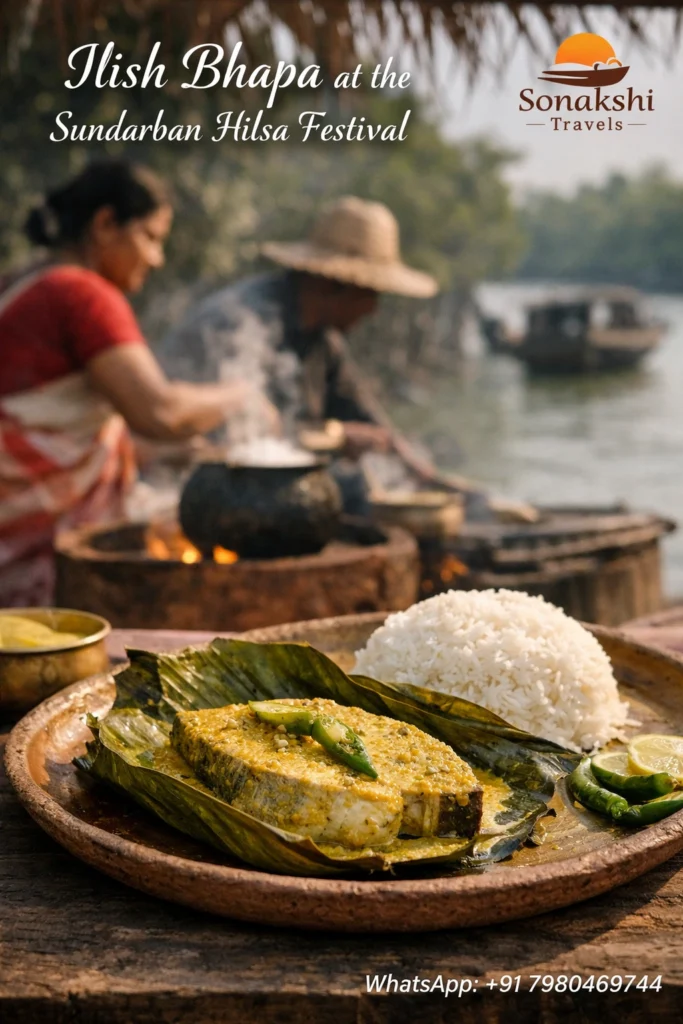
The delta does not merely nourish land; it nourishes memory. In the tidal embrace of Bengal’s southern rivers, where silt, salt, and freshwater converge, a singular culinary expression rises above all others—Ilish Bhapa. At the Sundarban Hilsa Festival, this dish is not presented as a menu item. It is positioned as a cultural text, a living archive of riverine identity, and a refined articulation of Bengal’s gastronomic philosophy.
To understand Ilish Bhapa in this setting is to understand how ecology, technique, emotion, and ritual converge. The dish gains layered meaning when prepared and served within the delta itself, where Hilsa is not an imported commodity but a migratory phenomenon intimately tied to tidal rhythms. The festival curated by Sonakshi Travels frames this culinary act not as spectacle, but as homage—to the river, to ancestral kitchens, and to the quiet dignity of local food traditions.
Ilish and the Delta: Ecology on the Plate
Hilsa (Tenualosa ilisha) is an anadromous fish, migrating from the Bay of Bengal into freshwater rivers to spawn. This biological journey shapes its texture, fat composition, and flavor profile. During monsoon months, when the rivers swell and salinity gradients shift, Hilsa accumulates a delicate layer of lipid-rich tissue. This natural marbling produces the characteristic buttery softness for which the fish is celebrated.
Within the Sundarban delta, the interplay of tidal flux and nutrient-rich sediment enhances plankton diversity. Hilsa feeding in such waters develops a distinct taste—clean yet complex, subtly sweet yet mineral. Ilish Bhapa, when prepared from freshly sourced fish within this region, becomes a precise reflection of its habitat. The dish therefore functions as ecological translation: the river speaks through mustard and steam.
At the festival, chefs and home cooks alike acknowledge this biological context. The preparation is guided by respect for the fish’s inherent qualities. Over-seasoning is avoided. Excessive manipulation is discouraged. The aim is preservation of natural integrity rather than culinary dominance.
The Architecture of Ilish Bhapa
Ingredient Integrity
The structure of Ilish Bhapa rests on restraint. Each component serves a defined purpose:
- Fresh Hilsa cuts — preferably mid-section pieces containing balanced bone and fat structure.
- Stone-ground mustard paste — typically combining black and yellow mustard seeds for layered pungency.
- Green chilies — contributing aromatic sharpness rather than overwhelming heat.
- Turmeric — providing mild earthiness and antiseptic properties.
- Mustard oil — functioning as both flavor carrier and preservative medium.
- Salt — applied with precision to avoid moisture extraction.
At the Sundarban Hilsa Festival, mustard is often ground fresh on sil-batta stones. This mechanical method releases volatile oils gradually, producing a rounded pungency that differs significantly from pre-processed paste. The oil’s aroma, when freshly poured over marinated fish, signals the beginning of transformation.
Marination as Controlled Infusion
Marination is not a passive waiting period. It is a controlled infusion stage. Salt first interacts with the fish’s surface proteins, enabling absorption of mustard compounds. The paste, emulsified with mustard oil, forms a coating that seals moisture while permitting gentle penetration.
Resting time is carefully judged. Excess marination may harden texture; insufficient time yields superficial flavoring. Experienced cooks read the fish’s response through touch and scent. The festival setting allows visitors to observe this stage closely, revealing the quiet technical intelligence embedded within domestic culinary traditions.
Steaming: Thermal Precision
Steaming defines Ilish Bhapa. Unlike frying or grilling, steaming applies indirect heat, preserving the fish’s fat content and delicate muscle fibers. The banana leaf wrapping often used during the festival contributes subtle vegetal notes and regulates moisture loss.
Thermally, steaming allows mustard’s enzymatic compounds to mellow. Allyl isothiocyanate—the chemical responsible for mustard’s pungency—softens under moist heat, producing depth rather than aggression. The result is a balanced aromatic profile in which oil, fish, and spice coexist without hierarchy.
Cultural Semiotics of Mustard and Hilsa
Mustard occupies a central place in Bengali food culture. It represents agrarian continuity, riverbank cultivation, and household economy. Hilsa, meanwhile, symbolizes abundance and monsoon renewal. Their union in Ilish Bhapa reflects more than taste—it reflects seasonal gratitude.
During the festival, the act of serving this dish acquires ceremonial undertones. Plates of steaming rice accompany the fish. Conversations slow. Silence often precedes the first bite. The meal becomes participatory reflection rather than hurried consumption.
This dynamic aligns with anthropological observations of food rituals in riverine societies, where specific dishes mark ecological cycles. Ilish Bhapa at the Sundarban Hilsa Festival becomes a marker of continuity, reinforcing collective memory through sensory engagement.
Gastronomic Texture and Sensory Mapping
From a culinary science perspective, Ilish Bhapa offers a layered sensory experience:
- Visual — golden mustard coating against pearlescent fish flesh.
- Aromatic — volatile mustard oils mingling with the marine sweetness of Hilsa.
- Tactile — soft muscle fibers yielding effortlessly, interspersed with fine bones demanding attentiveness.
- Gustatory — interplay of salt, fat, and spice.
The presence of bones is not inconvenience but instruction. Hilsa requires mindful eating. Each careful separation heightens engagement. The eater participates in the structure of the fish, reinforcing attentiveness and patience.
Within the festival context, this tactile engagement becomes shared cultural practice. Guests learn to navigate the fish respectfully, guided by those who have mastered its anatomy since childhood.
Collective Kitchens and Culinary Transmission
The Sundarban Hilsa Festival 2026 provides a rare opportunity to witness intergenerational culinary transmission. Elderly women demonstrate leaf wrapping techniques; younger chefs refine presentation without altering core methods. This coexistence of continuity and adaptation sustains authenticity.
Cooking often occurs in semi-open kitchens adjacent to water channels. The proximity to river reinforces origin. Visitors observe fish being cleaned, marinated, and steamed within sight of the delta landscape that produced it. The spatial unity of environment and cuisine deepens experiential resonance.
Such settings also underscore labor realities. Cleaning Hilsa demands dexterity. Removing scales without damaging skin, cutting symmetrical pieces, and preserving roe require expertise. The festival foregrounds this labor rather than concealing it, granting visibility to those who sustain culinary heritage.
Hilsa Variations and the Centrality of Bhapa
While the festival presents multiple Hilsa preparations—Paturi, Jhol, Polao—Bhapa remains central. The reason lies in its elemental purity. Frying introduces caramelization; curries introduce dilution. Steaming preserves essence.
Comparatively, Bhapa offers minimal intervention. It highlights fish quality and mustard calibration. In analytical terms, it functions as the baseline expression against which other variations are measured. For connoisseurs, tasting Bhapa first establishes reference before exploring more elaborate interpretations.
Psychological Resonance of Riverine Cuisine
Food memory is neurologically powerful. Smell, particularly, activates limbic pathways associated with emotion. Mustard oil heated gently releases aromatic compounds that anchor deeply within memory circuits. For many participants, tasting Ilish Bhapa evokes childhood kitchens, monsoon afternoons, and familial gatherings.
The festival setting amplifies this effect by aligning sensory cues with natural surroundings. The scent of wet earth, the sound of distant oars, and the sight of rippling water reinforce cognitive associations. The experience becomes immersive memory construction.
This psychological layering distinguishes the festival meal from urban restaurant renditions. Context modifies perception. Within the delta, authenticity is not staged—it is ambient.
Ethics of Celebration
Celebrating Hilsa within its ecological landscape carries responsibility. Sustainable sourcing, size regulation, and seasonal awareness are emphasized during the festival. Responsible culinary celebration acknowledges biological cycles rather than exploiting them.
By framing Ilish Bhapa as reverent preparation rather than indulgent excess, the festival aligns gastronomy with environmental consciousness. The dish becomes emblem of balance—between appetite and respect, between tradition and stewardship.
Ilish Bhapa as Culinary Identity
Ultimately, Ilish Bhapa at the Sundarban Hilsa Festival represents convergence. Ecology shapes ingredient. Technique shapes texture. Culture shapes meaning. The delta provides stage, but the dish carries narrative.
Each serving embodies river migration, agricultural labor, household wisdom, and communal continuity. The banana leaf parcel, opened at the table, releases more than steam. It releases accumulated history—compressed within mustard, oil, and fish.
In the quiet after the final bite, what remains is not merely satisfaction but reflection. Ilish Bhapa in this setting affirms that cuisine can function as archive, ritual, and revelation simultaneously.
In the Sundarban delta, the river writes. Ilish Bhapa reads aloud.