Updated: 28 February 2026
The Enchanting Sundarban: Where the Earth Breathes in Green Silence
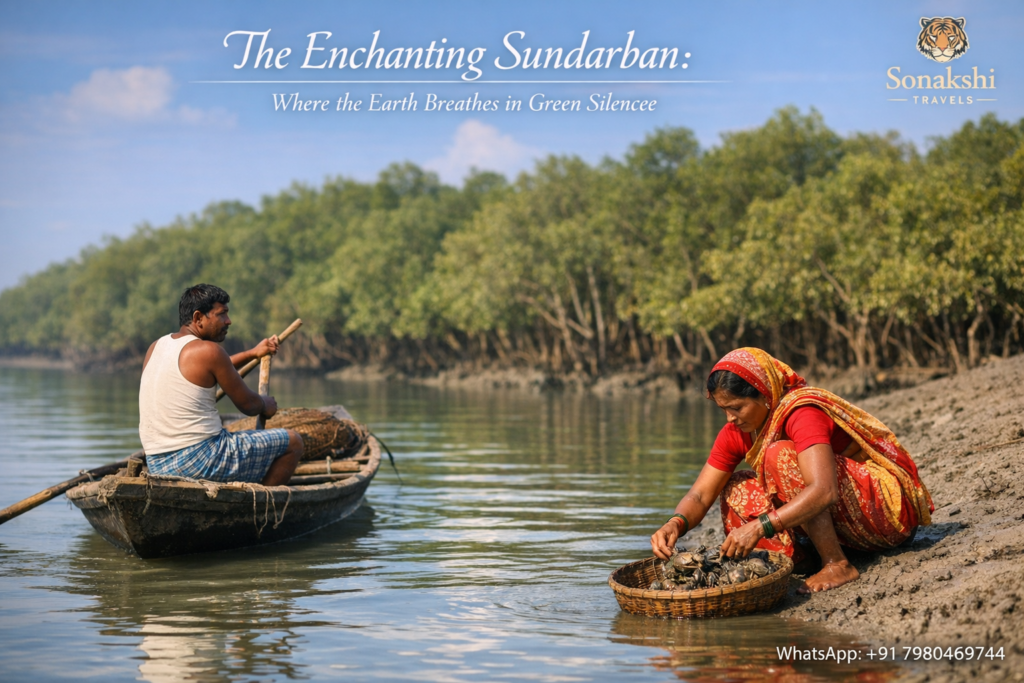
The Sundarban is not simply a place that people pass through and forget. It is a living system that breathes, shifts, absorbs, shields, and renews itself. In its quietness there is movement, and in its still waters there is strength that is easy to miss at first glance. Many readers begin by exploring the region’s broader reference base at Sundarban Travel, then realise that this mangrove world is best understood as an active ecological engine where land and tide negotiate space every day.
This region does not rely on spectacle to leave an impression. It works slowly and deliberately, with a quiet authority that feels almost scientific in its precision. The forest does not shout; it holds a low, steady presence. The rivers do not rush; they pulse with tidal rhythm. The enchantment of the Sundarban sits inside that restraint, where the Earth performs delicate work without asking to be noticed.
A Landscape Built by Water and Time
The Sundarban exists because of rivers and long geological patience. Sediment carried from the Himalayas through the Ganges and Brahmaputra systems has, over extended time, shaped a delta of remarkable scale. This is not stable ground. It is a fluid terrain that changes under the combined pressure of saltwater tides and freshwater flow. Islands appear, shrink, merge, and sometimes vanish, not as an exception but as part of the delta’s normal behaviour.
What makes this landscape extraordinary is the mangrove ecosystem that holds it together. Mangroves are not ordinary trees. They are salt-tolerant plants built to survive in brackish water where many forms of vegetation fail. Their roots rise above the mud like breathing structures. These aerial roots allow oxygen exchange in waterlogged soil, and they stabilise loose sediment that would otherwise drift away with the tide.
The enchantment begins at this point of function. The forest is not only standing on land; it is actively creating and protecting land. Each interlocked root system acts like natural infrastructure, binding mud, slowing erosion, and helping the shoreline resist constant tidal pressure. Visitors who want a field-level understanding of how this living landscape is navigated often start with a structured Sundarban tour overview before trying to interpret what the river is doing to the forest in real time.
The Ecological Intelligence of Mangroves
Mangrove forests are regularly described as “productive ecosystems,” but that phrase can sound abstract unless the science behind it is explained clearly. Research in coastal ecology shows that mangroves are among the most effective carbon sinks on Earth. They store carbon not only in trunks and leaves but also deep in waterlogged soils, where decomposition occurs slowly and carbon can remain trapped for long periods. This matters because soil storage is often the larger share of mangrove carbon, turning these forests into long-term climate stabilisers.
The Sundarban performs this work at scale. Dense mangrove coverage absorbs carbon continuously, acting as a quiet defence against rising atmospheric carbon dioxide. Unlike many ecosystems that are fragmented or restricted to small patches, this delta spans wide stretches of tidal channels and mangrove islands. The result is an ecological service that extends far beyond what a visitor sees from the waterline.
Carbon capture is only one dimension. Mangroves also stabilise microclimates by reducing temperature extremes near the surface and maintaining moisture patterns that support biodiversity. They reduce wave energy during storms by forcing water to pass through dense root networks and vegetation, which slows surge and disperses force. After major cyclones, comparative field observations repeatedly show that coastlines backed by intact mangroves often experience less severe damage than exposed areas. When people discuss the Sundarban as “paradise,” this functional protection is part of what they are sensing, even if they cannot name it.
The Royal Bengal Tiger: Apex Presence in a Fluid Forest
The Royal Bengal Tiger of the Sundarban occupies an ecological niche unlike that of many other tiger landscapes. Here, the predator operates inside a tidal system, moving between islands, crossing creeks, and adapting to saline conditions that shape prey movement and habitat use. Territory is not defined by fixed trails; it is influenced by channels that widen, narrow, or shift over time. In this setting, survival depends on flexibility, patience, and exceptional environmental reading.
This tiger functions as an apex regulator. In ecological terms, apex predators help maintain balance by influencing prey behaviour and population structure. Where such predators persist, the broader system often shows signs of integrity: prey species remain within natural checks, smaller predators do not expand unchecked, and the ecosystem’s structure stays more stable. When the apex layer collapses, ripple effects can move through food chains in ways that reduce biodiversity and alter habitat quality.
Yet the tiger in this mangrove world is rarely seen. It moves through dense vegetation and narrow, broken sightlines. Its elusiveness is not a disappointment; it is an ecological truth. The forest does not reveal itself on demand. The enchantment lies in presence rather than performance—knowing that a powerful life form moves unseen in a green labyrinth that does not cater to human expectation.
Life at the Edge: Human Adaptation in a Tidal World
The Sundarban is not an empty wilderness. Human communities live on inhabited islands and adapt daily to the same tidal forces that shape the forest. Their resilience is practical rather than romantic. Farming is constrained by salinity and waterlogging. Freshwater availability can shift with season and embankment conditions. Fishing depends on tidal timing and species cycles. Honey collection and certain forms of forest-linked work carry risks that are managed through strict discipline, shared knowledge, and a deep awareness of boundaries.
These communities do not “control” the land in the way modern cities control space. They negotiate with it. Embankments protect villages, yet breaches and erosion remain real threats. Cyclones and storm surges can force sudden change, and recovery is often shaped by what the delta allows, not by what people prefer. Over generations, local knowledge systems have developed around tide cycles, river behaviour, and the practical ethics of living near a protected forest.
The enchantment extends to this coexistence because it remains visibly fragile. In many places, nature is pushed into a narrow corner. Here, the boundary between human life and wild terrain is still sharp, and daily decisions reflect that reality. For travellers who want more controlled observation time in such a sensitive setting, a private Sundarban tour can make it easier to maintain quiet movement and avoid disturbance, which supports both interpretation and ecological respect.
Soundscape of Silence
Silence in the Sundarban is not the absence of sound. It is the absence of mechanical dominance. Instead of engines and traffic, one notices wind brushing leaves, distant bird calls, and water tapping softly against mud banks. The forest communicates through subtle acoustics, and the ear gradually starts to separate layers that urban life often masks.
This soundscape has measurable psychological effects. Research in environmental psychology and public health repeatedly links natural sound exposure with reduced stress markers, improved attention, and better emotional regulation. The mechanisms are simple to understand: predictable natural rhythms lower vigilance, while organic sound complexity restores attention without demanding constant decision-making. In the Sundarban, this restoration often feels like mental clarity that arrives quietly rather than dramatically.
The enchantment deepens when one recognises that “quiet” here contains constant activity. Crabs move beneath mud. Fish stir under the surface. Insects sustain their own small economies within the canopy. What seems like stillness is actually a functioning network, and the human mind reads it as calm because the system is balanced enough not to need noise.
Water as Architect
Tides define daily life in the Sundarban. Twice each day, water rises and falls, redrawing shorelines and changing the relationship between forest and river. Mudflats appear and vanish. Channels widen, then narrow. This movement prevents stagnation and keeps nutrients circulating across the delta, feeding both aquatic and terrestrial layers of life.
The mixing of saltwater and freshwater creates brackish conditions that support specialised species. Many fish and crustaceans thrive in this transitional zone because it offers food, shelter, and breeding space. In ecological terms, deltas often function as nurseries, producing life that later contributes to larger river and coastal systems. The Sundarban’s waters are therefore not only scenic; they are productive in ways that sustain biodiversity beyond the mangrove boundary.
Seen through this lens, the enchantment is hydrological and structural. Water here is not merely present; it is the architect that shapes habitat, drives nutrient flow, and defines the daily rules under which every species operates.
Biodiversity Beyond the Tiger
Although the tiger holds symbolic power, the Sundarban’s ecological richness is broader and more intricate than any single species. Spotted deer graze along forest edges. Saltwater crocodiles use creek mouths and banks for rest and ambush. Dolphins surface briefly in tidal rivers. Birds occupy different layers of mangrove height, each adapted to specific feeding patterns and nesting needs. The diversity is not random; it is structured by water, salinity, and the changing availability of space.
Each species contributes to a web of interaction that keeps the delta functioning. Crabs help aerate soil and recycle organic matter. Fish move nutrients through channels. Birds disperse seeds and influence insect populations. Even leaf fall is not waste. In mangrove systems, fallen leaves are a primary input into the food web, breaking down into forms that feed microorganisms and small aquatic species, which then support larger animals.
Ecologists describe mangroves as highly productive partly because of this nutrient recycling. Warm, moist conditions speed breakdown, while tidal flushing spreads nutrients across a wide area. For travellers trying to understand this complexity rather than viewing it as a simple “forest,” a well-structured Sundarban tour packages can be useful because interpretation improves when observation follows ecological logic rather than random movement.
Climate Vulnerability and Global Significance
The Sundarban stands on the frontline of climate change. Rising sea levels threaten low-lying islands. Increased salinity can alter vegetation patterns. More intense cyclones test ecosystem resilience and human safety. These are not distant theories for the delta; they are pressures that already influence land stability and livelihood security.
Vulnerability, however, does not reduce significance. It increases responsibility. The survival of this mangrove system affects regional climate regulation, coastal stability, and ecological productivity for large populations. When mangroves decline, coastlines lose a natural shield, and the cost of artificial defences rises sharply. When mangroves persist, they continue to provide protection that no simple engineered structure can fully replicate at the same ecological scale.
Researchers often note that preserving mangroves is economically rational as well as environmentally necessary. The Sundarban is a natural infrastructure system that works continuously, without fuel, without maintenance contracts, and without producing waste. Protecting it is not sentimental; it is a practical investment in regional stability.
Spiritual Geometry of the Mangrove
There is a visible rhythm in mangrove roots rising from mud, forming vertical and horizontal lines that resemble living architecture. Sunlight filters through narrow gaps and creates moving shadows on water surfaces. The geometry is not decorative; it reflects functional adaptation to tidal conditions. Yet the effect on perception can feel deeply personal.
Many visitors report humility when confronted with the scale and complexity of this ecosystem. The forest does not invite conquest. It requires attention. In psychological terms, this is a shift from a “control” mindset to an “observational” mindset. Instead of demanding that nature perform, the visitor starts to recognise that nature is already doing its work, and human presence is secondary.
The enchantment lies in this change of orientation. Modern life often trains people to expect speed, certainty, and instant reward. The Sundarban insists on patience and acceptance of uncertainty. Its spiritual quality emerges from ecological truth: systems this complex cannot be rushed, and they do not reveal themselves to impatience.
Ethics of Presence
To enter the Sundarban is to enter a delicate living system. Responsible engagement becomes essential, not as a moral slogan, but as an ecological requirement. Conservation rules that regulate movement in core forest zones exist because disturbance carries consequences in habitats where breeding space, shelter, and food chains are finely balanced.
Awareness of fragility shapes the quality of experience. Observing wildlife from a distance, maintaining quiet movement, and respecting protected boundaries reduce stress on animals and protect habitat integrity. These behaviours also improve interpretation, because the forest responds more naturally when it is not pressured by noise and crowd energy.
For travellers who want to align experience with conservation logic, choosing a seasonally appropriate, regulated format such as the 2 Nights 3 Days Sundarban tour package can offer time for slower observation without compressing the ecosystem into hurried checklists.
The Emotional Aftermath
Some landscapes fade quickly from memory once daily routines return. The Sundarban often does the opposite. Its quietness stays present in urban noise. Its tidal rhythm contrasts sharply with mechanical schedules. The memory of green horizons and slow-moving water can return unexpectedly, as if the mind continues to process what it witnessed.
This lingering effect is not just nostalgia. It reflects how rare it is to experience a functioning ecosystem where natural rhythms still dominate. The forest does not overwhelm; it leaves a steady imprint. Its impact unfolds later, through reflection, and often through a renewed sensitivity to how fragile such systems are in a world that tends to simplify everything.
Conclusion: A Living Testament to Earth’s Quiet Strength
The Sundarban is not paradise because it is comfortable or decorative. It is paradise because it functions. It sustains biodiversity, stores carbon, buffers storms, and supports complex life under harsh saline conditions. It demonstrates adaptation without aggression, strength without noise, and protection without visibility.
Its green silence is not emptiness but disciplined vitality. Its tides are not disorder but rhythm. To witness this delta closely is to understand how Earth stabilises itself through living systems that work quietly and consistently.
The enchantment of the Sundarban lies in integrity. It remains one of the rare places where ecological processes are visible, powerful, and undramatic. In a world shaped by acceleration, it offers a clear reminder: the most important forces are often the quiet ones.