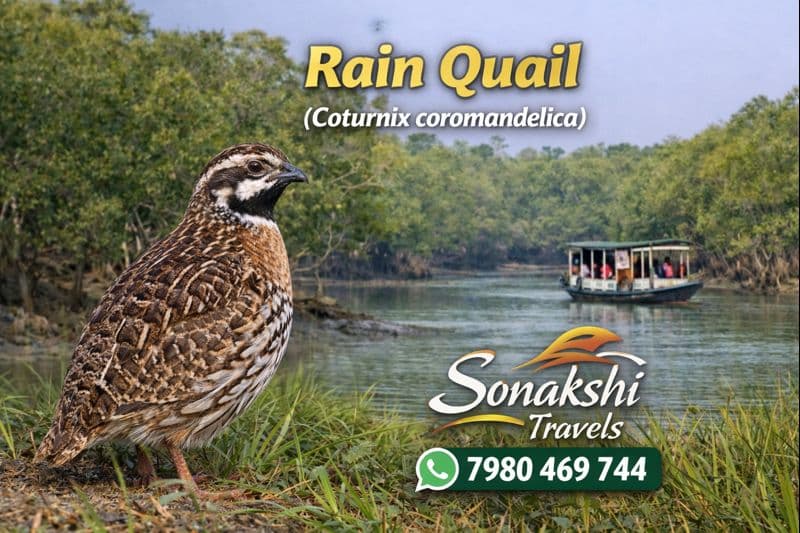
The Rain Quail (Coturnix coromandelica) is a small, elusive ground-dwelling bird of the family Phasianidae, renowned for its strong association with the Indian monsoon and seasonal grassland ecosystems. Despite its modest size and cryptic nature, the Rain Quail holds considerable ecological significance as an insect regulator, seed consumer, and prey species within terrestrial food webs. Often detected more by its sudden explosive flight than by sight, this species is a subject of sustained interest among ornithologists, grassland ecologists, and conservation biologists across South Asia.
Taxonomy & Classification
The Rain Quail belongs to the order Galliformes and the family Phasianidae, which includes pheasants, partridges, junglefowl, and quails. The genus Coturnix comprises several small-bodied quails adapted to open habitats and ground-based lifestyles. The species epithet coromandelica refers to the Coromandel Coast of India, indicating the region from which early scientific descriptions were derived. Taxonomically, the Rain Quail is closely related to the Common Quail (Coturnix coturnix), but it is distinguished by its smaller size, distinctive plumage patterns, and more localized migratory behavior within the Indian subcontinent.
Morphology & Field Identification
In the field, the Rain Quail presents a compact, rounded profile with a short tail, rounded wings, and a proportionally large head. Its plumage is predominantly brown and buff, intricately patterned with dark streaks and mottling that provide exceptional camouflage in dry grasses and crop stubble. The bill is short and conical, adapted for picking seeds and small invertebrates, while the legs are pale and relatively short, reflecting its terrestrial habits.
Male Features
Male Rain Quails are characterized by a more pronounced facial pattern, including a darker throat and bold streaking on the head and upper breast. During the breeding season, males may exhibit slightly enhanced contrast in plumage, aiding in sexual recognition. Their vocalizations, though soft and infrequent, play a role in mate attraction and territorial signaling within dense grass cover.
Female Features
Females are marginally larger than males and display duller, more uniformly mottled plumage. This subdued coloration serves as an effective adaptation for concealment during nesting and incubation. Females lack any distinctive ornamental features and rely heavily on camouflage to avoid predation.
Size & Wingspan
The Rain Quail typically measures between 16–18 cm in length and weighs approximately 40–60 grams. Its wingspan averages 32–35 cm, enabling short bursts of rapid flight. Despite its small size, the bird is robustly built, with well-developed pectoral muscles that support sudden take-offs.
Flight Characteristics
Flight is rapid, low, and explosive, often accompanied by a characteristic whirring sound. The Rain Quail rarely flies unless disturbed, preferring to remain concealed within ground vegetation. When flushed, it usually flies only a short distance before dropping back into cover, making prolonged observation difficult.
Habitat & Distribution
Global Range
The Rain Quail is primarily distributed across the Indian subcontinent, including India, Nepal, Bangladesh, Sri Lanka, and parts of Pakistan and Myanmar. Its range is largely confined to South Asia, where seasonal climatic patterns strongly influence its occurrence and abundance.
Preferred Habitat
This species favors open grasslands, scrubby plains, agricultural fields, fallow lands, and low-lying meadows. It is particularly associated with areas experiencing seasonal rainfall, where fresh grass growth provides both food and cover. The Rain Quail avoids dense forests and wetlands, preferring relatively dry, open terrain.
Diet & Feeding Ecology
The Rain Quail is omnivorous, with a diet comprising grass seeds, cereal grains, tender shoots, and a wide range of invertebrates. Insects such as ants, beetles, termites, and grasshoppers form a crucial component of its diet, especially during the breeding season when protein requirements are elevated.
Foraging Technique
Foraging occurs almost entirely on the ground. The bird moves slowly through grass cover, pecking at seeds and invertebrates while maintaining constant vigilance. Feeding activity peaks during early morning and late afternoon, coinciding with cooler temperatures and reduced predator activity.
Breeding & Reproduction
Breeding is closely synchronized with the onset of the monsoon, typically between June and September. Increased vegetation growth during this period provides optimal nesting cover and abundant food resources. Courtship is subtle, involving low vocal calls and close following behavior by males.
Nesting Sites
Nests are shallow depressions scraped into the ground and lined sparingly with grass. They are usually well concealed within tall grass, crop fields, or low scrub. Clutches typically consist of 6–10 eggs, which are pale buff with fine speckling. Incubation lasts approximately 16–18 days and is carried out solely by the female.
Unique Adaptations & Behavioral Ecology
Speed & Agility
Although primarily terrestrial, the Rain Quail possesses remarkable agility. Strong leg muscles enable swift running through dense grass, while powerful wings facilitate instant vertical take-off when threatened. This dual strategy significantly enhances survival in predator-rich environments.
Camouflage and Nesting Strategy
Cryptic plumage is one of the Rain Quail’s most effective adaptations. The intricate patterns of brown, buff, and black blend seamlessly with grassland substrates, rendering both adults and nests extremely difficult to detect. This camouflage reduces predation pressure during both feeding and breeding.
Social Behavior
The Rain Quail is generally solitary or found in pairs, particularly during the breeding season. Outside this period, small loose groups may form in favorable feeding areas. Social interactions are minimal, with individuals relying more on concealment than group defense.
Occurrence & Seasonal Movement
This species exhibits localized seasonal movement rather than long-distance migration. Populations appear suddenly with the arrival of monsoon rains, giving rise to its common name. As grasslands dry out post-monsoon, individuals gradually disperse or move to areas with residual cover and food availability.
Preferred Habitat in the Sundarbans Region
Within the Sundarbans landscape, the Rain Quail is primarily restricted to peripheral zones rather than core mangrove forests. It is observed in reclaimed agricultural land, grassy embankments, village outskirts, and fallow fields where seasonal grasses flourish. These transitional habitats provide suitable foraging grounds while remaining above tidal influence.
Nature enthusiasts exploring the grassland edges and rural ecosystems can enrich their experience through a guided Sundarban Tour, where seasonal birds and diverse habitats coexist beyond the mangrove creeks.
Ecological Role
The Rain Quail plays a vital ecological role by regulating insect populations and contributing to seed dispersal. As a prey species, it supports higher trophic levels, including raptors, snakes, and small carnivorous mammals. Its presence indicates healthy grassland and agro-ecosystems.
Habitat Alteration
Rapid agricultural intensification, excessive pesticide use, and conversion of grasslands into urban or industrial zones pose significant threats. Loss of seasonal grass cover directly impacts breeding success and population stability, making habitat alteration a critical concern.
Conservation Efforts
Currently listed as Least Concern, the Rain Quail nonetheless requires sustained monitoring. Conservation strategies emphasize the preservation of grasslands, promotion of eco-friendly farming practices, and maintenance of fallow land. Awareness among rural communities is essential for long-term population stability.
Did You Know?
The Rain Quail often appears suddenly with the first monsoon showers, leading to its distinctive common name.
It prefers running over flying and relies heavily on camouflage to avoid detection.
Despite being widespread, it is rarely seen due to its secretive behavior.