Detailed Biology, Ecology, and Seasonal Presence in Asian Wetlands
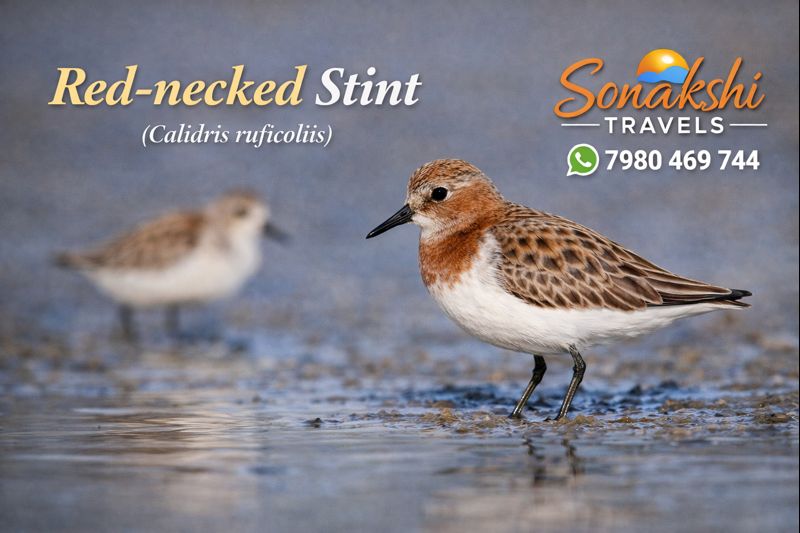
The Red-necked Stint (Calidris ruficollis) is a small yet exceptionally dynamic migratory shorebird, renowned for its remarkable endurance and vast seasonal movements across hemispheres. Despite its delicate appearance and diminutive size, this species undertakes some of the longest migratory journeys among waders, linking Arctic breeding grounds with temperate and tropical wintering habitats. In Asian wetlands, including the extensive intertidal systems of eastern India, the Red-necked Stint is a familiar winter visitor whose presence reflects the productivity and ecological integrity of coastal and estuarine environments.
Taxonomy & Classification
The Red-necked Stint belongs to the order Charadriiformes and the family Scolopacidae, a group comprising sandpipers, snipes, and related waders. It is placed within the genus Calidris, which includes numerous small-bodied shorebirds adapted to probing and surface-feeding strategies. The species is taxonomically distinct and does not exhibit recognized subspecies variation. Phylogenetic studies indicate close evolutionary relationships with other Arctic-breeding stints, shaped by shared migratory pressures and ecological niches.
Morphology & Field Identification
The Red-necked Stint is compact, short-legged, and fine-billed, with a rounded head and relatively short neck. In non-breeding plumage, it appears pale gray above with clean white underparts, making it superficially similar to other small stints. During the breeding season, however, the species develops its characteristic rufous-red coloration on the neck, face, and upper breast, which serves as a key identification feature. In the field, size, active feeding behavior, and flocking tendencies aid in distinguishing this species from congeners.
Male Features
Male Red-necked Stints exhibit more intense rufous coloration during the breeding season, particularly on the neck and upper breast. The contrast between reddish tones and darker upperparts is more pronounced in males, playing a role in courtship and territorial interactions on Arctic breeding grounds.
Female Features
Females closely resemble males but generally show slightly duller and less extensive rufous coloration in breeding plumage. Outside the breeding season, sexual differences are minimal, and both sexes appear largely identical in the field.
Size & Wingspan
Adults typically measure between 14 and 16 centimeters in length, with a wingspan ranging from 28 to 32 centimeters. Their lightweight build supports efficient long-distance flight while maintaining agility during foraging and predator avoidance.
Flight Characteristics
In flight, the Red-necked Stint demonstrates rapid wingbeats and tight flock coordination. Large flocks often perform synchronized aerial maneuvers, changing direction swiftly in response to threats. This collective movement reduces individual predation risk and enhances navigational efficiency during migration.
Habitat & Distribution
Global Range
The species breeds in the high Arctic regions of northeastern Siberia. Following the breeding season, it migrates southward across East Asia to wintering grounds in Australia, Southeast Asia, South Asia, and parts of the western Pacific. This extensive migratory range highlights its reliance on a chain of suitable stopover habitats across continents.
Preferred Habitat
Throughout its annual cycle, the Red-necked Stint favors open, low-vegetation habitats. During migration and winter, it is most commonly found on tidal mudflats, estuarine margins, salt pans, shallow lagoons, and occasionally inland wetlands. The availability of soft substrates rich in invertebrates is a critical factor in habitat selection.
Diet & Feeding Ecology
The diet consists primarily of small invertebrates, including insect larvae, tiny crustaceans, polychaete worms, and mollusks. Feeding intensity increases during migratory stopovers, where rapid energy accumulation is essential for completing long flights between staging areas.
Foraging Technique
Foraging behavior is energetic and continuous. Birds move quickly across mudflats, employing rapid pecking and shallow probing to capture prey near the surface. This feeding strategy allows efficient exploitation of dense prey populations exposed during low tide.
Breeding & Reproduction
Breeding takes place during the brief Arctic summer, where continuous daylight and abundant insect prey support rapid reproductive cycles. Pair bonds are seasonal, with nesting, incubation, and chick rearing completed within a narrow time frame.
Nesting Sites
Nests are shallow ground scrapes lined with plant material, typically located on open tundra with sparse vegetation. The placement provides both camouflage and a wide field of view, enabling adults to detect approaching predators early.
Unique Adaptations & Behavioral Ecology
Speed & Agility
The Red-necked Stint exhibits exceptional agility, both on the ground and in flight. Rapid takeoff, swift directional changes, and coordinated flock movements are key adaptations for survival in open habitats with high predation pressure.
Camouflage and Nesting Strategy
Plumage coloration closely matches the tones of tundra soils and coastal mudflats. Eggs and incubating adults blend seamlessly into their surroundings, reducing detection by predators during the vulnerable breeding period.
Social Behavior
Outside the breeding season, the species is highly gregarious, often forming large mixed-species flocks with other stints and sandpipers. This social structure enhances foraging efficiency and collective vigilance.
Occurrence & Seasonal Movement
In South Asia, the Red-necked Stint is primarily a winter visitor, arriving after the monsoon and remaining through the cooler months. Numbers peak during mid-winter, with departure occurring in early spring as birds begin their northward migration.
Preferred Habitat in the Sundarbans Region
Within the Sundarbans, the Red-necked Stint is most frequently observed along exposed tidal mudflats, creek edges, and shallow estuarine zones adjacent to mangrove forests. These areas provide abundant prey during low tide and serve as important wintering and stopover habitats.
Wildlife enthusiasts interested in observing migratory shorebirds within mangrove-fringed estuaries may consider a carefully planned Sundarban Tour, which offers opportunities to explore these ecologically rich tidal landscapes.
Ecological Role
The Red-necked Stint plays a vital role in wetland ecosystems by regulating populations of small invertebrates. Through its feeding activities, it contributes to nutrient cycling and energy transfer within intertidal food webs.
Habitat Alteration
Habitat loss and degradation pose significant threats to the species, particularly along coastal stopover and wintering sites. Land reclamation, pollution, altered tidal regimes, and human disturbance can reduce feeding efficiency and disrupt migratory connectivity.
Conservation Efforts
International migratory bird agreements, wetland conservation programs, and long-term monitoring initiatives are critical for the protection of the Red-necked Stint. Preserving a network of healthy coastal and inland wetlands across its flyway remains a conservation priority.
Nature-focused travelers seeking insight into tidal biodiversity may also explore a responsibly designed Sundarban Tour, highlighting the region’s exceptional migratory birdlife.
Did You Know?
The Red-necked Stint undertakes one of the longest migratory routes among small shorebirds, with some individuals traveling from Arctic Siberia to Australia and back each year.
External Reference
For further taxonomic and ecological information, visit: