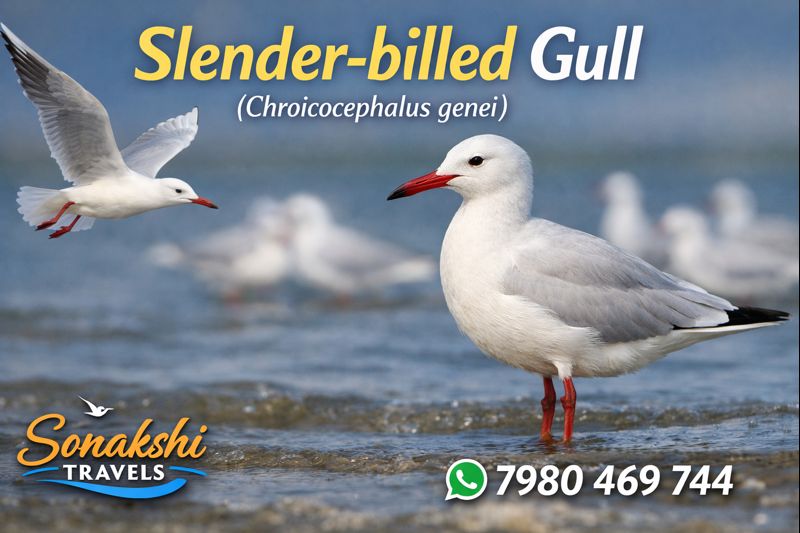
The Slender-billed Gull (Chroicocephalus genei) is a refined and elegant member of the family Laridae, distinguished by its elongated bill, pale plumage, and graceful flight. Often associated with shallow coastal wetlands, saline lagoons, estuaries, and inland salt pans, this species represents a specialized ecological guild adapted to feeding in calm, shallow waters. Although less numerous and less conspicuous than many other gulls, the Slender-billed Gull holds considerable ecological significance, especially within wetland ecosystems of the Mediterranean basin, parts of Africa, West Asia, and South Asia.
In the Indian subcontinent, the species is primarily encountered as a winter visitor, with occasional records from coastal regions and large deltaic systems. Its occurrence in eastern India, including the Sundarbans landscape, is sporadic but biologically noteworthy, offering insights into migratory connectivity between West Asian wetlands and South Asian coastal habitats.
Taxonomy & Classification
Systematic Position
The Slender-billed Gull belongs to the order Charadriiformes and family Laridae, a diverse group that includes gulls, terns, and skimmers. Within this family, it is placed in the genus Chroicocephalus, which comprises several small to medium-sized gulls characterized by seasonal head markings and relatively delicate bill structures.
Taxonomically, the species was previously placed under the genus Larus, but molecular and morphological studies have supported its reassignment to Chroicocephalus, reflecting closer evolutionary relationships with smaller hooded gulls.
Morphology & Field Identification
The Slender-billed Gull is immediately recognizable by its slim profile, long neck, narrow wings, and conspicuously elongated bill. Its overall appearance is lighter and more graceful than many sympatric gull species.
Male Features
Adult males typically exhibit a pale pearl-grey mantle and upperwings, contrasting with white underparts. During the breeding season, males develop a soft pinkish wash on the breast and belly, a subtle but distinctive feature. The bill is long, slender, and deep red, lacking the dark markings seen in many other gulls. The head is white with a faint dusky ear-spot, never forming a complete hood.
Female Features
Females closely resemble males in plumage and coloration, reflecting minimal sexual dimorphism. On average, females may appear slightly smaller and marginally less robust in bill structure. Seasonal changes in plumage follow similar patterns, with breeding females also showing a delicate pink flush on the underparts.
Size & Wingspan
The Slender-billed Gull measures approximately 37–42 cm in length, placing it among medium-sized gulls. The wingspan ranges from 90 to 102 cm. Its wings are narrow and pointed, contributing to a buoyant and agile flight style.
Flight Characteristics
In flight, the species appears light and elegant, with shallow, fluid wingbeats interspersed with gliding. The upperwings are pale grey with narrow black tips, lacking the bold white mirrors typical of larger gulls. This subtle wing pattern aids field identification at a distance.
Habitat & Distribution
Global Range
The global distribution of the Slender-billed Gull spans southern Europe, North Africa, West Asia, and parts of Central and South Asia. Major breeding populations occur around the Mediterranean Sea, the Black Sea region, and inland saline lakes of Central Asia. During the non-breeding season, birds disperse southward to coastal Africa, the Middle East, and the Indian subcontinent.
Preferred Habitat
This species shows a strong preference for shallow, calm water bodies with minimal wave action. Typical habitats include coastal lagoons, salt marshes, estuaries, tidal flats, salt pans, and inland saline or alkaline lakes. Such environments provide optimal conditions for its specialized feeding techniques.
Diet & Feeding Ecology
The Slender-billed Gull is primarily carnivorous, feeding on a variety of small aquatic and terrestrial organisms. Its diet includes small fish, crustaceans, mollusks, aquatic insects, insect larvae, and occasionally worms. Compared to larger gulls, it relies less on scavenging and human-associated food sources.
Foraging Technique
Foraging is typically conducted in shallow water, where the bird wades delicately while probing the substrate with its elongated bill. It may also pick prey from the water surface or mudflats. This precise, tactile feeding strategy allows exploitation of niches less accessible to bulkier gull species.
Breeding & Reproduction
Breeding occurs mainly between April and June in the Northern Hemisphere. The species is colonial, forming loose to moderately dense nesting colonies in suitable wetland habitats.
Nesting Sites
Nests are typically constructed on low islands, sandbars, or muddy flats surrounded by shallow water. The nest itself is a simple scrape lined with vegetation, feathers, or shells. Clutches usually consist of two to three eggs, which are incubated by both parents.
Unique Adaptations & Behavioral Ecology
Speed & Agility
The slender body and narrow wings of this gull confer high maneuverability, particularly useful when feeding in confined wetland spaces or avoiding predators.
Camouflage and Nesting Strategy
Egg coloration blends effectively with surrounding mud and vegetation, providing passive camouflage against predators. Colony placement on isolated wetland features further reduces predation risk.
Social Behavior
Outside the breeding season, Slender-billed Gulls are often observed in small flocks, sometimes associating with other gull and tern species. Vocalizations are relatively soft and less aggressive compared to larger gulls.
Occurrence & Seasonal Movement
The species is largely migratory, with pronounced seasonal movements between breeding and wintering grounds. In South Asia, it is mainly a winter visitor, arriving between October and November and departing by early spring.
Preferred Habitat in the Sundarbans Region
Within the Sundarbans delta, the Slender-billed Gull is an uncommon but notable visitor. It favors open mudflats, estuarine sandbars, and quiet creeks where salinity levels fluctuate. These habitats mirror its preferred wetlands elsewhere, providing suitable foraging opportunities during winter months.
Exploring the rich birdlife of eastern India becomes even more rewarding with a guided Sundarban Tour, offering close encounters with unique wetland species.
Ecological Role
As a mid-level predator, the Slender-billed Gull helps regulate populations of small aquatic organisms, contributing to the balance of wetland food webs. Its presence often indicates healthy, undisturbed wetland conditions.
Habitat Alteration
Wetland degradation poses the most significant threat to this species. Drainage of lagoons, conversion of salt pans, pollution, and disturbance at breeding sites can adversely affect local populations. Climate change–induced sea-level rise further threatens low-lying nesting habitats.
Conservation Efforts
Globally, the Slender-billed Gull is currently assessed as a species of Least Concern, yet localized declines have prompted conservation attention. Protection of key breeding and wintering wetlands, regulation of human disturbance, and long-term monitoring are essential measures for its continued stability.
For travelers interested in wetland biodiversity and migratory birds, a well-planned Sundarban Tour provides exceptional opportunities for observation and learning.
Did You Know?
The Slender-billed Gull is one of the few gull species that rarely scavenges at landfills or fishing ports, relying instead on natural wetland prey. Its delicate pink breeding flush, visible only under favorable light conditions, is among the most subtle seasonal color changes seen in gulls.
External Reference
For additional scientific details and global distribution data, consult the Slender-billed Gull page on Wikipedia.