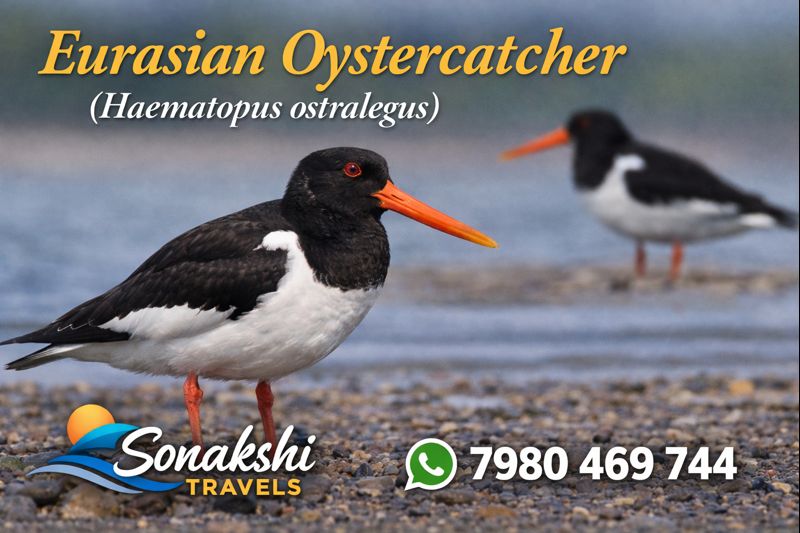
The Eurasian Oystercatcher (Haematopus ostralegus) is a conspicuous and ecologically significant shorebird, instantly recognizable by its bold black-and-white plumage, long vermilion-red bill, and piercing calls that echo across tidal flats. Distributed widely across temperate and subarctic regions of Europe and Asia, this species has become emblematic of intertidal ecosystems. Its life history is closely intertwined with coastal dynamics, shellfish availability, and seasonal environmental change.
As one of the most intensively studied wading birds, the Eurasian Oystercatcher provides invaluable insights into coastal ecology, predator–prey relationships, and long-term population dynamics. Although globally assessed as relatively stable, regional populations experience pressures from habitat alteration, climate variability, and human disturbance, making continued ecological understanding and conservation management essential.
Taxonomy & Classification
The Eurasian Oystercatcher belongs to the order Charadriiformes, a diverse assemblage of birds adapted to aquatic, coastal, and wetland environments. Within this order, it is placed in the family Haematopodidae, a small but highly specialized family comprising oystercatchers. Members of this family are characterized by strong bodies, sturdy legs, and powerful bills adapted for handling hard-shelled prey.
The genus Haematopus is derived from Greek terms meaning “blood” and “foot,” referring to the bird’s bright red legs and bill. The species epithet ostralegus reflects its historical association with shellfish feeding. Among all oystercatchers worldwide, the Eurasian Oystercatcher is the most widespread and extensively researched.
Morphology & Field Identification
Field identification of the Eurasian Oystercatcher is straightforward due to its high-contrast plumage. The head, neck, upper breast, wings, and back are deep black, while the underparts, rump, and wing bars are white. This striking coloration remains consistent throughout the year, with minimal seasonal variation.
The bill is long, straight, and laterally compressed, glowing orange-red with a sharp tip designed for prying, hammering, or probing. The eyes are crimson, encircled by a narrow yellow orbital ring, giving the bird an alert and vigilant appearance.
Male Features
Male Eurasian Oystercatchers are typically marginally heavier than females and often possess slightly shorter yet thicker bills. This morphology may provide increased mechanical strength when opening tightly closed bivalves, particularly mussels and cockles on rocky or compact substrates.
Female Features
Females closely resemble males in plumage but generally have longer and more slender bills. This subtle difference allows females to probe deeper into sediment layers, accessing prey unavailable to males and thereby reducing feeding competition between the sexes.
Size & Wingspan
Adult Eurasian Oystercatchers measure approximately 39–44 centimeters in length. Their wingspan ranges from 72 to 83 centimeters, providing ample lift for sustained flight over open water and facilitating long-distance seasonal movements.
Flight Characteristics
In flight, the Eurasian Oystercatcher exhibits strong, direct wingbeats with limited gliding. Key identification features include a bold white wing bar, white rump, black tail band, and long red legs trailing conspicuously behind the body.
Habitat & Distribution
Global Range
The species has a broad Palearctic distribution. Breeding populations occur across northern and western Europe, Scandinavia, the British Isles, and parts of central and eastern Asia. During winter, many birds migrate southward to temperate coastal regions of southern Europe, the Mediterranean basin, South Asia, and East Asia.
Preferred Habitat
Eurasian Oystercatchers show a strong preference for coastal and estuarine habitats, particularly intertidal mudflats, sandy beaches, rocky shores, and salt marshes. During the breeding season, inland habitats such as river gravel bars, open grasslands, and agricultural fields may also be utilized.
Diet & Feeding Ecology
The species is a specialized carnivore, feeding predominantly on bivalve mollusks including mussels, cockles, and clams. Depending on habitat and seasonal availability, its diet may also include polychaete worms, crustaceans, echinoderms, and aquatic insects.
Foraging Technique
Foraging strategies are highly refined and often individualized. Some oystercatchers specialize in hammering shells open using repeated blows of the bill, while others probe soft sediments to extract worms and buried prey. This individual specialization increases foraging efficiency and minimizes competition within flocks.
Exploring tidal ecosystems and riverine estuaries offers valuable insight into shorebird ecology. Experience these landscapes through our Sundarban Tour Packages and plan your journey responsibly.
Breeding & Reproduction
Breeding occurs primarily during spring and early summer. Eurasian Oystercatchers are socially monogamous and frequently form long-term pair bonds, with many pairs returning to the same nesting territories year after year.
Nesting Sites
Nests are simple ground scrapes located on sandy beaches, shingle banks, salt marsh edges, or open grassland near water. The clutch usually contains two to four eggs, cryptically patterned to blend seamlessly with surrounding substrates.
Unique Adaptations & Behavioral Ecology
Speed & Agility
Although not among the fastest shorebirds, the Eurasian Oystercatcher displays impressive agility on tidal flats. Quick foot movements, precise bill control, and strong neck muscles enable efficient handling of mobile or hard-shelled prey.
Camouflage and Nesting Strategy
Eggs and chicks rely heavily on camouflage for survival. Their speckled coloration closely matches sand and gravel, while adults employ distraction displays and vocal alarms to divert predators away from nesting sites.
Social Behavior
Outside the breeding season, Eurasian Oystercatchers are highly gregarious, forming large communal roosts along coasts and estuaries. These aggregations enhance predator detection and may improve thermal efficiency during colder months.
Occurrence & Seasonal Movement
Seasonal movements vary across the species’ range. Northern breeding populations migrate southward during winter, while birds in milder coastal regions may remain resident year-round. Migration routes typically follow coastlines and major river systems.
Preferred Habitat in the Sundarbans Region
In the Sundarbans region, the Eurasian Oystercatcher is most likely to be encountered along open estuarine mudflats, sandy islands, and tidal river mouths bordering mangrove forests. These transitional zones provide suitable feeding grounds rich in mollusks and other invertebrates.
Ecological Role
As a key predator of intertidal invertebrates, the Eurasian Oystercatcher plays an important role in regulating shellfish populations. Its foraging activity influences sediment structure and contributes to the ecological balance of coastal ecosystems.
Habitat Alteration
Coastal development, land reclamation, shellfish overexploitation, pollution, and rising sea levels pose ongoing threats to suitable habitat. Loss of intertidal feeding areas can significantly affect winter survival and breeding success.
Conservation Efforts
Conservation initiatives focus on protecting intertidal habitats, implementing sustainable shellfish harvesting practices, and monitoring breeding and wintering populations. Due to its sensitivity to environmental change, the Eurasian Oystercatcher is widely used as an indicator species in coastal conservation research.
Did You Know?
Individual Eurasian Oystercatchers often specialize in a single feeding technique throughout their lives.
Some breeding pairs maintain the same nesting territory for several decades.
The species has played a major role in advancing scientific understanding of shorebird ecology.
Mangrove-dominated coastlines support a remarkable diversity of shorebirds. Plan your nature-focused experience with our Sundarban Tour Packages and explore these habitats with ecological sensitivity.