A Comprehensive Study of Biology, Ecology, and Behaviour
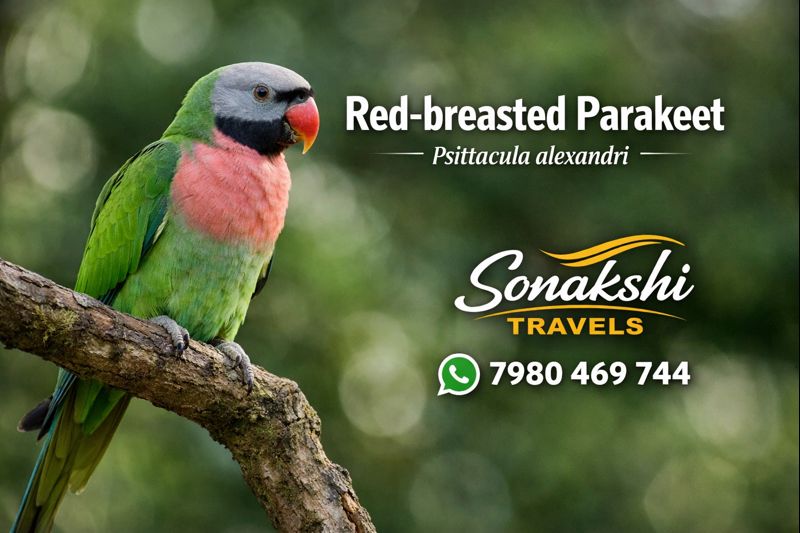
The Red-breasted Parakeet (Psittacula alexandri) is a medium-to-large Asian parakeet distinguished by its vibrant green plumage, elongated tail, and the striking red to maroon breast patch seen in adult males. Widely distributed across South and Southeast Asia, this species demonstrates remarkable ecological adaptability, thriving in forests, wetlands, agricultural mosaics, and even semi-urban landscapes. Its strong flight, social behavior, and flexible diet have enabled it to persist across rapidly changing environments.
In eastern India and the lower Gangetic plains, the Red-breasted Parakeet is an important avian component of mixed woodland and mangrove-adjacent ecosystems. Beyond its visual appeal, the species contributes significantly to ecological processes such as seed dispersal and forest regeneration. The following article provides an in-depth, research-oriented examination of its taxonomy, morphology, feeding ecology, reproductive biology, behavioral adaptations, and conservation challenges, with special reference to the Sundarbans region.
Taxonomy & Classification
Systematic Placement
The Red-breasted Parakeet belongs to the order Psittaciformes, a group characterized by highly developed vocal abilities, strong hooked beaks, and complex social behavior. Within this order, it is a member of the family Psittaculidae, which includes Old World parrots distributed across Asia, Africa, and Australasia.
Taxonomic hierarchy:
Kingdom: Animalia
Phylum: Chordata
Class: Aves
Order: Psittaciformes
Family: Psittaculidae
Genus: Psittacula
Species: Psittacula alexandri
The species was historically confused with closely related parakeets due to overlapping ranges and similar morphology. Modern taxonomic revisions based on vocalization patterns and plumage details have clarified its distinct species status.
Morphology & Field Identification
General Morphology
The Red-breasted Parakeet is a slender yet powerful parakeet with predominantly bright green plumage. The head is rounded with a pale green to bluish wash on the crown. The bill is robust, deep red in adults, and well suited for cracking seeds and hard fruits.
Male Features
Adult males are distinguished by a conspicuous red to maroon breast patch extending across the upper chest. A narrow black chin stripe may be visible, and some individuals show a faint collar. These features become more pronounced with age and play a role in sexual signaling during courtship.
Female Features
Females lack the red breast patch and exhibit a more uniform green underpart coloration. Their plumage is slightly duller, aiding camouflage while nesting. Juveniles closely resemble females until they reach sexual maturity.
Size & Wingspan
The species measures approximately 45–50 cm in total length, including the long graduated tail. The wingspan averages between 40–45 cm, enabling sustained and efficient flight across open landscapes.
Flight Characteristics
Flight is swift, direct, and strong, marked by rapid wingbeats and shallow glides. When flying in flocks, individuals maintain tight formations, producing loud, sharp calls that facilitate group cohesion.
Habitat & Distribution
Global Range
The Red-breasted Parakeet is distributed across northeastern India, Bangladesh, Myanmar, Thailand, Laos, Cambodia, Vietnam, southern China, and parts of the Malay Peninsula. Its wide distribution reflects its tolerance of diverse climatic and ecological conditions.
Preferred Habitat
This species occupies tropical and subtropical forests, riverine woodlands, mangrove edges, plantations, orchards, and agricultural fields. It shows a strong preference for landscapes that combine tall trees for roosting with open feeding areas.
Diet & Feeding Ecology
Diet Composition
The Red-breasted Parakeet is primarily granivorous and frugivorous. Its diet includes seeds, grains, fruits, berries, flower buds, nectar, and leaf shoots. Agricultural crops such as rice, maize, and sunflower are readily exploited when available.
Foraging Technique
Foraging is typically conducted in small to medium-sized flocks. Individuals use their strong bills to husk seeds, often holding food with one foot. Ground foraging occurs in harvested fields, while arboreal foraging dominates in forested areas.
Breeding & Reproduction
Breeding Season
Breeding generally occurs from December to April, coinciding with increased food availability. Seasonal timing may vary slightly across the species’ range.
Nesting Sites
Nests are established in natural tree cavities, often in large, mature trees. The female lays 2–4 white eggs, incubating them for approximately 22–26 days. The male plays an important role in provisioning food during incubation and early chick development.
Unique Adaptations & Behavioral Ecology
Speed & Agility
The species exhibits excellent aerial agility, allowing it to evade predators and navigate complex forest canopies. Rapid acceleration and tight turns are common during flock movements.
Camouflage and Nesting Strategy
The green plumage provides effective camouflage within foliage, while cavity nesting offers protection from predators and harsh weather conditions.
Social Behavior
Highly social by nature, Red-breasted Parakeets form noisy flocks outside the breeding season. Vocal communication is constant, serving to maintain group cohesion and alert others to potential threats.
Occurrence & Seasonal Movement
The species is largely resident, though local movements occur in response to food availability. Post-breeding dispersal often results in larger flocks in agricultural and wetland-adjacent areas.
Preferred Habitat in the Sundarbans Region
In the Sundarbans and its surrounding buffer zones, the Red-breasted Parakeet frequents village groves, mangrove fringes, riverbanks, and cultivated fields. Tall trees along embankments and forest edges provide nesting cavities and safe roosting sites.
Mangrove landscapes host remarkable avian diversity. Plan a responsible wildlife experience with a guided Sundarban Tour
and explore these habitats in depth.
Ecological Role
The Red-breasted Parakeet plays a vital role in seed dispersal and plant regeneration. By feeding on a wide range of fruits and seeds, it contributes to maintaining plant diversity across forest and wetland ecosystems.
Habitat Alteration
Deforestation, agricultural intensification, and loss of mature trees have altered much of the species’ natural habitat. While adaptable, the parakeet remains dependent on large trees for nesting and roosting.
Conservation Efforts
Conservation initiatives focus on habitat protection, regulation of wildlife trade, and public awareness. Preserving old-growth trees and maintaining mixed landscapes are crucial for sustaining stable populations.
Nature-based tourism supports conservation awareness. Choose a thoughtfully designed Sundarban Tour to understand the region’s wildlife and ecosystems.
Did You Know?
The Red-breasted Parakeet is capable of mimicking a variety of sounds and can live for more than two decades in the wild when habitat conditions are favorable.