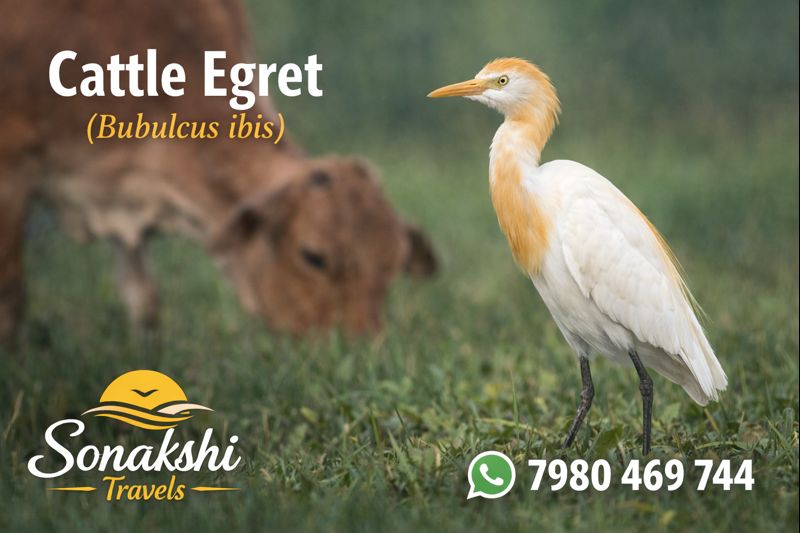
The Cattle Egret (Bubulcus ibis) is one of the most recognizable and widely distributed members of the heron family, renowned for its close association with grazing livestock and human-modified landscapes. Unlike many other egrets that remain closely tied to wetlands, the Cattle Egret demonstrates exceptional ecological flexibility, enabling it to thrive in agricultural fields, grasslands, wetlands, and coastal regions alike. Its adaptive foraging behavior, rapid global expansion, and significant ecological role make it an important subject of ornithological and environmental study.
Taxonomy & Classification
The Cattle Egret belongs to the order Pelecaniformes and the family Ardeidae, which includes herons, egrets, and bitterns. The genus Bubulcus is distinct from other egret genera due to its terrestrial feeding habits and close association with large mammals. Traditionally considered monotypic, the species is sometimes divided into two subspecies based on geographic distribution: Bubulcus ibis ibis across Europe, Africa, and Asia, and Bubulcus ibis coromandus in parts of South and Southeast Asia. Molecular studies confirm its close evolutionary relationship with other ardeids while highlighting its unique ecological niche.
Morphology & Field Identification
The Cattle Egret is a medium-sized, compact egret characterized by a stocky build, relatively short neck, and straight, pointed bill. In non-breeding plumage, the bird appears predominantly white, with subtle buff or cream tones occasionally visible under certain lighting conditions. During the breeding season, striking orange-buff plumes develop on the crown, chest, and back, serving as visual signals during courtship. The legs are typically dark gray to black, while the bill transitions from yellowish to reddish hues in breeding individuals.
Male Features
Male Cattle Egrets are marginally larger than females and display more pronounced ornamental plumes during the breeding season. The buff-colored feathers on the head and breast are often brighter and more extensive, enhancing visual dominance during mating displays. Males also exhibit heightened territorial behavior around nesting sites and are more actively involved in courtship rituals, including bill-pointing, plume-raising, and vocalizations.
Female Features
Females closely resemble males in overall appearance, making field differentiation challenging outside the breeding season. However, females generally possess slightly duller breeding plumes and a more subdued bill coloration. During nesting, females demonstrate strong nest defense behavior and play a critical role in egg incubation and chick provisioning.
Size & Wingspan
Adult Cattle Egrets typically measure between 46 and 56 centimeters in length. Their wingspan ranges from 88 to 96 centimeters, allowing efficient low-altitude flight over open landscapes. Despite their relatively compact size compared to other egrets, their wings are broad and well-adapted for sustained gliding and short bursts of agile flight.
Flight Characteristics
In flight, the Cattle Egret exhibits steady wingbeats interspersed with brief glides. The neck is retracted in an S-shaped curve, a characteristic feature of herons and egrets. Flocks often travel in loose formations, especially during daily movements between feeding grounds and communal roosts. Their flight is direct and purposeful, reflecting their reliance on predictable feeding habitats.
Habitat & Distribution
Global Range
Originally native to Africa, southern Europe, and parts of Asia, the Cattle Egret has undergone one of the most remarkable natural range expansions of any bird species. It now occupies every continent except Antarctica, having colonized the Americas, Australia, and numerous oceanic islands within the last two centuries. This expansion has been facilitated by its adaptability to human-altered environments and its ability to exploit new food sources.
Preferred Habitat
The species favors open habitats such as grasslands, agricultural fields, floodplains, wetlands, and coastal zones. Unlike many other egrets, it frequently forages far from water, often in dry pastures and croplands. Proximity to grazing animals or agricultural machinery significantly enhances its feeding efficiency, making these environments particularly attractive.
Diet & Feeding Ecology
The Cattle Egret is primarily insectivorous, feeding on grasshoppers, crickets, beetles, flies, and other terrestrial invertebrates. Its diet may also include spiders, small reptiles, amphibians, and occasionally fish. By consuming large quantities of agricultural pests, the species provides valuable ecosystem services in farming landscapes.
Foraging Technique
A defining behavioral trait of the Cattle Egret is its association with large mammals such as cattle, buffalo, and deer. As these animals move through grasslands, they flush insects and small vertebrates, which the egret quickly captures. The bird also follows tractors and ploughs, exploiting disturbed soil to access prey. This opportunistic foraging strategy significantly increases feeding success.
Exploring bird-rich mangrove landscapes can be a rewarding experience. Discover carefully planned itineraries with our Sundarban Tour options and immerse yourself in the region’s unique avifauna.
Breeding & Reproduction
Breeding seasons vary across regions but are typically aligned with periods of high food availability. Cattle Egrets are colonial nesters, often sharing breeding sites with other herons and egrets. Courtship displays include plume erection, bill snapping, and mutual preening, strengthening pair bonds.
Nesting Sites
Nests are constructed from sticks and vegetation and placed in trees, shrubs, or reed beds near wetlands or flooded areas. Colonies may contain hundreds of nests, creating dense breeding aggregations. Both parents participate in nest construction, incubation, and chick rearing.
Unique Adaptations & Behavioral Ecology
Speed & Agility
Although not among the fastest flying birds, the Cattle Egret displays remarkable agility on the ground. Quick reflexes and precise movements allow it to capture agile insects flushed by grazing animals. This terrestrial agility distinguishes it from many other wading birds.
Camouflage and Nesting Strategy
The predominantly white plumage reflects sunlight, reducing heat absorption in open habitats. Nest placement in dense vegetation offers protection from predators and environmental stressors, while colonial nesting provides additional safety through collective vigilance.
Social Behavior
Cattle Egrets are highly social, often forming large feeding flocks and communal roosts. Social interactions facilitate information sharing about food sources and enhance predator detection. Their tolerance of conspecifics contributes to their success in densely populated habitats.
Occurrence & Seasonal Movement
In many regions, the species is largely resident, while populations in temperate zones may exhibit seasonal movements linked to climatic conditions and food availability. Post-breeding dispersal often leads to temporary range expansions, especially among juvenile birds.
Preferred Habitat in the Sundarbans Region
Within the Sundarbans, the Cattle Egret is commonly observed along riverbanks, mudflats, agricultural fringes, and grazing areas near human settlements. The mosaic of mangroves, open grasslands, and livestock-rich zones provides ideal foraging opportunities, supporting stable local populations.
For nature enthusiasts seeking close encounters with wetland birds, explore curated Sundarban Tour experiences designed around seasonal wildlife activity.
Ecological Role
The Cattle Egret plays a vital role in regulating insect populations, particularly agricultural pests. Its presence contributes to balanced ecosystems and reduced reliance on chemical pest control. In wetland systems, it forms part of complex food webs involving insects, reptiles, birds of prey, and mammals.
Habitat Alteration
While habitat modification has negatively affected many bird species, the Cattle Egret has benefited from certain forms of land-use change, particularly the expansion of agriculture and livestock farming. However, excessive pesticide use, wetland drainage, and loss of nesting trees can pose localized threats.
Conservation Efforts
Currently classified as a species of Least Concern, the Cattle Egret enjoys stable global populations. Conservation efforts focus on protecting wetland habitats, promoting sustainable agriculture, and monitoring population trends to ensure long-term ecological balance.
Did You Know?
The Cattle Egret is one of the few bird species that expanded its range globally without direct human introduction.
It was first recorded in the Americas in the late 19th century and spread rapidly across the continent.
Its association with livestock significantly increases its feeding efficiency.