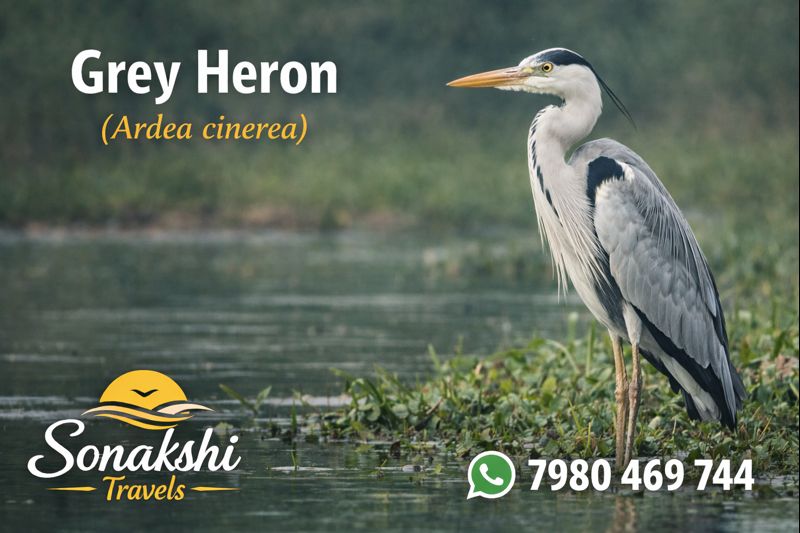
The Grey Heron (Ardea cinerea) stands as one of the most iconic and ecologically significant wading birds across the Old World. Distinguished by its tall stature, ash-grey plumage, and deliberate hunting posture, this species represents a high level of evolutionary specialization within wetland ecosystems. From remote marshlands and floodplains to tidal mangroves and human-altered landscapes, the Grey Heron has demonstrated exceptional adaptability. Its presence is widely regarded as a reliable indicator of aquatic ecosystem health, making it a key species for ecological assessment and conservation planning.
Taxonomy & Classification
The Grey Heron belongs to the order Pelecaniformes and the family Ardeidae, a diverse group that includes herons, egrets, and bitterns. Within this family, the genus Ardea comprises the larger herons characterized by elongated legs, long necks, and robust spear-like bills. The species Ardea cinerea is closely related to other large herons such as the Purple Heron (Ardea purpurea) and Goliath Heron (Ardea goliath). Two subspecies are generally recognized: Ardea cinerea cinerea, widespread across Europe, Africa, and western Asia, and Ardea cinerea jouyi, occurring mainly in eastern Asia. Genetic evidence suggests strong evolutionary stability across its extensive range.
Morphology & Field Identification
The Grey Heron is a large, slender bird with an unmistakable silhouette. Adults display predominantly ash-grey upperparts, contrasting with a white head and neck adorned by bold black superciliary stripes that extend into elongated occipital plumes. The neck bears fine black streaking, while the underparts are pale grey to whitish. The long, straight, yellowish bill is sharply pointed and perfectly adapted for capturing slippery aquatic prey. Its upright stance, slow measured movements, and preference for shallow waters make field identification straightforward even at considerable distances.
Male Features
Male Grey Herons are slightly larger and heavier than females, although sexual dimorphism is subtle. During the breeding season, males develop longer and more prominent occipital plumes, along with enhanced contrast in head markings. These features are actively displayed during courtship rituals and territorial interactions. Males typically initiate nest-site defense and play a leading role in early pair formation.
Female Features
Females closely resemble males in general appearance but tend to have marginally shorter plumes and a slightly finer bill. Their breeding plumage is usually less pronounced. Females invest significant energy in egg production and incubation and exhibit strong nest fidelity throughout the breeding period.
Size & Wingspan
The Grey Heron is among the largest herons, with adults measuring approximately 90 to 100 centimeters in body length. The wingspan ranges from 175 to 195 centimeters, allowing efficient long-distance flight. Adult body weight typically varies between 1.0 and 2.0 kilograms, influenced by season, sex, and food availability.
Flight Characteristics
In flight, the Grey Heron exhibits slow, deep wingbeats interspersed with gliding. The neck is retracted into a characteristic S-shaped curve, while the long legs trail straight behind the body. This flight profile is a defining identification feature and enables the bird to conserve energy during extended movements between feeding and roosting areas.
Habitat & Distribution
Global Range
The Grey Heron has a vast distribution across Europe, Africa, and Asia, occupying temperate, subtropical, and tropical zones. Northern populations are largely migratory, moving southward during winter, while populations in warmer regions remain resident throughout the year. This extensive range reflects the species’ adaptability to diverse climatic and ecological conditions.
Preferred Habitat
This species is strongly associated with wetlands, including rivers, lakes, marshes, floodplains, estuaries, mangroves, and coastal lagoons. It also frequents fish ponds, reservoirs, and irrigated agricultural fields. Shallow waters rich in prey and minimal disturbance are particularly favored, while tall trees near water bodies provide secure roosting and nesting sites.
Diet & Feeding Ecology
The Grey Heron is a generalist carnivore with a diet dominated by fish. It also consumes amphibians, reptiles, small mammals, large aquatic insects, and crustaceans. Dietary composition varies seasonally and regionally, reflecting local prey availability. This flexibility allows the species to persist in fluctuating and human-influenced environments.
Foraging Technique
Foraging behavior is typically solitary and highly methodical. The heron stands motionless or advances slowly through shallow water, relying on acute vision to detect prey. Once a target is located, it delivers a rapid and precise strike with its bill. This ambush-based hunting strategy minimizes energy expenditure while maintaining high success rates.
Wetland birdwatching reaches its finest expression in mangrove ecosystems. Explore carefully curated Sundarban Tour itineraries designed around prime avian habitats.
Breeding & Reproduction
Breeding seasons vary geographically but are generally aligned with periods of optimal food availability. Grey Herons are colonial nesters, forming long-established heronries that may persist for decades. Courtship involves ritualized movements, bill-clattering, and plume displays that reinforce pair bonds and synchronize breeding behavior.
Nesting Sites
Nests are constructed from sticks and twigs and placed high in trees, reed beds, or mangrove stands near water bodies. Both parents participate in nest building, incubation, and chick rearing. Typical clutches consist of three to five pale blue eggs, with asynchronous hatching common.
Unique Adaptations & Behavioral Ecology
Speed & Agility
Despite its large size, the Grey Heron demonstrates remarkable speed during prey capture. Specialized cervical vertebrae and musculature enable rapid extension of the neck, allowing lightning-fast strikes that are crucial for catching agile fish and amphibians.
Camouflage and Nesting Strategy
The muted grey plumage provides effective camouflage against water surfaces, reeds, and overcast skies. Elevated nesting sites protect eggs and chicks from flooding and terrestrial predators, while colonial nesting enhances collective vigilance and predator deterrence.
Social Behavior
Outside the breeding season, Grey Herons are largely solitary feeders, though they may congregate at particularly productive feeding sites. During breeding, social interactions intensify within colonies, involving vocal communication, visual displays, and hierarchical spacing.
Occurrence & Seasonal Movement
Northern populations undertake seasonal migrations to avoid severe winters, while southern populations remain resident. Juvenile dispersal following fledging can be extensive, contributing to gene flow and population stability across the species’ range.
Preferred Habitat in the Sundarbans Region
Within the Sundarbans, the Grey Heron is commonly encountered along tidal creeks, mudflats, freshwater ponds, and mangrove-lined channels. The region’s dynamic tidal regime supports abundant fish populations, providing ideal feeding conditions. Tall mangrove trees offer secure nesting and roosting opportunities above tidal influence.
Experience the biological richness of tidal forests through guided Sundarban Tour programs focused on wetland birds and mangrove ecology.
Ecological Role
As a top predator within wetland ecosystems, the Grey Heron plays a crucial role in regulating fish and amphibian populations. Its presence reflects ecological balance and contributes to the stability of aquatic food webs. The species also serves as prey for large raptors, integrating it into higher trophic levels.
Habitat Alteration
Wetland drainage, pollution, and loss of nesting trees pose localized threats to Grey Heron populations. Nevertheless, the species has shown resilience by utilizing artificial wetlands, reservoirs, and managed fish ponds. Long-term sustainability depends on responsible wetland management and habitat protection.
Conservation Efforts
The Grey Heron is currently classified as a species of Least Concern. Conservation measures focus on protecting wetlands, regulating water quality, and safeguarding long-established breeding colonies. Continued monitoring remains essential to detect emerging threats and population changes.
Did You Know?
The Grey Heron can remain motionless for extended periods while hunting.
Some heronries have been used continuously for over a hundred years.
Its neck contains specialized vertebrae that function like a spring during strikes.