A Comprehensive Study of Biology, Behavior and Wetland Ecology
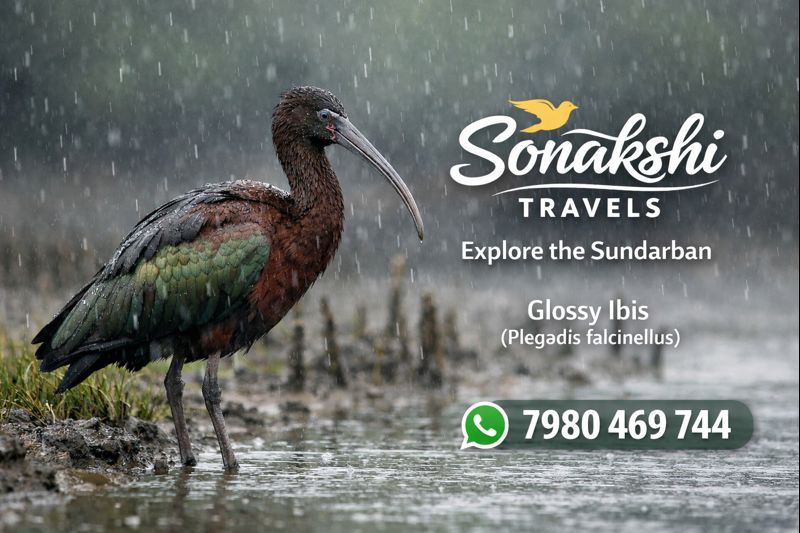
The Glossy Ibis (Plegadis falcinellus) is a distinctive wetland bird admired for its elegant curved bill, iridescent plumage, and wide-ranging migratory behavior. As one of the most cosmopolitan ibis species, it inhabits wetlands across multiple continents, demonstrating exceptional ecological adaptability. Its presence is closely linked with healthy marshes, floodplains, and mangrove-associated wetlands, making it an important indicator of ecosystem integrity. In India, and particularly within the dynamic landscape of the Sundarbans, the Glossy Ibis forms an integral part of seasonal waterbird assemblages.
Taxonomy & Classification
The Glossy Ibis belongs to the family Threskiornithidae, which includes ibises and spoonbills. The genus Plegadis comprises medium-sized ibises characterized by slender bodies and decurved bills adapted for probing soft substrates.
Kingdom: Animalia
Phylum: Chordata
Class: Aves
Order: Pelecaniformes
Family: Threskiornithidae
Genus: Plegadis
Species: Plegadis falcinellus
Although closely related to species such as the White-faced Ibis, the Glossy Ibis is taxonomically distinct and widely recognized for its broader global distribution.
Morphology & Field Identification
The Glossy Ibis is a medium-sized wader with a slender profile, long legs, and a noticeably downcurved bill. Its overall appearance is dark, but under favorable light conditions the plumage exhibits striking metallic hues.
Male Features
Adult males display rich chestnut-brown body plumage with iridescent green and purplish gloss on the wings and back. During the breeding season, the sheen becomes particularly vivid. The bill is dark grey to black, elongated, and finely tapered, enabling precise probing in wet substrates.
Female Features
Females closely resemble males in plumage and coloration. Sexual dimorphism is minimal, with females being marginally smaller on average. Both sexes participate actively in breeding and chick-rearing duties.
Size & Wingspan
Adults typically measure between 55 and 65 centimeters in length. The wingspan ranges from 90 to 105 centimeters. Body weight generally varies from 500 to 800 grams, influenced by season and food availability.
Flight Characteristics
In flight, the Glossy Ibis appears graceful and buoyant, with steady wingbeats and occasional gliding. Flocks often fly in loose formations, sometimes forming lines or shallow V-shapes during longer movements between wetlands.
Habitat & Distribution
Global Range
The Glossy Ibis has an extensive global range, occurring across southern Europe, Africa, Asia, Australia, and parts of the Americas. This wide distribution reflects its strong dispersal ability and tolerance of varied climatic conditions.
Preferred Habitat
Preferred habitats include freshwater marshes, floodplains, rice fields, lagoons, estuaries, and mangrove-associated wetlands. The species favors shallow waters with soft mud or silt, which support abundant invertebrate prey.
Diet & Feeding Ecology
The Glossy Ibis is primarily carnivorous, feeding on a wide range of invertebrates such as insects, worms, crustaceans, mollusks, and small aquatic organisms. It also consumes amphibians and occasionally small fish.
Foraging Technique
Foraging involves rhythmic probing of the bill into soft mud or shallow water. The sensitive bill tip allows detection of prey by touch rather than sight. Birds often forage in groups, advancing slowly across wetlands while probing continuously.
Breeding & Reproduction
Breeding typically coincides with seasonal flooding or monsoon periods that enhance food availability. The species is colonial, often nesting alongside herons, egrets, and other ibises.
Nesting Sites
Nests are constructed in dense vegetation, reeds, shrubs, or low trees, frequently over water. The nest is a platform of sticks and plant material. Females usually lay three to four eggs, which are incubated by both parents. Chicks fledge within several weeks but remain dependent for a short period afterward.
Unique Adaptations & Behavioral Ecology
Speed & Agility
While not exceptionally fast on land, the Glossy Ibis exhibits agile movements during flight and coordinated group foraging. Its long legs enable efficient wading through shallow waters without disturbing prey excessively.
Camouflage and Nesting Strategy
The dark, glossy plumage provides effective camouflage against muddy wetlands and shadowed vegetation. Colonial nesting offers additional protection through collective vigilance against predators.
Social Behavior
This species is highly social, especially during feeding and breeding. Large flocks may form outside the breeding season, enhancing foraging efficiency and predator detection.
Occurrence & Seasonal Movement
The Glossy Ibis exhibits partial migratory behavior. Populations in temperate regions migrate seasonally, while tropical populations are often resident or locally nomadic. In India, the species is commonly observed during winter months, with numbers increasing after the monsoon.
Preferred Habitat in the Sundarbans Region
Within the Sundarbans, the Glossy Ibis frequents tidal wetlands, mudflats, freshwater ponds near forest edges, and seasonally flooded areas. The mosaic of saline and freshwater habitats provides abundant feeding opportunities, particularly during low tide and post-monsoon periods.
Looking to explore rich wetland birdlife in a mangrove landscape? Join a professionally guided Sundarban Tour and experience seasonal waterbirds in their natural habitat.
Ecological Role
As a forager of invertebrates and small aquatic fauna, the Glossy Ibis plays a vital role in regulating wetland food webs. Its feeding activity also contributes to nutrient cycling and sediment turnover within marsh ecosystems.
Habitat Alteration
Wetland drainage, pollution, altered hydrology, and agricultural expansion pose significant threats in parts of its range. Although adaptable, the species depends on intact wetlands for breeding and large-scale foraging.
Conservation Efforts
Globally classified as Least Concern, the Glossy Ibis benefits from wetland conservation initiatives, protected areas, and international agreements safeguarding migratory birds. Continued monitoring of wetlands remains essential for long-term population stability.
Discover the seasonal movements of migratory birds with a responsible Sundarban Tour designed for nature lovers and birdwatchers.
Did You Know?
The iridescent sheen of the Glossy Ibis becomes most visible under direct sunlight.
Young birds lack gloss and appear dull brown, gaining adult plumage after their first year.
The species can travel long distances between wetlands in search of suitable feeding conditions.
External Reference
Wikipedia reference: https://en.wikipedia.org/wiki/Glossy_ibis