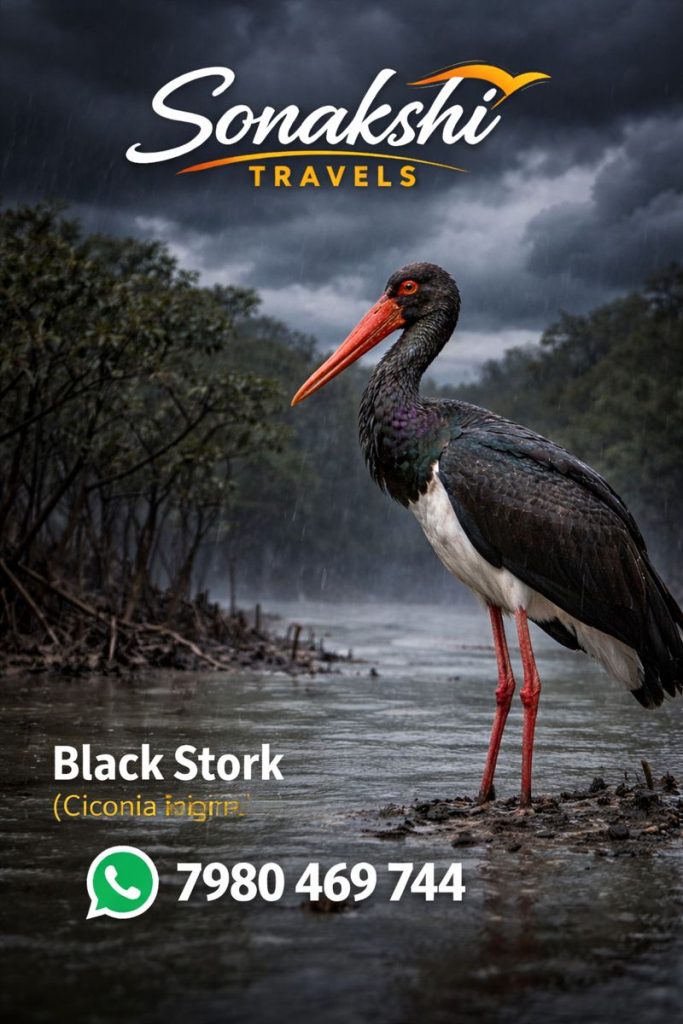
The Black Stork (Ciconia nigra) is among the most elusive and ecologically sensitive members of the stork family. Unlike its more conspicuous relatives that thrive near human settlements, this species is characteristically shy, preferring secluded forests, undisturbed wetlands, and remote riverine landscapes. Its glossy dark plumage, striking red bill and legs, and silent, solitary behavior have made it an emblem of intact freshwater ecosystems across Eurasia. In South Asia, including parts of eastern India, the Black Stork is primarily a winter visitor, where its presence reflects the availability of undisturbed aquatic habitats.
Taxonomy & Classification
Systematic Position
The Black Stork belongs to the family Ciconiidae, which includes all true storks. It is closely related to the White Stork (Ciconia ciconia), yet differs markedly in behavior, habitat preference, and coloration.
Kingdom: Animalia
Phylum: Chordata
Class: Aves
Order: Ciconiiformes
Family: Ciconiidae
Genus: Ciconia
Species: Ciconia nigra
The genus Ciconia includes several large-bodied storks, but the Black Stork is unique in its preference for forested wetlands and minimal tolerance of human disturbance.
Morphology & Field Identification
General Appearance
The Black Stork is a large wading bird with a sleek, elegant build. Its upperparts appear black from a distance but reveal iridescent green, purple, and bronze hues under sunlight. The underparts are white, creating a strong contrast that is especially noticeable during flight.
Male Features
Adult males tend to be slightly larger and more robust than females. They possess a thicker bill and more intense iridescence on the mantle and wing coverts. During the breeding season, the red coloration of the bill and legs becomes particularly vivid.
Female Features
Females closely resemble males but are marginally smaller with a slightly finer bill. The gloss on the plumage may appear less intense, especially outside the breeding season.
Size & Wingspan
An adult Black Stork measures approximately 95 to 100 cm in length. The wingspan ranges from 145 to 155 cm, allowing sustained soaring flight. Body weight typically varies between 2.5 and 3 kilograms.
Flight Characteristics
In flight, the Black Stork exhibits broad wings and a steady, graceful wingbeat. Like other storks, it flies with its neck extended and legs trailing behind. Soaring on thermals is common during migration, with individuals covering vast distances with minimal energy expenditure.
Habitat & Distribution
Global Range
The Black Stork has a wide but fragmented distribution across Europe, Central Asia, East Asia, and parts of the Indian subcontinent. Breeding populations are found in temperate regions of Europe and Asia, while wintering grounds extend southward into Africa and South Asia.
Preferred Habitat
This species favors undisturbed freshwater habitats such as forested rivers, streams, wetlands, and marshes. Proximity to mature woodland is essential, particularly for nesting, as it provides seclusion and suitable nesting substrates.
Diet & Feeding Ecology
Diet Composition
The Black Stork is a carnivorous feeder, consuming a diverse range of aquatic prey. Its diet includes fish, amphibians, crustaceans, aquatic insects, and occasionally small reptiles. The species is highly selective, often abandoning feeding sites that are disturbed or depleted.
Foraging Technique
Foraging typically occurs in shallow water along riverbanks and wetlands. The bird uses a slow, deliberate stalking method, capturing prey with a rapid bill strike. Unlike some other storks, tactile feeding is less common; visual cues play a dominant role.
Breeding & Reproduction
Breeding Season
Breeding usually takes place between March and June in temperate regions. The timing is closely linked to water availability and prey abundance, ensuring sufficient food for chick rearing.
Nesting Sites
Nests are constructed high in tall trees, often in remote forests near water bodies. Occasionally, cliffs and rocky ledges are also used. The nest is a large platform of sticks, reused and expanded over successive years.
Unique Adaptations & Behavioral Ecology
Speed & Agility
Although not exceptionally fast in short bursts, the Black Stork demonstrates remarkable endurance in flight. Its large wings enable efficient gliding and soaring, particularly during long migratory journeys.
Camouflage and Nesting Strategy
The dark, iridescent plumage provides effective camouflage in shaded forest environments. Nest placement in secluded areas minimizes disturbance and reduces predation risk.
Social Behavior
Unlike many stork species, the Black Stork is largely solitary or found in pairs. Outside the breeding season, small groups may form at rich feeding sites, but large aggregations are rare.
Occurrence & Seasonal Movement
The Black Stork is a long-distance migrant. Populations breeding in Europe and Central Asia migrate southward to Africa and South Asia during winter. In India, sightings are largely confined to the winter months, when individuals occupy suitable wetlands.
Preferred Habitat in the Sundarbans Region
In the Sundarbans, the Black Stork is an uncommon but noteworthy winter visitor. It favors quiet freshwater creeks, inland wetlands, and forest-fringed water bodies away from heavy human activity. Its presence highlights the ecological value of undisturbed wetland pockets within the broader mangrove landscape.
Planning a guided mangrove exploration? Discover immersive Sundarban Tour itineraries designed for nature enthusiasts.
Ecological Role
The Black Stork functions as an apex wetland predator, helping regulate populations of fish and amphibians. Its sensitivity to disturbance makes it an effective indicator species for assessing the health of freshwater ecosystems.
Habitat Alteration
Deforestation, river regulation, wetland drainage, and human disturbance pose significant threats to Black Stork habitats. Loss of mature nesting trees and degradation of feeding sites directly impact breeding success and survival.
Conservation Efforts
Conservation of the Black Stork depends on the protection of forested wetlands and riverine systems. Legal protection, habitat preservation, and minimizing disturbance during the breeding season are essential measures for sustaining populations.
Did You Know?
The Black Stork avoids nesting near human settlements, making it far rarer to observe than the White Stork.
Its iridescent feathers can appear green, purple, or bronze depending on light conditions.
The species often returns to the same nesting site year after year if undisturbed.
Looking to experience pristine mangrove biodiversity? Choose a curated Sundarban Tour and explore hidden wetland habitats.
External Reference
Additional scientific and general information about this species can be accessed through Wikipedia: Black Stork (Ciconia nigra).