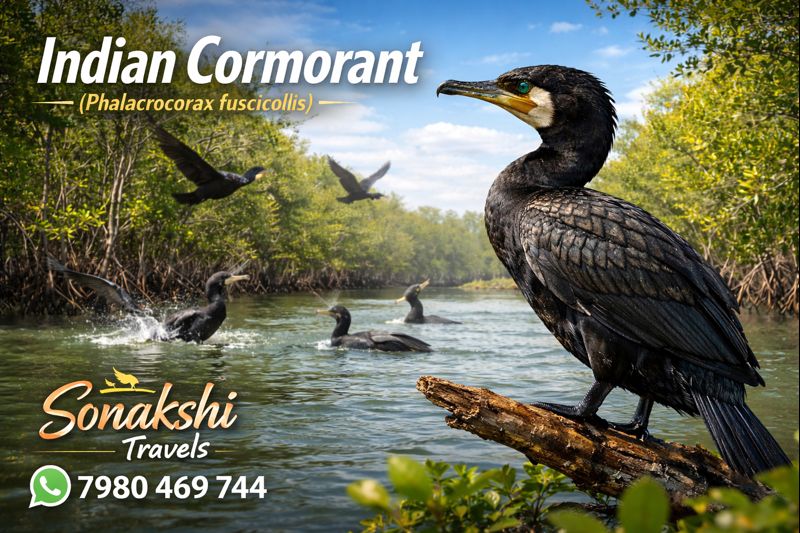
The Indian Cormorant (Phalacrocorax fuscicollis), also known as the Indian Shag, is a prominent piscivorous waterbird of the family Phalacrocoracidae. Widespread across the Indian subcontinent and adjoining regions of South Asia, this species is a characteristic inhabitant of rivers, wetlands, estuaries, reservoirs, and coastal lagoons. Distinguished by its slender build, glossy dark plumage, and exceptional underwater foraging abilities, the Indian Cormorant occupies a vital ecological niche within freshwater and brackish ecosystems. Its frequent association with large water bodies and mangrove-lined channels makes it a familiar avian presence in biologically rich regions such as the Sundarbans.
Taxonomy & Classification
The Indian Cormorant belongs to the order Suliformes and the family Phalacrocoracidae, a group comprising medium to large waterbirds specialized in fish-eating. The genus Phalacrocorax encompasses numerous species distributed across the globe, many of which exhibit remarkable similarities in morphology and behavior. Phalacrocorax fuscicollis was formally described in the early nineteenth century and is taxonomically distinct from the Great Cormorant due to its smaller size, slimmer neck, and proportionately narrower bill.
Morphology & Field Identification
In the field, the Indian Cormorant is identified by its elongated neck, streamlined body, and dark, glossy plumage. The bird often adopts an upright posture while perched, with the neck held vertically and wings partially drooped. During flight, it appears slender and agile, with rapid wingbeats and a direct flight path. Its bill is long, slightly hooked at the tip, and well adapted for grasping slippery prey.
Male Features
Male Indian Cormorants are marginally larger than females and exhibit a more robust head and bill. During the breeding season, males develop subtle ornamental features, including faint white filoplumes on the head and neck. These seasonal traits play a role in courtship displays and pair bonding.
Female Features
Females closely resemble males in coloration and structure, making sexual dimorphism minimal. However, females generally possess a slightly slimmer bill and body profile. Behavioral cues during nesting and chick-rearing periods often provide clearer differentiation between sexes than physical traits alone.
Size & Wingspan
The Indian Cormorant measures approximately 65–75 centimeters in length, with a wingspan ranging between 95 and 110 centimeters. Its body mass typically varies from 1.2 to 1.5 kilograms, depending on age, sex, and seasonal food availability.
Flight Characteristics
In flight, the Indian Cormorant displays strong, rhythmic wingbeats interspersed with short glides. It often flies low over water surfaces, especially when commuting between feeding grounds and roosting sites. Flocks may form linear or loosely organized formations during longer flights.
Habitat & Distribution
Global Range
The species is widely distributed across South Asia, including India, Sri Lanka, Bangladesh, Pakistan, and parts of Southeast Asia. Its range extends from inland freshwater bodies to coastal and estuarine environments, demonstrating remarkable ecological adaptability.
Preferred Habitat
Indian Cormorants favor large, open water bodies with abundant fish populations. Typical habitats include rivers, lakes, reservoirs, marshes, irrigation canals, estuaries, and mangrove creeks. Availability of suitable roosting trees or rocky outcrops is a key factor influencing habitat selection.
For travelers interested in observing wetland birds within pristine mangrove channels, a professionally guided Sundarban Tour offers excellent opportunities for close ecological interpretation.
Diet & Feeding Ecology
The Indian Cormorant is a specialized piscivore, feeding predominantly on small to medium-sized fish. Its diet may also include crustaceans, amphibians, and aquatic invertebrates when fish availability is low. Feeding often occurs in shallow waters where prey density is high.
Foraging Technique
Cormorants are exceptional underwater hunters. They dive from the water surface, propelling themselves with powerful webbed feet while steering with partially spread wings. Unlike many seabirds, their feathers are less waterproof, reducing buoyancy and allowing efficient submersion. Prey is captured underwater and brought to the surface before being swallowed headfirst.
Breeding & Reproduction
Breeding seasons vary geographically but often coincide with monsoon or post-monsoon periods when fish abundance peaks. Indian Cormorants are colonial nesters, forming breeding colonies in trees near water bodies or on isolated islands safe from terrestrial predators.
Nesting Sites
Nests are constructed from twigs and vegetation, placed on tree branches, mangroves, or occasionally rocky ledges. Both parents participate in nest building, incubation, and chick rearing. Clutches usually consist of three to five pale bluish eggs.
Unique Adaptations & Behavioral Ecology
Speed & Agility
Underwater agility is a defining adaptation of the Indian Cormorant. Its streamlined body, strong legs, and flexible neck enable rapid pursuit of fish in complex aquatic environments.
Camouflage and Nesting Strategy
The dark plumage provides effective camouflage against shaded water surfaces and mangrove backdrops. Nesting in colonies further reduces predation risk through collective vigilance.
Social Behavior
Indian Cormorants are highly social, often seen roosting, feeding, and breeding in groups. Communal roosting facilitates information sharing regarding productive feeding sites and enhances protection against predators.
Occurrence & Seasonal Movement
While largely resident across much of its range, local movements occur in response to water availability and prey abundance. Seasonal dispersal is common during dry periods when inland water bodies shrink.
Preferred Habitat in the Sundarbans Region
Within the Sundarbans, Indian Cormorants are frequently observed along tidal creeks, estuarine channels, and large rivers bordered by dense mangrove forests. The region’s rich fish diversity and extensive water network provide ideal foraging and nesting conditions.
Ecological Role
As apex fish predators, Indian Cormorants help regulate fish populations and maintain ecological balance within aquatic systems. Their guano contributes nutrients to nesting areas, indirectly supporting plant growth and invertebrate communities.
Habitat Alteration
Habitat degradation due to pollution, overfishing, dam construction, and wetland reclamation poses significant challenges. Changes in water quality and prey availability directly affect breeding success and population stability.
Conservation Efforts
The Indian Cormorant is currently listed as a species of Least Concern, yet local declines have been noted in heavily disturbed wetlands. Conservation measures focusing on wetland protection, sustainable fisheries management, and pollution control are essential for long-term population security.
Did You Know?
The Indian Cormorant can remain submerged for over 30 seconds while hunting fish.
Its partially wettable feathers are a key adaptation for efficient diving.
Large communal roosts may include hundreds of individuals sharing the same trees.
Nature enthusiasts and birdwatchers often combine wildlife observation with cultural exploration through a curated Sundarban Tour, which highlights the ecological richness of India’s largest mangrove ecosystem.