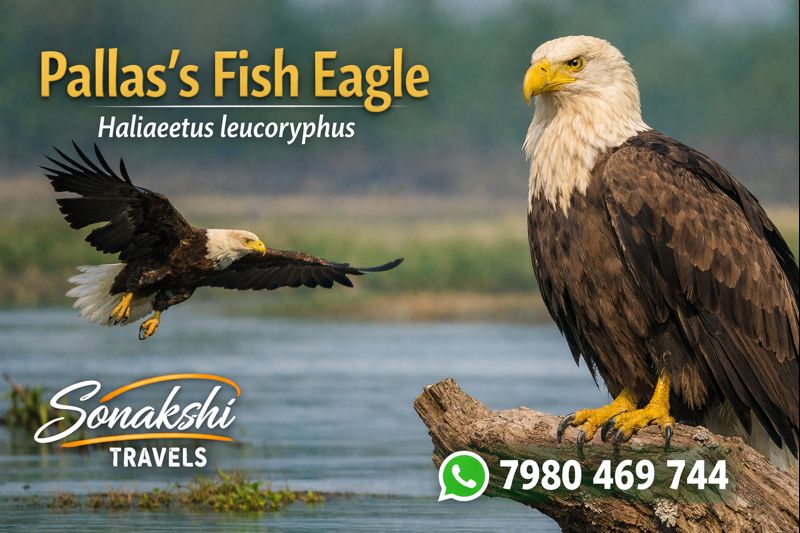
Pallas’s Fish Eagle (Haliaeetus leucoryphus) is one of the most enigmatic and least-studied large raptors of Asia. Named in honor of the German naturalist Peter Simon Pallas, this eagle represents a highly specialized lineage within the sea-eagle group. Although historically widespread across large river systems of the Indian subcontinent and Central Asia, the species has suffered dramatic population declines, making it one of the most threatened eagles in the world today. Its biology, behavior, and ecological role provide critical insights into the health of freshwater ecosystems.
Taxonomy & Classification
Pallas’s Fish Eagle belongs to the family Accipitridae, which includes hawks, kites, harriers, and eagles. Within this family, it is classified under the genus Haliaeetus, a group commonly referred to as sea eagles. Despite the name, many species in this genus, including Pallas’s Fish Eagle, are more strongly associated with inland freshwater habitats than coastal environments.
The species is monotypic, meaning no subspecies are currently recognized. Molecular and morphological studies indicate that it is closely related to other fish-eating eagles, yet it retains distinct structural and behavioral characteristics that justify its unique taxonomic position.
Morphology & Field Identification
Pallas’s Fish Eagle is a massive, broad-winged raptor with a heavy bill and powerful talons. In the field, it is often identified by its dark brown body, contrasting pale head and neck, and large yellow bill. The species exhibits a robust build, reflecting its specialization for capturing large, slippery prey such as fish.
Male Features
Adult males are slightly smaller than females but otherwise similar in plumage. They possess a pale buff to whitish head, neck, and upper breast, which contrasts sharply with the dark chocolate-brown wings and back. The bill is massive and strongly hooked, colored yellow to horn-yellow, and the eyes are pale, giving the bird a stern, penetrating expression.
Female Features
Females are noticeably larger and heavier, an adaptation that allows them to dominate nesting territories and handle larger prey items. Plumage differences between the sexes are minimal, though females often appear bulkier with broader wings and a deeper chest.
Size & Wingspan
This species ranks among the largest eagles in Asia. Adults typically measure between 75 and 85 cm in body length, with a wingspan ranging from 180 to over 210 cm. The sheer breadth of the wings enables efficient soaring over vast riverine landscapes.
Flight Characteristics
In flight, Pallas’s Fish Eagle appears heavy yet majestic. The wings are held flat or slightly raised while soaring, and the bird relies extensively on thermal currents. Wingbeats are slow and powerful, interspersed with long glides. When hunting, it may circle patiently above water bodies before making a decisive descent.
Habitat & Distribution
Global Range
Historically, Pallas’s Fish Eagle ranged across a broad swath of Eurasia, from eastern Europe through Central Asia, the Indian subcontinent, and parts of East Asia. Today, its distribution is highly fragmented, with small, isolated populations surviving in select regions.
Preferred Habitat
The species is strongly associated with large freshwater systems, including major rivers, oxbow lakes, reservoirs, and extensive wetlands. It requires mature trees near water for nesting and perching, making it particularly vulnerable to riparian deforestation.
Diet & Feeding Ecology
As its name suggests, Pallas’s Fish Eagle is predominantly piscivorous. Fish constitute the bulk of its diet, although it may occasionally take water birds, reptiles, or carrion when fish availability is low. Its feeding ecology places it at the apex of freshwater food webs.
Foraging Technique
The eagle typically hunts from a high perch or while soaring. Upon spotting prey near the water surface, it descends rapidly, extending its talons forward to snatch the fish. Unlike some other eagles, it rarely plunges fully into the water, relying instead on surface captures.
Breeding & Reproduction
Breeding behavior is closely tied to river systems and seasonal water levels. Pairs are generally monogamous and may occupy the same territory for several years if conditions remain favorable.
Nesting Sites
Nests are massive structures built high in large trees, often close to water. They are composed of heavy branches and lined with softer materials. The same nest may be reused and expanded over successive breeding seasons, eventually reaching enormous dimensions.
Unique Adaptations & Behavioral Ecology
Speed & Agility
Despite its size, Pallas’s Fish Eagle demonstrates remarkable agility when hunting. Precise wing control allows it to adjust rapidly during prey capture, even in windy conditions over open water.
Camouflage and Nesting Strategy
The subdued coloration of the eagle blends well with riverine forests and muddy banks, offering a degree of camouflage while perched. Nest placement high in trees reduces disturbance and predation risk.
Social Behavior
This species is largely solitary outside the breeding season. However, individuals may congregate near abundant food sources, such as large reservoirs, particularly during winter months.
Occurrence & Seasonal Movement
Pallas’s Fish Eagle exhibits partial migratory behavior. Northern populations tend to move southward during winter, while southern populations may remain resident year-round. Seasonal movements are influenced by water availability and prey abundance.
Preferred Habitat in the Sundarbans Region
Within the Sundarbans landscape, suitable habitats include large tidal rivers, wide creeks, and adjacent freshwater zones. Although primarily a freshwater species, occasional records from the Sundarbans suggest that individuals utilize the region as a wintering or passage area, benefiting from its rich fish resources and extensive forest cover.
Those interested in observing riverine wildlife and raptors can plan an immersive Sundarban Tour that focuses on mangrove ecosystems and their avian predators.
Ecological Role
As an apex predator, Pallas’s Fish Eagle plays a vital role in regulating fish populations and maintaining ecological balance within freshwater systems. Its presence is often considered an indicator of healthy aquatic environments.
Habitat Alteration
Habitat degradation represents the greatest threat to this species. River regulation, dam construction, pollution, overfishing, and the removal of large nesting trees have drastically reduced suitable habitats across its range.
Conservation Efforts
Pallas’s Fish Eagle is currently listed as Endangered due to its rapid population decline. Conservation efforts focus on habitat protection, monitoring breeding sites, reducing human disturbance, and raising awareness about the importance of preserving large river ecosystems.
Did You Know?
The global population of Pallas’s Fish Eagle is estimated to be extremely low, making every confirmed sighting significant.
It is one of the few large eagles that depend almost entirely on freshwater habitats.
Loss of mature riverside trees directly impacts its breeding success.
For nature enthusiasts seeking rare bird experiences, a carefully planned Sundarban Tour offers opportunities to explore diverse wetland habitats.