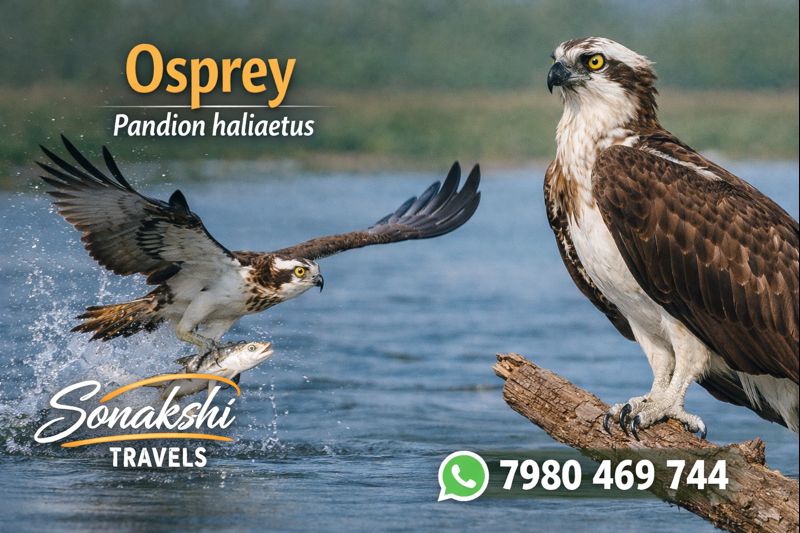
A Comprehensive Study of the World’s Fish-Hunting Raptor
The Osprey (Pandion haliaetus) stands apart among birds of prey as one of the most specialized fish-eating raptors on Earth. Often referred to as the “Fish Hawk” or “River Hawk,” this species has evolved a remarkable suite of anatomical, physiological, and behavioral adaptations that allow it to hunt live fish with exceptional precision. Distributed across nearly every continent except Antarctica, the Osprey is one of the most widely dispersed raptors in the world, serving as a powerful indicator of aquatic ecosystem health.
Taxonomy & Classification
The Osprey belongs to the order Accipitriformes, which includes eagles, hawks, and vultures. However, unlike most raptors, it is placed within its own distinct family, Pandionidae. This taxonomic separation reflects its highly specialized morphology and feeding ecology, which differ significantly from other birds of prey.
The genus Pandion contains a single extant species, Pandion haliaetus, though several subspecies are recognized based on geographic variation. Genetic studies confirm that the Osprey represents an ancient evolutionary lineage, diverging early from other accipitrid raptors.
Morphology & Field Identification
The Osprey is a medium-to-large raptor with long, narrow wings and a distinctive silhouette in flight. Its overall appearance is dominated by contrasting dark upperparts and pale underparts, creating a bold pattern easily recognizable even at great distances.
Male Features
Adult males display a clean white head and underparts, with dark brown upper wings and back. A prominent dark eye-stripe extends from the bill through the eye toward the neck. In breeding plumage, males may show a lightly mottled breast band, though this is generally less pronounced than in females.
Female Features
Females are slightly larger and heavier than males and typically possess a more distinct, darker breast band. This feature aids in field identification during the breeding season. Females also exhibit broader wings and a more robust body structure, reflecting sexual dimorphism common among raptors.
Size & Wingspan
Adult Ospreys measure approximately 50–66 cm in length, with a wingspan ranging from 127 to 180 cm. Body weight varies between 1.2 and 2.1 kg, with females averaging heavier than males. The long wings are well suited for soaring over open water.
Flight Characteristics
In flight, the Osprey exhibits a distinctive “M-shaped” wing profile when gliding. Wingbeats are strong and deliberate, often interspersed with prolonged soaring. While hunting, the bird may hover briefly above the water surface before plunging feet-first to capture prey.
Habitat & Distribution
Global Range
The Osprey has an almost global distribution, breeding across North America, Europe, Asia, and Australia, and wintering in South America, Africa, South Asia, and Southeast Asia. Its cosmopolitan range makes it one of the most geographically successful raptors.
Preferred Habitat
This species is strongly associated with aquatic environments. It inhabits coastal regions, estuaries, large rivers, lakes, reservoirs, and wetlands where fish populations are abundant. Access to open water and elevated nesting sites are critical habitat requirements.
Diet & Feeding Ecology
The Osprey’s diet consists almost exclusively of live fish, typically measuring 15–35 cm in length. More than 95 percent of its food intake is derived from fish, making it one of the most specialized piscivorous birds in the world.
Foraging Technique
Ospreys hunt by soaring or hovering above water and scanning for fish near the surface. Upon detecting prey, the bird plunges feet-first, sometimes fully submerging itself. Specialized talons and reversible outer toes allow a secure grip on slippery fish, which are carried head-first to reduce aerodynamic drag.
Breeding & Reproduction
Ospreys are typically monogamous and often return to the same nesting sites year after year. Breeding success is closely linked to food availability and the stability of nesting structures.
Nesting Sites
Nests are large, bulky structures constructed from sticks and lined with softer materials. They are commonly built on tall trees, cliffs, utility poles, and specially designed nesting platforms near water bodies. Over time, nests can become massive due to repeated reuse.
Unique Adaptations & Behavioral Ecology
Speed & Agility
Despite its size, the Osprey demonstrates impressive agility, particularly during hunting dives. Its streamlined body and powerful wings enable rapid acceleration and precise control when striking prey.
Camouflage and Nesting Strategy
The contrasting plumage of the Osprey provides camouflage against both sky and water surfaces. Nest placement in elevated, open locations reduces predation risk and allows clear access routes for incoming adults carrying fish.
Social Behavior
Ospreys are generally solitary outside the breeding season. However, they may congregate in areas with abundant food resources, particularly during migration and at wintering grounds.
Occurrence & Seasonal Movement
Many Osprey populations are strongly migratory. Birds breeding in temperate and northern regions migrate south during winter, traveling thousands of kilometers. Migration routes often follow coastlines and major river systems.
Preferred Habitat in the Sundarbans Region
Within the Sundarbans, Ospreys are most commonly observed during the winter months. The extensive network of rivers, creeks, and estuarine channels provides ideal foraging conditions. Open water areas near mangrove edges are particularly favored for hunting.
Wildlife enthusiasts visiting the mangrove delta can include bird observation as part of a curated Sundarban Tour designed around seasonal avian movement.
Ecological Role
As a top-level predator within aquatic food webs, the Osprey plays a critical role in regulating fish populations. Its presence often reflects healthy, unpolluted water systems with sufficient prey diversity.
Habitat Alteration
Habitat loss, water pollution, and overfishing pose significant threats to Osprey populations. Changes in river flow, wetland drainage, and coastal development can reduce prey availability and nesting opportunities.
Conservation Efforts
Conservation initiatives have proven highly successful for the Osprey in many regions. Protective legislation, reduction of harmful pesticides, and the installation of artificial nesting platforms have contributed to population recovery in several countries.
Did You Know?
Ospreys can dive at speeds exceeding 80 km/h when striking prey.
They possess specialized barbed pads on their feet to grip slippery fish.
The species is often used as a global indicator of aquatic ecosystem health.
Birdwatchers and nature lovers can experience seasonal raptors during a well-planned Sundarban Tour focused on wetland biodiversity.
External Reference
Further scientific information and global distribution data can be accessed through the Wikipedia species account: https://en.wikipedia.org/wiki/Osprey