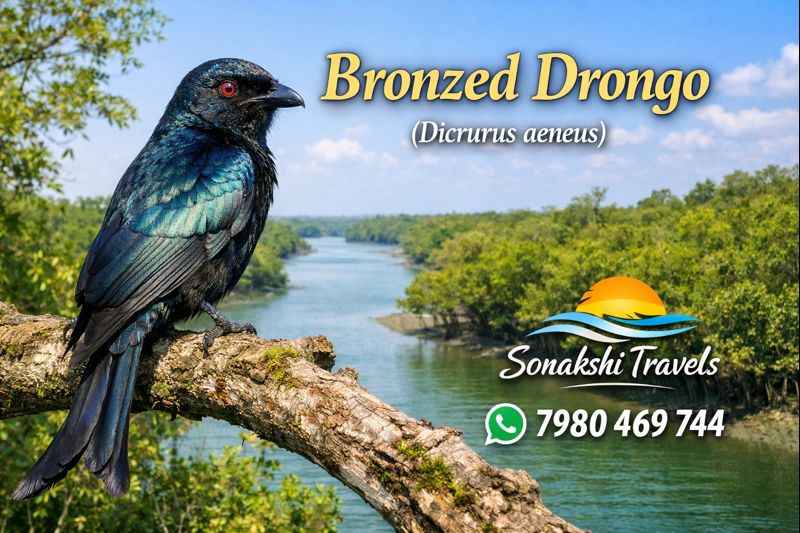
The Bronzed Drongo (Dicrurus aeneus) is a striking passerine bird of the family Dicruridae, widely admired for its metallic sheen, agile flight, and highly adaptive foraging behavior. Occupying forested landscapes across South and Southeast Asia, this species plays a vital ecological role as an aerial insectivore and forest-edge sentinel. The following article presents a detailed, research-oriented overview of the Bronzed Drongo, with particular emphasis on morphology, behavior, ecology, and its relevance within the Sundarbans region.
Taxonomy & Classification
Systematic Position
The Bronzed Drongo belongs to the order Passeriformes and the family Dicruridae, a group characterized by medium-sized insectivorous birds commonly referred to as drongos. The genus Dicrurus comprises more than 20 species distributed across Africa and Asia, many of which exhibit glossy plumage and forked tails.
The Bronzed Drongo is a medium-sized drongo with a sleek body profile and a subtly forked tail. Its plumage displays a distinctive bronze-green metallic gloss, particularly visible under direct sunlight. The bird’s upright posture and alert demeanor make it readily noticeable in forested habitats.
Male Features
Adult males exhibit a uniform bronzy-black coloration with strong iridescence across the wings and upperparts. The tail is moderately forked, and the central tail feathers are slightly elongated. Males possess a robust black bill and dark brown to black eyes, giving them a sharp and focused expression.
Female Features
Females closely resemble males, though the metallic sheen may appear slightly subdued. Sexual dimorphism is minimal, and reliable differentiation often requires behavioral observation during the breeding season rather than visual cues alone.
Size & Wingspan
The Bronzed Drongo typically measures between 23 and 26 centimeters in length. The wingspan ranges from approximately 34 to 38 centimeters, allowing efficient maneuverability in densely vegetated environments.
Flight Characteristics
Flight is agile and buoyant, characterized by rapid wingbeats interspersed with short glides. The species is capable of sudden directional changes, enabling precise aerial pursuit of flying insects.
Habitat & Distribution
Global Range
The Bronzed Drongo is widely distributed across the Indian subcontinent, extending eastward through Bangladesh, Myanmar, Thailand, and into parts of southern China and the Malay Peninsula. Its range overlaps with several forest types, from lowland tropical forests to foothill woodlands.
Preferred Habitat
This species shows a strong preference for moist deciduous forests, evergreen forests, and forest edges. It is frequently observed along clearings, riverine forests, and wooded trails where insect abundance is high.
Diet & Feeding Ecology
Primary Diet
The Bronzed Drongo is predominantly insectivorous. Its diet consists of flying insects such as beetles, dragonflies, moths, ants, and termites. Occasionally, it may consume small fruits or nectar, particularly during periods of low insect availability.
Foraging Technique
Foraging typically involves sallying flights from exposed perches. The bird launches into the air to capture prey mid-flight before returning to the same or a nearby perch. This sit-and-wait strategy conserves energy while maximizing hunting efficiency.
Breeding & Reproduction
Breeding Season
The breeding season generally coincides with the onset of the monsoon, when insect populations peak. This timing ensures ample food availability for both adults and nestlings.
Nesting Sites
Nests are shallow cup-shaped structures constructed from twigs, rootlets, and plant fibers. They are usually placed on horizontal branches at moderate heights, offering a balance between concealment and visibility.
Unique Adaptations & Behavioral Ecology
Speed & Agility
The Bronzed Drongo’s streamlined body and strong wing musculature contribute to exceptional speed and aerial agility. These traits are essential for capturing fast-moving insects in complex forest environments.
Camouflage and Nesting Strategy
The metallic sheen of the plumage provides subtle camouflage by reflecting surrounding foliage colors. Nest placement on slender branches reduces access by predators and minimizes detection.
Social Behavior
Outside the breeding season, Bronzed Drongos are typically solitary or found in pairs. They may occasionally join mixed-species foraging flocks, benefiting from collective vigilance.
Occurrence & Seasonal Movement
The species is largely resident throughout its range, though minor local movements may occur in response to seasonal changes in food availability. In forested regions, it maintains stable territories year-round.
Preferred Habitat in the Sundarbans Region
Within the Sundarbans landscape, the Bronzed Drongo favors elevated forest patches, mangrove-fringe woodlands, and inland forest edges where insect diversity is high. Its presence indicates relatively undisturbed microhabitats with adequate canopy cover.
Planning a guided mangrove adventure? Explore our Sundarban Tour Packages and choose the best itinerary for your dates.
Ecological Role
As an efficient insect predator, the Bronzed Drongo contributes significantly to controlling insect populations. Its role as a mid-level predator supports trophic balance within forest ecosystems.
Habitat Alteration
Deforestation, fragmentation, and conversion of forest land for agriculture pose localized threats to the species. While adaptable, prolonged habitat degradation can lead to population declines.
Conservation Efforts
The Bronzed Drongo is currently not considered globally threatened. Conservation measures focusing on forest protection and sustainable land-use practices indirectly benefit this species and its habitat.
Planning a guided mangrove adventure? Explore our Sundarban Tour Packages and choose the best itinerary for your dates.
Did You Know?
The Bronzed Drongo is known for its fearless nature and has been observed aggressively mobbing much larger birds that approach its nesting territory, demonstrating remarkable territorial defense behavior.