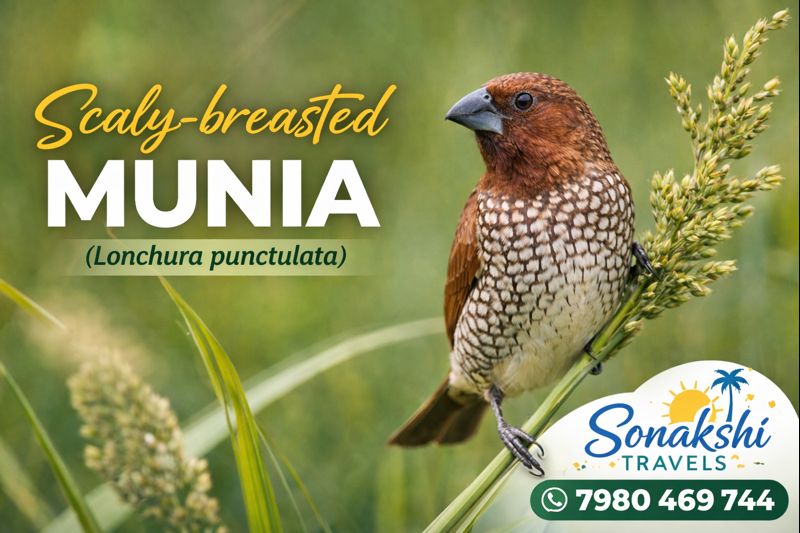
The Scaly-breasted Munia (Lonchura punctulata), also known as the Spotted Munia or Nutmeg Mannikin, is a small granivorous passerine bird widely distributed across South and Southeast Asia. Recognized for its distinctive scale-like plumage pattern and highly social behavior, this species plays an important ecological role in grassland, wetland-edge, and agricultural ecosystems. In regions such as eastern India and the Sundarbans delta, the Scaly-breasted Munia represents both a familiar avian presence and a valuable indicator of habitat health.
Taxonomy & Classification
The Scaly-breasted Munia belongs to the family Estrildidae, a group commonly referred to as waxbills, munias, and finches of the Old World tropics. This family is characterized by small-bodied, seed-eating birds adapted to open and semi-open habitats.
Several regional subspecies have been described based on plumage shade and geographic distribution, though all share the characteristic scaly underparts that define the species.
Morphology & Field Identification
The Scaly-breasted Munia is a compact, short-tailed bird with a stout, conical bill adapted for seed consumption. Its plumage pattern is highly distinctive, allowing reliable field identification even among mixed finch flocks.
Male Features
Adult males exhibit rich brown upperparts with a darker head and nape. The underparts are pale buff to whitish, marked with dark crescent-shaped edges on each feather, creating a striking “scaly” appearance. The bill is bluish-gray to slate-colored, becoming darker during the breeding season.
Female Features
Females closely resemble males in coloration and pattern, making sexual dimorphism subtle. In most cases, females appear slightly duller, with marginally less contrast in the scaly pattern. Behavioral cues rather than plumage are often required for accurate sex identification in the field.
Size & Wingspan
This species typically measures 11–12 centimeters in length, with a wingspan of approximately 17–19 centimeters. Its body mass usually ranges between 12 and 16 grams, reflecting a lightweight build suited for agile flock flight.
Flight Characteristics
Flight is rapid and direct, consisting of quick wingbeats interspersed with brief glides. When moving in flocks, individuals maintain close spacing, producing a synchronized, wave-like movement across open fields and reedbeds.
Habitat & Distribution
Global Range
The Scaly-breasted Munia is widely distributed across the Indian subcontinent, Sri Lanka, Nepal, Bangladesh, Myanmar, Thailand, southern China, and much of Southeast Asia. Introduced populations have also become established in parts of the Pacific and the Caribbean.
Preferred Habitat
This species favors open habitats with abundant grass cover, including grasslands, agricultural fields, wetlands margins, reedbeds, and village outskirts. It readily adapts to human-modified landscapes, provided sufficient seed resources are available.
Diet & Feeding Ecology
The Scaly-breasted Munia is primarily granivorous, feeding on a wide variety of grass seeds. Its strong, triangular bill allows efficient husking and processing of small, hard seeds.
Foraging Technique
Foraging occurs mostly on the ground or on seed heads of grasses. Birds often cling acrobatically to swaying stems, bending them downward to access ripe seeds. Feeding is highly social, with flocks descending simultaneously on productive patches.
In addition to seeds, small quantities of insects may be consumed, particularly during the breeding season when additional protein is required for chick development.
Breeding & Reproduction
Breeding activity varies geographically but is often timed to coincide with the monsoon and post-monsoon periods, when seed availability is at its peak.
Nesting Sites
Nests are large, dome-shaped structures made of grasses and fine plant fibers, with a side entrance. They are typically placed in dense shrubs, tall grasses, reeds, or occasionally in trees. The species readily uses human-associated vegetation, including hedges and climbers.
Clutch size generally ranges from four to six white eggs. Both parents participate in incubation and chick-rearing, reflecting a high degree of biparental care.
Unique Adaptations & Behavioral Ecology
Speed & Agility
Despite its small size, the Scaly-breasted Munia exhibits impressive agility, enabling rapid escape from predators. Its compact body and short tail facilitate sharp turns during flight.
Camouflage and Nesting Strategy
The scaly plumage pattern provides effective camouflage among dry grasses and reeds. Nests are carefully concealed within dense vegetation, reducing visibility to predators and environmental exposure.
Social Behavior
This species is highly gregarious outside the breeding season, forming flocks that may number in the hundreds. Social cohesion improves foraging efficiency and predator detection, enhancing survival in open habitats.
Occurrence & Seasonal Movement
The Scaly-breasted Munia is largely resident across most of its range, though local movements occur in response to rainfall patterns and food availability. Seasonal dispersal often follows the maturation of grass seeds.
Preferred Habitat in the Sundarbans Region
Within the Sundarbans, this species is commonly observed along embankments, grassy clearings near mangrove edges, village fringes, and cultivated fields adjacent to tidal channels. It avoids dense mangrove interiors but thrives where grasses and reeds flourish.
For visitors interested in observing wetland-edge birdlife and traditional rural landscapes, a guided Sundarban Tour offers ideal opportunities during early morning excursions.
Ecological Role
As a seed consumer, the Scaly-breasted Munia influences grass population dynamics and contributes to seed dispersal. It also serves as prey for small raptors and snakes, forming an integral part of local food webs.
Habitat Alteration
While the species demonstrates adaptability, large-scale habitat alteration poses risks. Conversion of grasslands to intensive agriculture, excessive pesticide use, and wetland drainage can reduce food availability and nesting sites.
Conservation Efforts
Currently classified as Least Concern, the Scaly-breasted Munia benefits from its wide distribution and flexible habitat preferences. Conservation measures focusing on grassland preservation and sustainable agricultural practices indirectly support healthy populations.
Nature enthusiasts seeking responsible wildlife experiences may explore curated Sundarban Tour itineraries that emphasize biodiversity awareness and low-impact travel.
Did You Know?
The scaly pattern on the underparts is formed by dark feather edges rather than spots.
This species often roosts communally in dense grass clumps.
It is one of the most widely introduced estrildid finches outside its native range.