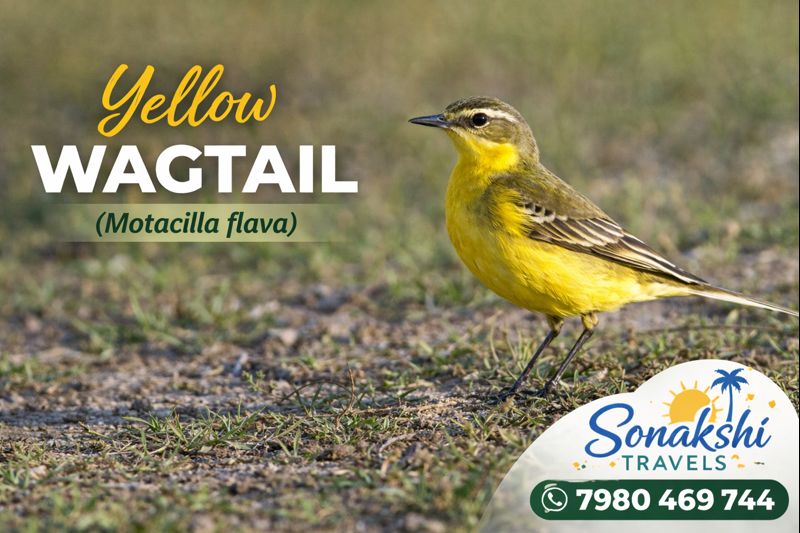
The Yellow Wagtail (Motacilla flava) is a slender, long-tailed passerine bird renowned for its vivid yellow underparts, graceful movements, and remarkable migratory journeys across continents. As one of the most geographically variable wagtail species, it exhibits extensive plumage diversity, making it a subject of significant interest in avian taxonomy and evolutionary biology. Its seasonal appearance in the Indian subcontinent, including the Sundarbans region, enhances the winter bird diversity of wetlands and open landscapes.
Highly adaptive yet sensitive to ecological change, the Yellow Wagtail serves as a valuable indicator of wetland health and insect abundance. Its elegant posture, constant tail-wagging behavior, and active foraging style distinguish it clearly from other sympatric wagtail species.
Taxonomy & Classification
The Yellow Wagtail belongs to the family Motacillidae, which includes wagtails and pipits. This family is characterized by elongated bodies, fine bills, and ground-oriented feeding behavior.
The species complex includes numerous subspecies differentiated by head pattern, eye-stripe coloration, and crown markings. This extensive variation reflects adaptation to diverse breeding environments across Eurasia.
Morphology & Field Identification
The Yellow Wagtail is a slim, agile bird with a long tail and upright stance. Its bright yellow underparts contrast with olive-green or greyish upperparts, creating a striking visual profile in open habitats.
Male Features
Breeding males are especially colorful, displaying vibrant yellow underparts and distinctive head patterns that vary by subspecies. Depending on the population, males may show blue-grey, black, or olive crowns, often accompanied by bold supercilia or facial markings.
Female Features
Females are generally duller, with paler yellow or buff underparts and less defined head markings. This subdued coloration provides effective camouflage during nesting and reduces predation risk.
Size & Wingspan
Adult Yellow Wagtails measure approximately 15–16 centimeters in length. The wingspan typically ranges from 23 to 27 centimeters. Average body weight lies between 14 and 20 grams, supporting agile flight and long-distance migration.
Flight Characteristics
Flight is low, buoyant, and undulating, characterized by rapid wingbeats followed by brief glides. The elongated tail plays a crucial role in balance and directional control during flight and ground movements.
Habitat & Distribution
Global Range
The Yellow Wagtail breeds across temperate and subarctic regions of Europe and Asia, extending from western Europe through Siberia. During winter, it migrates to Africa, South Asia, and Southeast Asia, undertaking transcontinental journeys that span thousands of kilometers.
Preferred Habitat
This species favors open landscapes such as wet meadows, floodplains, agricultural fields, grasslands, and marsh edges. Proximity to shallow water and insect-rich environments is a key determinant of habitat suitability.
Diet & Feeding Ecology
The Yellow Wagtail is predominantly insectivorous. Its diet includes flies, beetles, grasshoppers, caterpillars, ants, termites, and other small invertebrates. During migration and winter, it may also consume spiders and aquatic larvae.
Foraging Technique
Foraging occurs mainly on the ground using a rapid run-and-stop technique. The bird actively chases insects flushed by grazing livestock or human agricultural activity. Tail-wagging behavior may aid in startling prey or signaling vigilance.
Breeding & Reproduction
Breeding typically occurs between late spring and early summer in temperate regions. Nesting coincides with peak insect availability, ensuring adequate food for growing chicks.
Nesting Sites
Nests are built on the ground, often concealed within dense grass, crops, or low vegetation. The nest is a shallow cup constructed from grasses and fine plant material, lined with softer fibers. Ground nesting demands careful site selection to minimize predation.
Clutch size usually ranges from four to six eggs. Both parents share incubation duties and actively feed the nestlings.
Unique Adaptations & Behavioral Ecology
Speed & Agility
The streamlined body and long tail provide exceptional agility. These traits enable rapid pursuit of flying insects and swift escape responses when threatened.
Camouflage and Nesting Strategy
Females and non-breeding individuals exhibit muted plumage that blends seamlessly with grassy and muddy substrates. Ground nests are carefully hidden to reduce detection by predators.
Social Behavior
During migration and winter, Yellow Wagtails often form loose flocks, sometimes associating with other wagtail species. Communal roosting offers thermal benefits and enhanced predator awareness.
Occurrence & Seasonal Movement
In India, the Yellow Wagtail is primarily a winter visitor, arriving from September onwards and departing by April. Its presence peaks during mid-winter, particularly in open wetlands and agricultural landscapes.
Preferred Habitat in the Sundarbans Region
Within the Sundarbans, Yellow Wagtails are commonly observed along embankments, tidal mudflats, fallow agricultural fields, and grassy clearings near mangrove edges. These areas provide abundant insect prey and open ground for foraging.
Birdwatchers exploring winter migratory species often combine observation sessions with a well-planned Sundarban Tour to experience the delta’s ecological diversity.
Ecological Role
The Yellow Wagtail contributes significantly to insect population regulation, particularly in agricultural and wetland ecosystems. By feeding on pest species, it supports natural pest control and ecological balance.
Habitat Alteration
Wetland drainage, intensive agriculture, pesticide use, and loss of grassland habitats pose increasing threats. While adaptable, prolonged habitat degradation can negatively impact local wintering populations.
Conservation Efforts
Currently listed as Least Concern, the Yellow Wagtail benefits from its broad range and migratory flexibility. Conservation initiatives focused on wetland protection, sustainable farming, and reduced chemical use indirectly support this species.
Eco-focused travelers interested in seasonal birdlife may explore a responsible Sundarban Tour that emphasizes conservation and low-impact nature experiences.
Did You Know?
The Yellow Wagtail comprises one of the most variable plumage complexes among passerine birds.
It often follows grazing cattle to catch insects disturbed by movement.
The species migrates thousands of kilometers between breeding and wintering grounds.