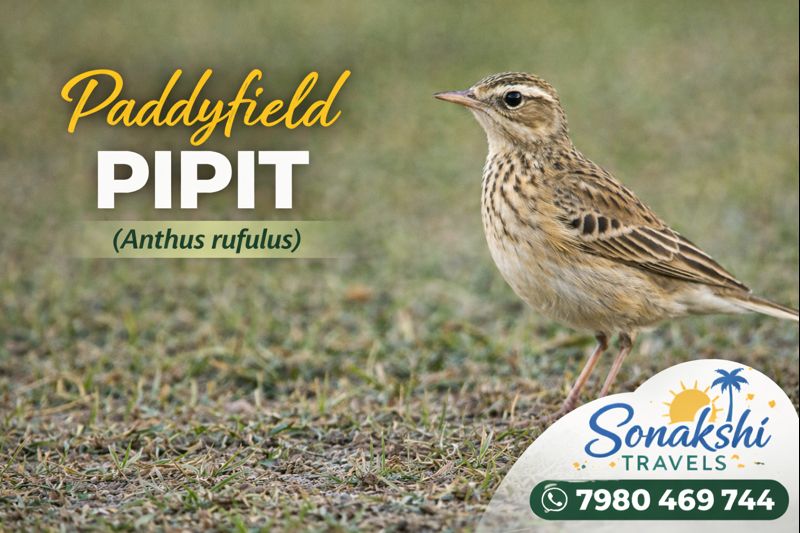
The Paddyfield Pipit (Anthus rufulus) is a small, ground-dwelling passerine bird widely distributed across the Indian subcontinent and parts of Southeast Asia. Often overlooked due to its cryptic plumage and unobtrusive behavior, this species plays a vital ecological role in grassland, agricultural, and wetland-edge ecosystems. Its close association with open fields, grazing lands, and paddy cultivation landscapes has earned it its common name.
Despite its modest appearance, the Paddyfield Pipit is a highly adaptable bird with a rich behavioral repertoire. It serves as an excellent representative of open-country avifauna and is frequently encountered in rural landscapes, coastal plains, and riverine floodplains, including the ecologically complex Sundarbans region.
Taxonomy & Classification
The Paddyfield Pipit belongs to the family Motacillidae, which includes wagtails and pipits. Members of this family are characterized by slender bodies, long tails, and terrestrial foraging habits.
The genus Anthus includes numerous pipit species globally, many of which exhibit subtle morphological differences. The Paddyfield Pipit is one of the most widespread and commonly observed pipits in South Asia.
Morphology & Field Identification
The Paddyfield Pipit is a small, slender bird with a brownish, streaked appearance that provides excellent camouflage in grassy and earthy environments. Its upright stance, elongated tail, and frequent ground movement are key identification features.
Male Features
Males exhibit brownish upperparts with darker streaks and buff to pale underparts marked with fine streaking on the breast. The face shows a faint supercilium and a subtle eye-ring. During the breeding season, males may appear slightly more contrasting due to fresher plumage.
Female Features
Females closely resemble males in coloration and pattern, with no pronounced sexual dimorphism. Slight differences may occur in size and tone, but these are generally indistinguishable in field conditions.
Size & Wingspan
The Paddyfield Pipit measures approximately 15–16 centimeters in length. The wingspan ranges from 23 to 26 centimeters. Body weight typically falls between 18 and 22 grams, making it a lightweight but resilient species.
Flight Characteristics
Flight is weakly undulating and low to the ground. When flushed, the bird often rises briefly before dropping back into cover. Its flight call is a sharp, repetitive note, often given during short flights.
Habitat & Distribution
Global Range
The Paddyfield Pipit is widely distributed across the Indian subcontinent, including India, Sri Lanka, Nepal, Bangladesh, and parts of Pakistan. Its range extends into Southeast Asia, particularly in suitable open habitats.
Preferred Habitat
This species favors open grasslands, agricultural fields, grazing pastures, fallow lands, riverbanks, coastal plains, and wetlands margins. It is especially common in cultivated landscapes, including paddy fields and harvested croplands.
Diet & Feeding Ecology
The Paddyfield Pipit is primarily insectivorous, feeding on a wide variety of small invertebrates. Its diet includes ants, beetles, grasshoppers, termites, caterpillars, and spiders. Seeds may occasionally supplement the diet, particularly during lean periods.
Foraging Technique
Foraging is conducted almost exclusively on the ground. The bird walks or runs with quick, deliberate steps, pausing frequently to pick prey from soil, grass, or leaf litter. This stop-and-go foraging strategy maximizes prey detection while conserving energy.
Breeding & Reproduction
Breeding typically coincides with the monsoon season, when insect availability is high. The timing may vary regionally depending on rainfall patterns and habitat conditions.
Nesting Sites
Nests are built on the ground, often concealed within dense grass, crop stubble, or low vegetation. The nest is a shallow cup made from grasses and fine plant fibers, lined with softer materials. Ground nesting makes careful site selection critical for reproductive success.
Clutch size usually ranges from three to five eggs. Both parents are involved in feeding the chicks, which fledge within a relatively short period after hatching.
Unique Adaptations & Behavioral Ecology
Speed & Agility
Although not a strong flier, the Paddyfield Pipit is highly agile on the ground. Its ability to move swiftly through grass and uneven terrain allows it to evade predators effectively.
Camouflage and Nesting Strategy
The streaked brown plumage blends seamlessly with soil, dry grass, and crop residues. This camouflage is particularly effective for both adults and ground nests, reducing visibility to predators.
Social Behavior
The species is generally solitary or found in pairs during the breeding season. Outside this period, it may form loose groups, especially in areas with abundant food resources.
Occurrence & Seasonal Movement
The Paddyfield Pipit is largely resident across most of its range, with only minor local movements influenced by rainfall, agricultural cycles, and food availability. It does not undertake long-distance migrations.
Preferred Habitat in the Sundarbans Region
In the Sundarbans, the Paddyfield Pipit is commonly observed along embankments, village outskirts, open grassy patches, reclaimed agricultural fields, and coastal plains adjacent to mangrove forests. It avoids dense mangrove interiors but thrives in transitional open habitats.
Exploring open grasslands and village fringes often complements a well-curated Sundarban Tour, offering insights into lesser-known bird species of the delta.
Ecological Role
The Paddyfield Pipit contributes significantly to controlling insect populations in agricultural and grassland ecosystems. By consuming pest species, it supports natural pest regulation and promotes ecological balance.
Habitat Alteration
Intensive agriculture, excessive pesticide use, grassland conversion, and urban expansion pose threats to suitable habitats. Although adaptable, sustained habitat degradation can lead to local population declines.
Conservation Efforts
Currently classified as Least Concern, the Paddyfield Pipit benefits from its wide distribution and tolerance of human-modified landscapes. Conservation strategies focused on sustainable agriculture and grassland preservation indirectly support the species.
Nature enthusiasts interested in grassland and wetland-edge birds may consider a responsible Sundarban Tour that highlights ecological diversity beyond the mangroves.
Did You Know?
The Paddyfield Pipit often sings from low perches or during short display flights.
Its cryptic coloration makes it difficult to spot until it moves.
It is one of the most common pipit species in rural South Asia.