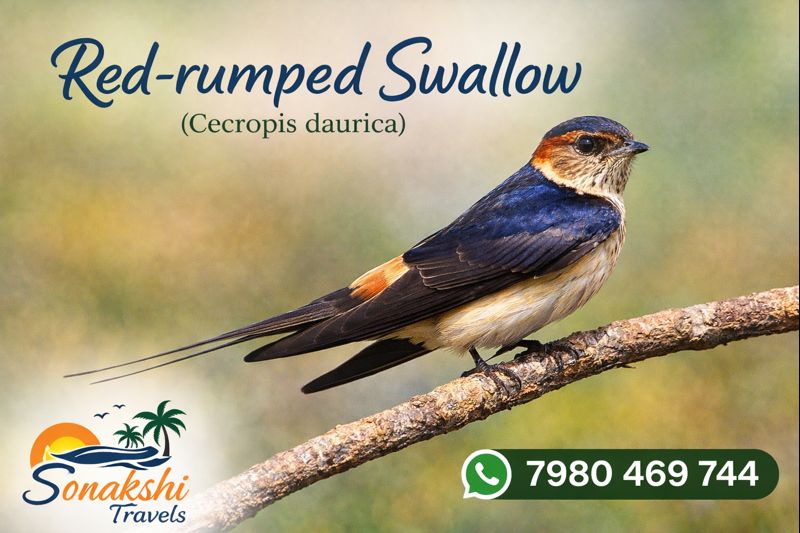
The Red-rumped Swallow (Cecropis daurica) is a graceful aerial insectivore belonging to the swallow family, widely admired for its elegant flight, warm rufous undertones, and distinctive nesting behavior. Unlike its more familiar relatives that readily associate with human structures, this species exhibits a nuanced balance between natural habitats and anthropogenic landscapes. Distributed across large parts of Europe, Asia, and Africa, the Red-rumped Swallow represents a remarkable example of evolutionary adaptation to open skies, seasonal migration, and specialized architectural nesting. This comprehensive article explores its taxonomy, morphology, ecology, and behavioral strategies, with special emphasis on its occurrence in the Indian subcontinent and the Sundarbans region.
Taxonomy & Classification
The Red-rumped Swallow is classified within the order Passeriformes, which includes the majority of perching birds. Within this vast order, it belongs to the family Hirundinidae, a group characterized by slender bodies, long pointed wings, and a lifestyle centered on aerial feeding. The genus Cecropis comprises several swallow species known for their enclosed mud nests and preference for warmer climates.
Kingdom: Animalia
Phylum: Chordata
Class: Aves
Order: Passeriformes
Family: Hirundinidae
Genus: Cecropis
Species: Cecropis daurica
Multiple subspecies have been described across its range, reflecting geographic variation in plumage intensity and migratory behavior. These variations provide valuable insight into the species’ evolutionary response to regional climatic and ecological pressures.
Morphology & Field Identification
The Red-rumped Swallow is a medium-sized swallow with an elongated body, deeply forked tail, and smooth, streamlined profile. In the field, it is readily identified by its pale underparts, blue-black upperparts, and the characteristic rufous coloration on the rump, which gives the species its common name.
Male Features
Male Red-rumped Swallows typically display slightly longer tail streamers and more vivid coloration on the rump and nape. These features are particularly prominent during the breeding season and are believed to play a role in mate attraction. The throat and forehead often show subtle chestnut tones, enhancing their visual appeal during aerial displays.
Female Features
Females closely resemble males in overall structure and coloration but generally exhibit shorter tail streamers and marginally paler plumage. Sexual dimorphism is modest, and accurate sex determination often requires behavioral observation, especially during nesting and incubation.
Size & Wingspan
Adults measure approximately 18–20 cm in length, including the tail streamers. The wingspan ranges between 32 and 35 cm, enabling sustained flight and efficient gliding during foraging. The lightweight skeletal structure supports long-distance migratory journeys.
Flight Characteristics
Flight is smooth, buoyant, and highly maneuverable. The Red-rumped Swallow alternates rapid wingbeats with graceful glides, often flying at moderate heights over open terrain. Its flight pattern is slightly less erratic than that of some other swallows, lending it an elegant, flowing appearance.
Habitat & Distribution
Global Range
The species has a wide distribution extending across southern Europe, North Africa, the Middle East, Central Asia, South Asia, and parts of East Asia. Northern populations are strongly migratory, wintering in sub-Saharan Africa and South Asia, while southern populations may be resident or partially migratory.
Preferred Habitat
Red-rumped Swallows favor open landscapes such as river valleys, grasslands, agricultural fields, rocky outcrops, and coastal plains. They are often associated with cliffs, bridges, culverts, and tunnels that provide suitable nesting surfaces and protection from predators.
Diet & Feeding Ecology
The species is strictly insectivorous, feeding primarily on flying insects including flies, beetles, ants, wasps, and small moths. Diet composition varies seasonally and geographically, reflecting local insect availability.
Foraging Technique
Foraging occurs almost exclusively in flight. Birds capture prey mid-air using rapid bill movements, often skimming above vegetation, water bodies, or open ground. This feeding strategy reduces competition with terrestrial insectivores and allows efficient exploitation of aerial insect swarms.
Breeding & Reproduction
Breeding seasons vary across the range but are generally synchronized with peaks in insect abundance. Courtship involves aerial chases, vocalizations, and visual displays that reinforce pair bonds.
Nesting Sites
One of the most distinctive features of the Red-rumped Swallow is its enclosed mud nest. These gourd-shaped structures are constructed from mud pellets mixed with plant fibers and saliva. Nests are typically attached to vertical surfaces under overhangs, cliffs, bridges, or inside tunnels, providing enhanced protection from weather and predators.
Unique Adaptations & Behavioral Ecology
Speed & Agility
While not the fastest swallow, the Red-rumped Swallow exhibits excellent maneuverability and endurance. Its wing morphology allows sustained flight with minimal energy expenditure, a crucial adaptation for both migration and daily foraging.
Camouflage and Nesting Strategy
The mud nests blend seamlessly with surrounding substrates, offering effective camouflage. The enclosed design further reduces nest predation and protects eggs and chicks from temperature fluctuations and rainfall.
Social Behavior
Outside the breeding season, Red-rumped Swallows are moderately social, often forming loose flocks during migration and communal roosts in favorable habitats. During breeding, however, they exhibit territorial behavior around nesting sites.
Occurrence & Seasonal Movement
In the Indian subcontinent, the Red-rumped Swallow is primarily a resident or partial migrant, with some northern populations moving southward during winter. Seasonal movements are influenced by monsoon patterns and insect abundance rather than extreme temperature changes.
Preferred Habitat in the Sundarbans Region
Within the Sundarbans, this swallow is observed along riverbanks, open mangrove clearings, embankments, and near human-made structures such as bridges and watchtowers. The region’s humid climate and rich insect fauna provide excellent feeding conditions, particularly during the dry winter months.
Nature enthusiasts exploring mangrove waterways often encounter aerial insectivores during a well-planned Sundarban Tour, offering rewarding birdwatching experiences.
Ecological Role
As an efficient predator of flying insects, the Red-rumped Swallow plays a vital role in regulating insect populations. Its presence contributes to natural pest control, benefiting both natural ecosystems and agricultural landscapes.
Habitat Alteration
Habitat modification through urban expansion, pesticide use, and the loss of traditional nesting sites poses localized threats. However, the species’ adaptability to certain human structures has helped buffer it against severe population declines.
Conservation Efforts
Currently classified as a species of least concern, conservation priorities focus on maintaining insect-rich habitats and preserving suitable nesting structures. Long-term monitoring is essential to detect population trends linked to climate change and agricultural intensification.
Bird-focused itineraries designed around wetland and mangrove ecosystems can be explored through curated Sundarban Tour programs tailored for nature travelers.
Did You Know?
The enclosed mud nest of the Red-rumped Swallow is among the most architecturally complex structures built by passerine birds.
Some populations reuse and repair old nests across multiple breeding seasons.
The species can forage several kilometers away from its nesting site in search of insect swarms.
External Reference
For further taxonomic and ecological information, consult the detailed species account available on Wikipedia.