A Comprehensive Study of Biology, Ecology, and Adaptations
The Gray-throated Martin (Riparia chinensis) is a subtle yet ecologically significant member of the swallow family, widely distributed across South and Southeast Asia. Often overlooked due to its understated plumage and swift aerial habits, this species represents a refined evolutionary design optimized for insectivorous flight and riverine environments. Closely associated with open landscapes, wetlands, and sandy embankments, the Gray-throated Martin plays a vital role in regulating insect populations and maintaining ecological equilibrium across its range.
Taxonomy & Classification
The Gray-throated Martin is classified under the order Passeriformes, which encompasses perching birds characterized by advanced vocal organs and adaptive behaviors. Within this order, it belongs to the family Hirundinidae, a lineage renowned for aerodynamic efficiency and aerial feeding specialization. The genus Riparia includes swallows adapted to nesting in earthen banks rather than trees or structures. The species name chinensis reflects early taxonomic associations with East Asian regions, although its present range extends far beyond its originally described locality.
Morphology & Field Identification
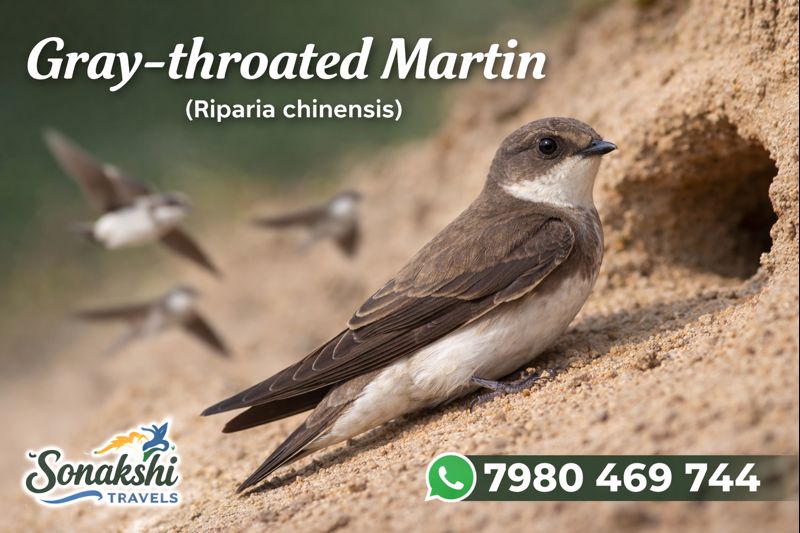
Field identification of the Gray-throated Martin relies on its compact structure, uniform brown upperparts, pale underparts, and distinctly grayish throat. Unlike some swallows that exhibit glossy or contrasting plumage, this species displays muted coloration that blends seamlessly with sandy banks and open skies. Its short, shallowly forked tail and slender wings further aid in differentiation from similar martins and swallows encountered in mixed-species flocks.
Male Features
Male Gray-throated Martins exhibit smooth brown upperparts with a clean gray throat that transitions gradually into a pale buff or off-white belly. The bill is short and black, well-suited for snapping up small insects mid-air. Males often show slightly crisper throat coloration during the breeding season, which may function as a subtle visual cue during courtship interactions near nesting sites.
Female Features
Females closely resemble males in size and coloration, reflecting minimal sexual dimorphism. The throat may appear marginally paler, and the overall plumage slightly softer in tone. This similarity likely reduces predation risk, particularly during nesting when both sexes repeatedly enter and exit burrows, making conspicuous coloration disadvantageous.
Size & Wingspan
The Gray-throated Martin measures approximately 12 to 13 centimeters in length, placing it among the smaller members of the swallow family. Its wingspan ranges from 26 to 30 centimeters, providing an optimal balance between lift and maneuverability. The lightweight skeletal structure minimizes energy expenditure during sustained flight and long-distance movements.
Flight Characteristics
Flight is fast, buoyant, and highly maneuverable. The species employs rapid wingbeats interspersed with brief glides, enabling precise turns while pursuing airborne prey. When feeding in groups, individuals often perform synchronized aerial movements, forming loose flocks that skim low over water bodies and open ground.
Habitat & Distribution
The Gray-throated Martin is strongly associated with open habitats that provide both suitable nesting substrates and abundant insect prey. Its distribution reflects adaptability to a wide range of lowland environments, from natural riverbanks to human-altered landscapes.
Global Range
This species is widely distributed across the Indian subcontinent, Southeast Asia, southern China, and parts of Indonesia. Populations occur in countries including India, Bangladesh, Myanmar, Thailand, Vietnam, and Malaysia. While largely resident in many regions, some populations exhibit local or seasonal movements influenced by rainfall and insect abundance.
Preferred Habitat
Preferred habitats include riversides, lakeshores, sandbanks, open fields near water, coastal flats, and agricultural landscapes. The presence of exposed soil or sandy embankments is critical for nesting, while nearby open airspace supports efficient aerial foraging.
Diet & Feeding Ecology
The Gray-throated Martin is an obligate aerial insectivore, relying almost entirely on flying insects for sustenance. Its diet primarily consists of small dipterans, mosquitoes, midges, flying ants, and other soft-bodied arthropods that congregate near water bodies and vegetation.
Foraging Technique
Foraging occurs almost exclusively in flight. Individuals capture prey by opening the bill mid-air, often flying just above water surfaces or low vegetation. Feeding activity peaks during early morning and late afternoon when insect activity is highest, optimizing energy intake relative to effort.
Breeding & Reproduction
Breeding seasons vary geographically but are generally aligned with warmer months and increased insect availability. The Gray-throated Martin is a colonial breeder, forming nesting aggregations that may range from a few pairs to several dozen individuals.
Nesting Sites
Nests are constructed within horizontal burrows excavated into vertical or sloping earthen banks. These burrows may extend 50 to 100 centimeters in length, terminating in a chamber lined with grasses and fine plant material. Both sexes participate in excavation, reinforcing pair bonds and shared parental investment.
Unique Adaptations & Behavioral Ecology
The Gray-throated Martin exhibits a suite of behavioral and morphological adaptations that support its aerial lifestyle and colonial nesting strategy. These adaptations reflect evolutionary responses to predation pressure, climatic variability, and habitat dynamics.
Speed & Agility
Exceptional agility allows the species to exploit dense insect swarms inaccessible to less maneuverable birds. Its streamlined body and pointed wings enable rapid acceleration and sharp directional changes, critical for efficient prey capture.
Camouflage and Nesting Strategy
Subdued earth-toned plumage provides effective camouflage against sandy and muddy substrates. Burrow nesting further enhances survival by shielding eggs and chicks from temperature extremes and reducing visibility to predators.
Social Behavior
Social interactions are most pronounced during the breeding season. Vocal communication, coordinated flight, and collective defense behaviors strengthen colony cohesion. Outside the breeding period, individuals may join mixed-species flocks with other swallows and martins.
Occurrence & Seasonal Movement
The Gray-throated Martin is largely resident across much of its range, though local movements occur in response to monsoon patterns and insect availability. Seasonal dispersal after breeding allows populations to exploit shifting resource landscapes efficiently.
Preferred Habitat in the Sundarbans Region
Within the Sundarbans region, the Gray-throated Martin is commonly observed along riverbanks, creeks, and open mudflats where exposed soil and abundant flying insects coexist. The dynamic tidal system continuously reshapes embankments, creating suitable nesting and foraging opportunities. Its presence highlights the ecological connectivity between mangrove forests and adjacent open habitats.
Birdwatchers exploring tidal rivers and open mangrove edges may enrich their experience through a guided Sundarban Tour,
designed around seasonal avifauna and natural history interpretation.
Ecological Role
As a prolific consumer of flying insects, the Gray-throated Martin contributes significantly to regulating insect populations, including agricultural pests and disease vectors. Its feeding activity supports ecosystem health and provides indirect benefits to human communities.
Habitat Alteration
Habitat alteration presents growing challenges for this species. Riverbank stabilization, sand mining, and infrastructure development reduce nesting opportunities, while pesticide use diminishes insect prey availability. Such pressures can lead to localized population declines.
Conservation Efforts
Conservation efforts focus on maintaining natural riverine processes, protecting nesting colonies, and promoting sustainable land-use practices. Monitoring programs and habitat management initiatives are essential to ensure long-term population stability.
Nature enthusiasts interested in observing aerial insectivores within mangrove landscapes can consider a curated Sundarban Tour
that emphasizes responsible wildlife observation and ecological awareness.
Did You Know?
A single Gray-throated Martin can consume several hundred insects in a single day. When feeding in colonies, these birds collectively remove vast numbers of insects from the environment, highlighting their understated yet critical ecological value.
External Reference
For further taxonomic details, distribution data, and scientific references, consult the comprehensive species account on Wikipedia:
Gray-throated Martin (Riparia chinensis) .