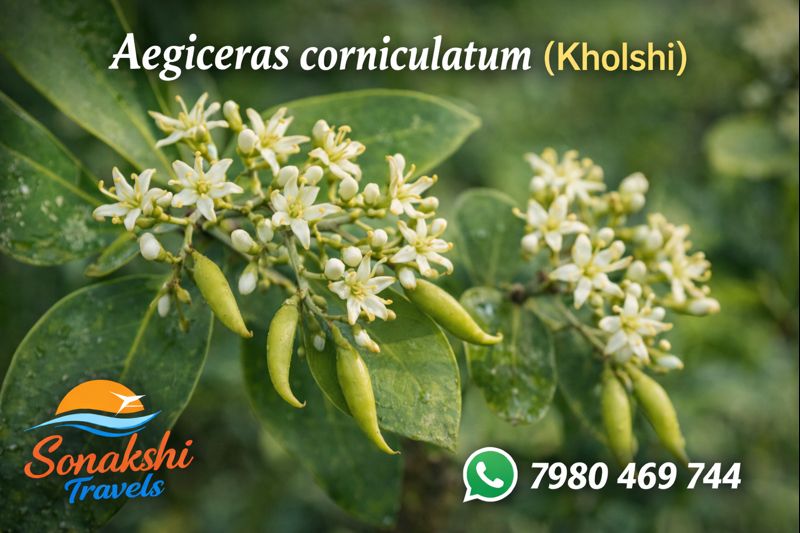
A Detailed Botanical and Ecological Study of a True Mangrove Species
Aegiceras corniculatum, locally known as Kholshi, is a true mangrove species of exceptional ecological importance in tropical and subtropical estuarine systems. Characterized by its salt tolerance, distinctive curved fruits, and adaptability to tidal inundation, this evergreen shrub or small tree forms a vital structural and functional component of mangrove forests. In the Sundarbans, Aegiceras corniculatum occupies intertidal zones where salinity, waterlogging, and anaerobic soils present extreme challenges to plant survival.
Beyond its structural role, this species contributes significantly to shoreline stabilization, nutrient cycling, and the maintenance of biodiversity. This article presents an in-depth, research-oriented examination of Aegiceras corniculatum (Kholshi), covering its taxonomy, morphology, habitat requirements, ecological role, regional occurrence, and conservation relevance, with a particular emphasis on the Sundarbans mangrove ecosystem.
Taxonomy & Classification
belongs to the family Primulaceae (formerly Myrsinaceae), a group that includes several salt-tolerant woody plants adapted to coastal environments. The genus Aegiceras is relatively small but ecologically significant, with species specialized for mangrove habitats.
Scientific Classification
Kingdom: Plantae
Clade: Angiosperms
Clade: Eudicots
Order: Ericales
Family: Primulaceae
Genus: Aegiceras
Species: Aegiceras corniculatum (L.) Blanco
The species epithet corniculatum refers to the horn-like curvature of its mature fruits, a key identifying characteristic.
Morphology & Field Identification
is typically an evergreen shrub or small tree reaching heights of 2–6 meters, though under optimal conditions it may grow taller. Its compact form and leathery foliage reflect strong adaptations to saline, waterlogged soils.
Stem and Bark
The stem is short and often multi-branched, with smooth to slightly fissured bark that appears greyish-brown. Young branches are greenish and flexible, facilitating resistance to tidal movement and wave action.
Leaves
Leaves are opposite, simple, and obovate to elliptic in shape, measuring 5–10 cm in length. The leaf surface is glossy, thick, and leathery, minimizing water loss and salt accumulation. Margins are entire, and the apex is typically rounded or slightly notched.
Flowers
Flowers are small, white to cream-colored, and borne in compact axillary clusters. They are fragrant and rich in nectar, attracting a variety of insect pollinators. Each flower consists of five petals and a prominent calyx.
Fruits and Seeds
The fruit is a distinctive curved, cylindrical capsule resembling a horn, measuring 5–8 cm in length. Seeds exhibit cryptovivipary, where germination begins while the seed is still attached to the parent plant, enhancing seedling establishment in unstable substrates.
Habitat & Distribution
is strictly associated with coastal and estuarine environments. It thrives in intertidal zones subjected to regular tidal flooding and fluctuating salinity levels.
Global Range
The species is widely distributed across:
South and Southeast Asia
Eastern India and Bangladesh
Myanmar, Thailand, and Malaysia
Southern China
Northern Australia and parts of the western Pacific
This extensive range highlights its remarkable adaptability to diverse tropical coastal environments.
Preferred Habitat
Preferred habitats include:
Intertidal mudflats
Creek banks and estuarine margins
Low-energy coastal zones
Areas with fine silty or clay-rich substrates
Occurrence
commonly forms dense thickets or mixed stands with other mangrove species. Its distribution within mangrove forests often reflects subtle variations in elevation, salinity, and tidal exposure.
Preferred Habitat in the Sundarbans Region
In the Sundarbans, Kholshi occupies middle to lower intertidal zones where tidal inundation is frequent but not continuous. It is commonly found along creek margins and sheltered estuarine banks, often associated with species such as Avicennia and Excoecaria.
Its presence contributes to sediment trapping and shoreline stabilization, reducing erosion and enhancing habitat complexity.
Experience the living mangrove corridors of the delta with a carefully curated Sundarban Tour that highlights true mangrove species and estuarine ecology.
Ecological Role
performs several critical ecological functions within mangrove ecosystems. Its dense root network stabilizes soft sediments and reduces coastal erosion.
Biodiversity Support
The flowers provide nectar for insects, while the dense foliage offers shelter for birds and juvenile fish during high tides. Fallen leaves contribute organic matter to detrital food webs, supporting invertebrates and microbial communities.
Coastal Protection
By attenuating wave energy and trapping sediments, this species plays a key role in protecting inland areas from storm surges and tidal erosion.
Habitat Alteration
Human-induced changes such as embankment construction, altered freshwater flow, and land reclamation have modified the natural distribution of Aegiceras corniculatum. While the species tolerates moderate salinity fluctuations, prolonged hypersaline conditions can impede regeneration.
Climate-driven sea-level rise and increased storm frequency further influence its habitat suitability.
Conservation Efforts
is not currently listed as globally threatened; however, conservation of intact mangrove habitats is essential for sustaining its populations. Restoration initiatives in the Sundarbans increasingly recognize the importance of native species like Kholshi in enhancing ecosystem resilience.
Protection of tidal creeks and prevention of large-scale habitat fragmentation remain key conservation priorities.
Did You Know?
The curved fruit of Aegiceras corniculatum is adapted for tidal dispersal.
It exhibits cryptovivipary, a rare reproductive strategy among mangroves.
The species plays a major role in sediment stabilization.
It is considered an indicator of relatively stable intertidal zones.
Discover the ecological richness of tidal forests through an immersive Sundarban Tour focused on mangrove biodiversity and conservation.