Botanical Identity, Mangrove Ecology, and Conservation Importance in Tropical Estuarine Systems
Ceriops decandra is a true mangrove species of high ecological importance, belonging to the family Rhizophoraceae. It is widely recognized as a characteristic component of Indo-Pacific mangrove forests, particularly in deltaic and estuarine environments where salinity gradients, tidal inundation, and anaerobic soils shape vegetation structure. In the Sundarbans, Ceriops decandra plays a vital role in stabilizing intertidal zones, maintaining soil integrity, and supporting complex food webs.
Often forming dense, low-growing stands, this species contributes significantly to the zonation patterns typical of mature mangrove ecosystems. Though less conspicuous than towering mangrove trees, Ceriops decandra is ecologically indispensable, especially in regions experiencing fluctuating salinity and sediment deposition. This article provides an in-depth, research-based exploration of its taxonomy, morphology, habitat preferences, distribution, ecological functions, and conservation status, with a special focus on the Sundarbans mangrove landscape.
Taxonomy & Classification
Systematic Position
Ceriops decandra belongs to the Rhizophoraceae family, a group renowned for its dominance in tropical mangrove ecosystems. Members of this family exhibit remarkable adaptations to saline, waterlogged, and oxygen-poor substrates.
Kingdom: Plantae
Clade: Angiosperms
Clade: Eudicots
Order: Malpighiales
Family: Rhizophoraceae
Genus:Ceriops
Species:Ceriops decandra
The genus Ceriops comprises a small number of mangrove species distinguished by knee roots, leathery leaves, and viviparous propagules. The specific epithet decandra refers to floral characteristics observed in early taxonomic descriptions.
Morphology & Field Identification
Growth Habit and Trunk
Ceriops decandra is a small to medium-sized evergreen mangrove tree, generally attaining heights of 5–10 meters, though stunted forms are common in highly saline or nutrient-poor sites. The trunk is often crooked or irregular, with a relatively thin diameter compared to larger mangrove trees.
Bark
The bark is greyish-brown to reddish-brown, smooth in young individuals and becoming rough and fissured with age. It is rich in tannins, a feature that historically made the species valuable for traditional tanning and dyeing practices.
Root System
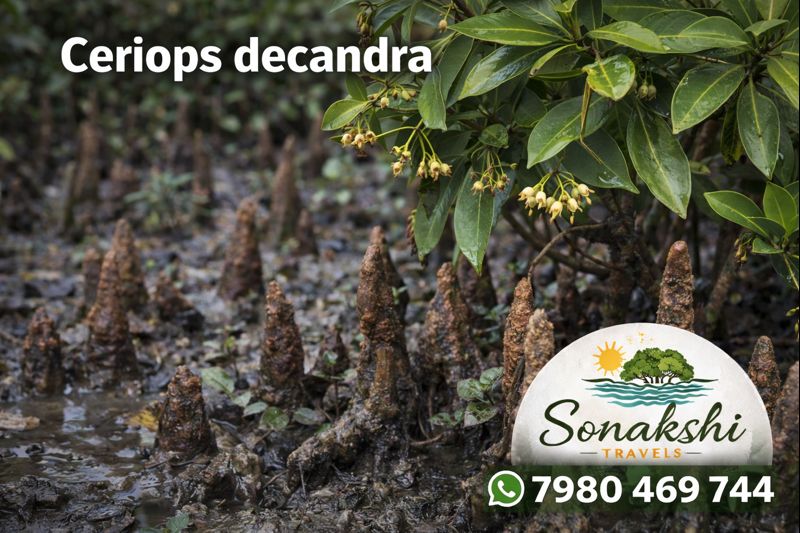
The species develops characteristic knee roots that emerge from the soil surface in looping structures. These roots enhance gas exchange in oxygen-deficient substrates and provide mechanical stability in soft, waterlogged sediments.
Leaves
Leaves are opposite, thick, and leathery, typically elliptic to obovate in shape. The upper surface is glossy green, while the underside is paler. Leaf margins are entire, and the leaf apex is often rounded or slightly notched.
Flowers
Flowers are small, greenish-white, and borne in compact axillary clusters. Each flower possesses a tubular calyx and reduced petals, reflecting adaptation to pollination by insects capable of navigating dense mangrove vegetation.
Fruits and Propagules
As with other members of Rhizophoraceae, Ceriops decandra exhibits vivipary. The seed germinates while still attached to the parent tree, forming an elongated, cylindrical propagule that later detaches and establishes in suitable substrates.
Habitat & Distribution
General Habitat
Ceriops decandra is strictly confined to mangrove ecosystems. It typically occupies mid to upper intertidal zones, where tidal inundation is regular but not continuous. The species shows strong tolerance to salinity and thrives in fine, silty-clay soils.
Environmental Conditions
The species prefers areas with moderate tidal flushing and stable sediment deposition. It is well adapted to anaerobic soils and can withstand prolonged exposure to saline water, making it a resilient component of coastal forests.
Global Range
The natural range of Ceriops decandra extends across the Indo-Pacific region. It is distributed along the coasts of South Asia, Southeast Asia, and parts of northern Australia. Countries where the species is commonly found include India, Bangladesh, Myanmar, Thailand, Malaysia, Indonesia, and Sri Lanka.
Within this range, its abundance varies depending on local hydrological conditions, sediment availability, and anthropogenic pressures.
Occurrence
In India, Ceriops decandra is predominantly found along the eastern coastline, particularly in West Bengal, Odisha, and Andhra Pradesh. The Sundarbans represent one of its most extensive and ecologically significant habitats.
The species often forms monospecific stands or grows in association with other mangrove species such as Rhizophora, Bruguiera, and Avicennia.
Preferred Habitat in the Sundarbans Region
Zonation Pattern
Within the Sundarbans, Ceriops decandra typically occupies intermediate zones between low-tide and high-tide mangrove communities. These areas experience regular tidal flooding but are less exposed to wave action.
Salinity and Soil Preferences
The species shows high tolerance to salinity fluctuations, making it particularly successful in central and western parts of the Sundarbans where salinity levels can be elevated. It favors compact, fine-textured soils that retain moisture and nutrients.
Understanding the structure of true mangrove forests becomes far more engaging through a guided Sundarban Tour, where species like Ceriops decandra define the landscape.
Ecological Role
Shoreline Stabilization
The extensive root systems of Ceriops decandra bind sediments and reduce erosion caused by tidal currents. This stabilization is crucial in maintaining the integrity of deltaic coastlines.
Biodiversity Support
Dense stands provide shelter and breeding grounds for fish, crustaceans, mollusks, and insects. Leaf litter from the species contributes to detrital food chains that sustain mangrove-associated fauna.
Habitat Alteration
Habitat alteration remains a significant threat to Ceriops decandra. Coastal development, embankment construction, shrimp aquaculture, and pollution have reduced suitable mangrove habitats. In the Sundarbans, rising sea levels and increased cyclonic activity further stress mangrove communities.
Although resilient, prolonged disturbances can hinder natural regeneration and alter species composition.
Conservation Efforts
Protected Area Management
Ceriops decandra benefits from conservation measures implemented within protected mangrove reserves, including the Sundarbans Biosphere Reserve. Legal protection of mangrove forests indirectly safeguards this species.
Restoration and Monitoring
Mangrove restoration projects increasingly recognize the importance of species diversity. Inclusion of Ceriops decandra in afforestation and monitoring programs enhances ecosystem resilience.
Participating in an eco-sensitive Sundarban Tour helps promote awareness of mangrove conservation and sustainable livelihoods.
Did You Know?
Ceriops decandra is a true mangrove species exhibiting vivipary.
The bark is rich in tannins and was traditionally used for dyeing fishing nets.
Its knee roots are specialized for oxygen uptake in waterlogged soils.
The species plays a critical role in sediment stabilization in deltaic regions.