A Botanical Profile of a Mangrove-Associated Tree of the Sundarbans
Cynometra ramiflora, locally known as Shingra, is a lesser-known yet ecologically significant tree species occurring in tropical coastal forests and mangrove-associated ecosystems of South and Southeast Asia. Within the complex tidal landscapes of the Sundarbans, this species plays a subtle but meaningful role in stabilizing forest structure, supporting biodiversity, and maintaining ecological balance. Although not as visually dominant as true mangroves such as Heritiera or Avicennia, Cynometra ramiflora represents an important component of the transitional vegetation between freshwater swamp forests and saline mangrove zones.
This article presents a comprehensive, research-based botanical overview of Cynometra ramiflora, covering its taxonomy, morphology, habitat preferences, distribution patterns, ecological functions, conservation concerns, and its specific relevance within the Sundarbans region.
Taxonomy & Classification
Systematic Position
Cynometra ramiflora belongs to the legume family, a large and diverse group of flowering plants known for their ecological importance and nitrogen-fixing capabilities. Its taxonomic classification is as follows:
Kingdom: Plantae
Clade: Angiosperms
Clade: Eudicots
Order: Fabales
Family: Fabaceae
Subfamily: Detarioideae
Genus: Cynometra
Species: Cynometra ramiflora L.
The genus Cynometra comprises several tropical tree species, many of which are associated with coastal, swampy, or seasonally inundated habitats. C. ramiflora is distinguished within the genus by its ramiflorous flowering habit and tolerance of moist, saline-influenced soils.
Morphology & Field Identification
General Growth Form
Cynometra ramiflora is a medium-sized evergreen tree that typically attains heights of 8–20 meters under favorable conditions. The trunk is generally straight with a moderately dense, spreading crown. Bark texture varies from smooth to slightly fissured, exhibiting greyish-brown to dark brown coloration.
Leaves
The leaves are compound, typically consisting of a single pair of opposite leaflets. Each leaflet is leathery, elliptic to oblong, with entire margins and a glossy upper surface. The thick, coriaceous texture of the leaves is an adaptation that reduces water loss and provides resistance against salt spray in coastal environments.
Flowers
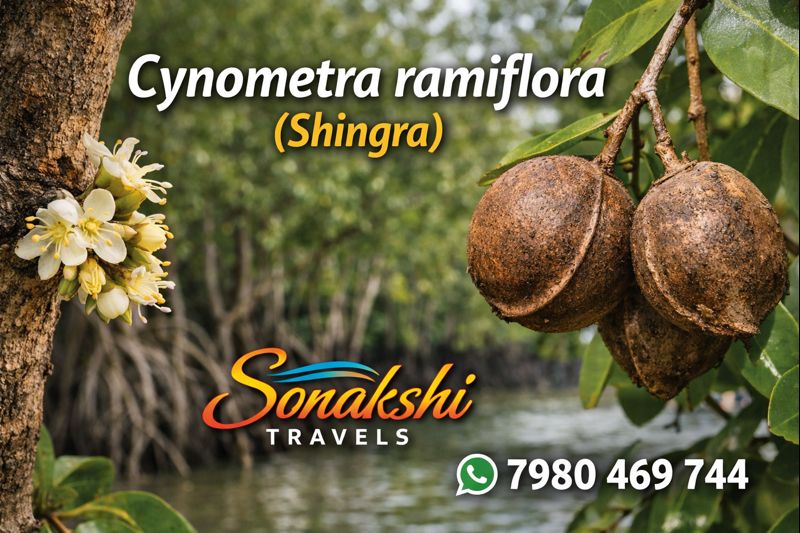
One of the most distinctive features of Cynometra ramiflora is its ramiflorous flowering pattern, where flowers emerge directly from older branches or the trunk. The flowers are small, pale yellow to creamy white, and mildly fragrant, appearing in clusters during the flowering season.
Fruits and Seeds
The fruit is a thick-walled, indehiscent pod, typically containing a single large seed. The pods are woody, globose to ovoid, and turn brown upon maturity. The robust nature of the fruit offers protection against tidal abrasion and facilitates dispersal in waterlogged habitats.
Habitat & Distribution
Habitat Characteristics
Cynometra ramiflora thrives in humid tropical climates and is commonly found in lowland rainforests, coastal swamps, riverbanks, and mangrove margins. It is particularly well adapted to seasonally inundated soils and areas with fluctuating salinity levels.
Global Range
Geographical Distribution
The species has a wide Indo-Pacific distribution. Its natural range extends across eastern India, Bangladesh, Sri Lanka, Myanmar, Thailand, Malaysia, Indonesia, Papua New Guinea, and parts of northern Australia. Within this broad range, populations are often fragmented, occurring in suitable microhabitats rather than forming extensive monocultures.
Preferred Habitat
Environmental Preferences
The species favors moist, clay-rich or alluvial soils with good organic content. It tolerates partial salinity and periodic flooding but does not usually dominate highly saline, open mangrove flats. Instead, it occupies transitional zones where freshwater input moderates salt concentrations.
Planning a guided mangrove forest exploration? Discover carefully curated Sundarban Tour experiences designed around nature, wildlife, and local ecology.
Occurrence
Population Pattern
Cynometra ramiflora generally occurs as scattered individuals or small clusters rather than dense stands. Its presence often indicates relatively stable hydrological conditions and moderate human disturbance.
Preferred Habitat in the Sundarbans Region
Local Ecological Niche
In the Sundarbans, Cynometra ramiflora is typically found along elevated creek banks, inner estuarine margins, and areas receiving periodic freshwater inflow from upstream rivers. These locations allow the species to avoid extreme salinity while still benefiting from nutrient-rich tidal sediments.
Ecological Role
Ecosystem Functions
As a leguminous tree, Cynometra ramiflora contributes to soil fertility through nitrogen enrichment, indirectly supporting understory vegetation. Its fruits and seeds provide food for small mammals and rodents, while its canopy offers shelter for birds and arboreal fauna.
Habitat Alteration
Threats and Pressures
Habitat alteration due to coastal development, embankment construction, altered freshwater flow, and climate-induced sea-level rise poses significant challenges to the long-term survival of Cynometra ramiflora. Reduction in transitional forest zones directly impacts its natural habitat.
Conservation Efforts
Protection Measures
Although not currently classified as globally threatened, conservation of Cynometra ramiflora depends on the protection of mangrove-associated forests and maintenance of natural hydrological regimes. Community-based forest management and mangrove restoration programs indirectly support its persistence.
Experience the living mangrove landscape responsibly through a guided Sundarban Tour that emphasizes ecology, conservation, and local heritage.
Did You Know?
Interesting Botanical Facts
The species name ramiflora refers to its unique habit of flowering directly from branches.
Its thick fruit wall helps protect the seed from prolonged water exposure.
Though a legume, it does not display conspicuous root nodules like many terrestrial Fabaceae.
The tree is often used as an indicator species for semi-saline forest health.