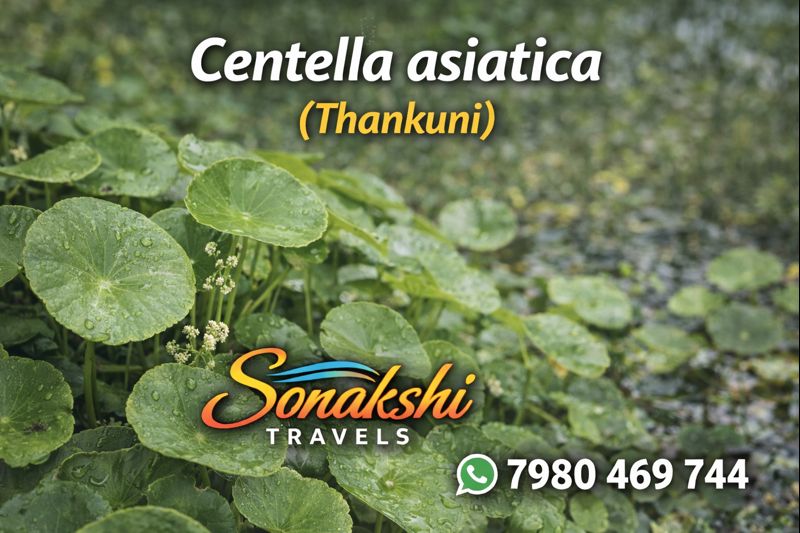
Centella asiatica, widely known as Thankuni in eastern India and Bangladesh, is a low-growing perennial herb revered for its remarkable medicinal, ecological, and cultural significance. Often associated with wetlands, marshy grounds, and riverine landscapes, this plant thrives in moist tropical environments and has been an integral component of traditional knowledge systems for centuries. In regions such as the Sundarbans, Centella asiatica represents both ecological resilience and ethnobotanical heritage, bridging natural ecosystems and human well-being.
Belonging to the family Apiaceae, Centella asiatica is characterized by its creeping growth habit, kidney-shaped leaves, and adaptability to fluctuating water regimes. This article presents a detailed, research-oriented exploration of the species, encompassing its taxonomy, morphology, habitat preferences, ecological functions, conservation concerns, and its relevance within the Sundarbans landscape.
Taxonomy & Classification
Systematic Position
Centella asiatica is a member of the Apiaceae family, commonly referred to as the carrot or parsley family, which includes numerous aromatic and medicinal herbs. The accepted taxonomic classification is as follows:
Kingdom: Plantae
Clade: Angiosperms
Clade: Eudicots
Order: Apiales
Family: Apiaceae
Genus: Centella
Species: Centella asiatica (L.) Urb.
The species has been described under several synonyms in historical botanical literature, reflecting its wide distribution and early documentation across continents. Modern taxonomy recognizes Centella asiatica as a distinct species with consistent morphological and phytochemical traits.
Morphology & Field Identification
Growth Habit
Centella asiatica is a perennial, creeping herb with slender stolons that root at nodes, allowing rapid horizontal spread across moist substrates. This growth form enables the plant to colonize open ground efficiently, particularly in wetlands and seasonally flooded areas.
Leaves
The leaves are simple, long-petioled, and reniform to orbicular in shape, with crenate or scalloped margins. Leaf blades are smooth, glabrous, and bright green, forming a ground-hugging rosette. The leaf venation radiates from the point of petiole attachment, a key diagnostic feature in field identification.
Flowers
Flowers are small, inconspicuous, and borne in simple umbels arising from leaf axils. They are typically pinkish, white, or light purple in color. Each flower possesses five petals and a reduced calyx, consistent with other members of the Apiaceae family.
Fruits and Seeds
The fruit is a small, laterally compressed schizocarp that splits into two mericarps upon maturity. Seeds are minute and lightweight, facilitating dispersal through water movement and surface runoff in wetland environments.
Habitat & Distribution
Ecological Preferences
Centella asiatica is strongly associated with moist and humid habitats. It thrives in marshes, wet grasslands, paddy fields, riverbanks, and shaded forest edges. The species shows a pronounced preference for water-retentive soils rich in organic matter.
Global Range
Geographical Distribution
The species has a pantropical distribution, occurring naturally across South Asia, Southeast Asia, East Asia, Africa, Australia, and parts of the Pacific Islands. It has also been introduced to the Americas and Europe through cultivation and medicinal use. Its wide global presence reflects its ecological plasticity and long history of human association.
Preferred Habitat
Environmental Conditions
Centella asiatica prefers semi-shaded to open areas with consistently moist soil. It tolerates periodic flooding and shallow standing water but does not thrive in prolonged drought conditions. Slightly acidic to neutral soil pH supports optimal growth.
Wetland flora such as Thankuni are best understood through on-ground exploration. Join a guided Sundarban Tour to experience native plants within their natural mangrove and riverine habitats.
Occurrence
Population Characteristics
Centella asiatica occurs abundantly in suitable habitats, often forming dense mats. Its rapid vegetative reproduction enables persistence even under moderate disturbance, making it a common component of wetland ground cover.
Preferred Habitat in the Sundarbans Region
Local Distribution
In the Sundarbans, Centella asiatica is commonly found in freshwater-dominated zones, village ponds, canal edges, embankment slopes, and the margins of mangrove forests where salinity is comparatively low. Seasonal inundation and nutrient-rich alluvial soils create ideal conditions for its growth.
Ecological Role
Ecosystem Functions
The species plays a vital ecological role as a ground-cover plant, reducing soil erosion and enhancing moisture retention. Its dense growth helps stabilize wet soils, while decomposing plant matter contributes to nutrient cycling. It also provides microhabitats for invertebrates and supports wetland biodiversity.
Habitat Alteration
Environmental Pressures
Habitat alteration through drainage of wetlands, conversion of marshes to agriculture, and urban expansion poses localized threats to Centella asiatica. In coastal regions, increasing salinity and pollution may reduce suitable habitat availability over time.
Conservation Efforts
Management and Sustainability
Although not classified as threatened, conservation of Centella asiatica depends on the protection of wetlands and sustainable harvesting practices. Community awareness and habitat conservation play a key role in maintaining natural populations, particularly in ecologically sensitive regions like the Sundarbans.
Explore wetland ecosystems and traditional plant knowledge through a guided Sundarban Tour that connects biodiversity, culture, and conservation.
Did You Know?
Interesting Facts
The plant is widely used in traditional herbal practices across Asia.
Its creeping habit allows rapid recovery after flooding.
The leaves are often consumed as a leafy vegetable in rural areas.
The species is valued for its role in maintaining wetland soil stability.