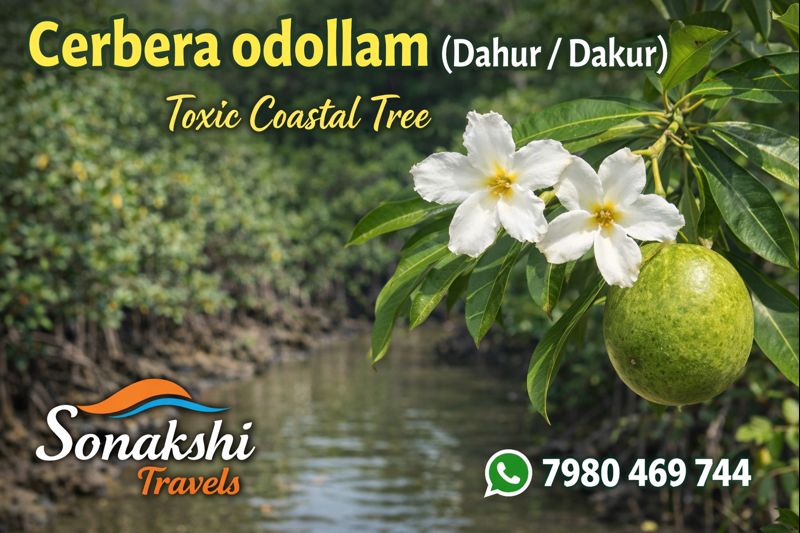
A Toxic Mangrove Associate with Profound Ecological Significance
Cerbera odollam, locally known as Dahur or Dakur, is a remarkable coastal tree species deeply embedded in the ecological fabric of tropical estuarine forests. Belonging to the family Apocynaceae, this species is widely recognized for its potent toxicity, glossy evergreen foliage, and strong association with mangrove-adjacent habitats. Although infamous in popular narratives due to the poisonous nature of its seeds, Cerbera odollam plays an essential ecological role in stabilizing coastal ecosystems, particularly within the Sundarbans delta.
In the Sundarbans, where land and water interact continuously under the influence of tides, salinity, and monsoonal floods, Cerbera odollam thrives as a resilient mangrove associate. Its ability to tolerate saline soils, waterlogged substrates, and periodic inundation makes it a vital component of transitional forest zones. Beyond its toxic reputation, the species contributes to biodiversity, shoreline protection, and ecological balance.
Taxonomy & Classification
Scientific Classification
Cerbera odollam is taxonomically placed within the Apocynaceae family, a group well known for latex-bearing plants and species containing powerful alkaloids and cardiac glycosides. The genus Cerbera includes several coastal species adapted to saline and tropical environments.
The species name odollam is derived from regional vernacular usage, reflecting its long-standing recognition in South Asian coastal cultures. Botanically, it is often described as a mangrove associate rather than a true mangrove, as it does not exhibit specialized aerial root systems like pneumatophores.
Morphology & Field Identification
General Growth Form
Cerbera odollam is a medium-sized evergreen tree, typically reaching heights of 8 to 15 meters. The trunk is straight and cylindrical, often branching at higher levels to form a dense, rounded canopy. The bark is greyish-brown, smooth in younger individuals, and slightly fissured in mature trees.
Leaves
The leaves are simple, glossy, and leathery, arranged spirally near the ends of branches. Each leaf is elongated, lanceolate to obovate, with entire margins and a prominent midrib. The leathery texture minimizes water loss and protects the leaf surface from saline spray, making it well suited for coastal conditions.
Flowers
The flowers of Cerbera odollam are visually striking and fragrant. They are typically white with a yellow or pale pink throat, arranged in terminal clusters. The tubular corolla structure attracts insect pollinators, particularly butterflies and bees, during the flowering season.
Fruits and Seeds
The fruit is a smooth, ovoid drupe resembling a green mango, which turns reddish or purplish upon maturity. Inside the fibrous mesocarp lies a hard kernel containing highly toxic seeds rich in cardiac glycosides, notably cerberin. These seeds are extremely poisonous if ingested.
Habitat & Distribution
General Habitat
Cerbera odollam naturally occurs in coastal forests, estuarine margins, riverbanks, and mangrove-adjacent zones. It favors areas that experience periodic tidal flooding but are not permanently submerged. The species is commonly found along brackish water channels and low-lying coastal plains.
Environmental Adaptations
The tree demonstrates remarkable tolerance to salinity, waterlogging, and fluctuating water tables. Its root system is adapted to anaerobic soil conditions, allowing survival in poorly oxygenated substrates common in estuarine environments.
Global Range
The global distribution of Cerbera odollam spans tropical regions of South Asia and Southeast Asia. It is widely recorded in India, Bangladesh, Sri Lanka, Myanmar, Thailand, Malaysia, Indonesia, and parts of the Pacific Islands. Its presence is closely linked to coastal and estuarine ecosystems influenced by tidal activity.
In India, the species is most commonly found along the eastern coastline, including West Bengal, Odisha, Andhra Pradesh, Tamil Nadu, and the Andaman and Nicobar Islands. The Sundarbans represent one of its most ecologically significant habitats.
Preferred Habitat
Soil Characteristics
Cerbera odollam prefers clayey to silty soils with high moisture content and moderate organic matter. These soils are often saline or brackish, especially in tidal zones. The species is well adapted to nutrient-poor substrates and can withstand prolonged water saturation.
Hydrological Conditions
Optimal growth occurs in areas subjected to seasonal flooding rather than constant inundation. The rhythmic influence of tides helps maintain soil chemistry favorable for this species.
Occurrence
The occurrence of Cerbera odollam is typically scattered rather than forming dense stands. In coastal forests, it is often interspersed with other mangrove associates and true mangrove species. In the Sundarbans, it appears along forest fringes, creek banks, and slightly elevated zones within the delta.
Preferred Habitat in the Sundarbans Region
Within the Sundarbans, Cerbera odollam thrives in transitional zones between dense mangrove interiors and terrestrial forest edges. These zones experience moderate salinity, regular tidal flushing, and rich alluvial deposition.
The species is frequently observed along riverbanks and embankments, where it contributes to soil stabilization and reduces erosion caused by tidal currents and storm surges.
Exploring coastal forests becomes more meaningful when guided by experts. Discover mangrove associates like Dahur through a thoughtfully curated Sundarban Tour Package designed for nature enthusiasts.
Ecological Role
Shoreline Stabilization
Cerbera odollam plays a crucial role in stabilizing coastal soils. Its extensive root system binds sediment, reducing erosion along riverbanks and tidal channels. This function is particularly valuable in cyclone-prone regions like the Sundarbans.
Biodiversity Support
The flowers provide nectar for pollinating insects, while the dense canopy offers shelter for birds and small arboreal fauna. Fallen leaves contribute organic matter to the forest floor, supporting detrital food webs.
Ecological Defense Mechanism
The extreme toxicity of its seeds acts as a natural defense against herbivory. This chemical protection helps maintain population stability and influences local food chain dynamics.
Habitat Alteration
Coastal development, land reclamation, aquaculture expansion, and embankment construction have altered many habitats suitable for Cerbera odollam. Disruption of natural tidal flow and increased pollution can negatively affect seedling establishment and long-term survival.
In the Sundarbans, rising sea levels and intensified cyclonic activity pose additional threats by reshaping forest structure and salinity gradients.
Conservation Efforts
Although Cerbera odollam is not currently listed as threatened, its ecological importance warrants proactive conservation measures. Protection of mangrove-associated forests, sustainable coastal management, and habitat restoration are essential to ensure healthy populations.
Including mangrove associates like Dahur in coastal afforestation and climate resilience programs can significantly enhance ecosystem stability and biodiversity conservation.
Witness the delicate balance between toxic plants and thriving wildlife on an immersive Sundarban Private Tour, guided by experienced naturalists.
Did You Know?
The seeds of Cerbera odollam contain cerberin, a powerful cardiac glycoside that affects heart function.
Despite its toxicity, the tree is an important ecological stabilizer in coastal forests.
The fruit can float, aiding water-based seed dispersal along tidal channels.
The species has been traditionally recognized in coastal folklore for its poisonous properties.