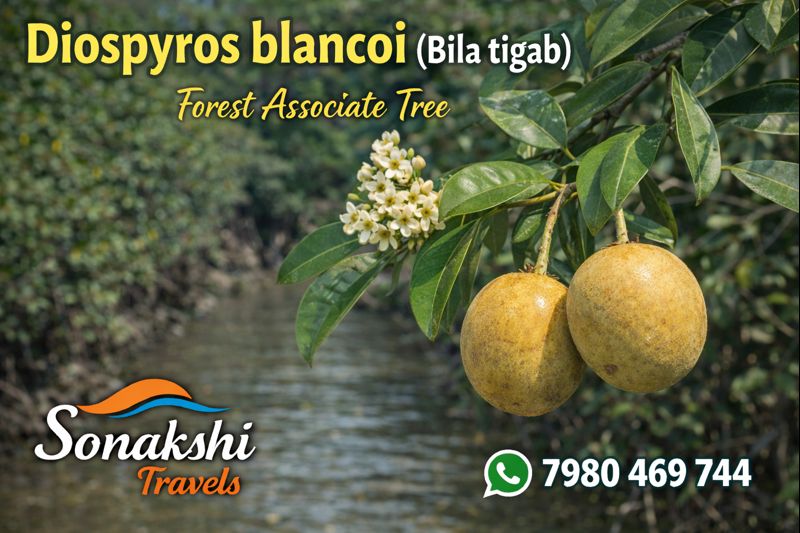
Botanical Characteristics, Ecological Importance, and Regional Presence
Diospyros blancoi, locally known as Bila tigab, is a distinctive evergreen tree species belonging to the ebony family. Revered for its dense wood, ornamental foliage, and ecological adaptability, this species occupies a significant yet understated role within tropical and subtropical forest ecosystems. In deltaic landscapes such as the Sundarbans and its peripheral regions, Diospyros blancoi functions as a resilient forest associate, contributing to habitat complexity and ecological stability.
While the genus Diospyros is globally renowned for economically important species like ebony and persimmon, Diospyros blancoi stands apart due to its tolerance of humid climates, variable soil conditions, and partial salinity. In the Sundarbans region, the tree is encountered primarily in elevated forest margins and transitional zones, where freshwater influence mitigates extreme salinity.
Taxonomy & Classification
Systematic Position
Diospyros blancoi is a member of the family Ebenaceae, a family comprising trees and shrubs known for their hard, dark-colored wood and leathery leaves. The genus Diospyros is one of the largest within the family and includes both fruit-bearing and timber-producing species.
The species name blancoi honors early botanical contributors associated with its formal description. In regional ethnobotanical contexts, the tree is recognized under various vernacular names, reflecting its long-standing presence in South and Southeast Asian landscapes.
Morphology & Field Identification
General Growth Form
Diospyros blancoi is a medium to large evergreen tree, typically attaining heights between 15 and 25 meters. The trunk is straight and cylindrical, often supporting a broad, rounded crown. Mature bark appears dark grey to brown, occasionally fissured, while younger bark remains smoother.
Leaves
The leaves are simple, alternate, and broadly elliptic to oblong in shape. They are thick, leathery, and glossy on the upper surface, with a paler underside. This coriaceous texture minimizes transpiration and provides resistance against strong winds and high humidity.
Flowers
Flowers are small, pale cream to yellowish, and generally inconspicuous. The species is typically dioecious, bearing male and female flowers on separate trees. Pollination is facilitated by insects attracted to the subtle floral scent.
Fruits and Seeds
The fruit is a rounded to slightly flattened berry, often covered with a fine velvety texture. When mature, the fruit turns yellowish to orange-brown. Inside, several seeds are embedded in soft pulp. Although not a major commercial fruit, fallen fruits provide food for wildlife and contribute to nutrient cycling.
Habitat & Distribution
Natural Habitat
Diospyros blancoi inhabits tropical evergreen and semi-evergreen forests, riverine woodlands, and coastal plains. It prefers environments with high atmospheric humidity, stable temperatures, and seasonal rainfall.
Environmental Adaptability
The species demonstrates moderate tolerance to waterlogged soils and can survive short periods of inundation. This adaptability enables its survival in deltaic and estuarine landscapes where hydrological conditions fluctuate seasonally.
Global Range
The natural range of Diospyros blancoi extends across South and Southeast Asia. It is recorded in eastern India, Bangladesh, Myanmar, Thailand, Malaysia, Indonesia, and the Philippines. Within these regions, the species occurs sporadically rather than forming dominant forest stands.
In India, its presence is mainly confined to eastern and northeastern states, where climatic and soil conditions align with its ecological requirements.
Preferred Habitat
Soil Preferences
Diospyros blancoi grows best in deep, loamy to clay-loam soils enriched with organic matter. While it prefers well-drained substrates, it can tolerate periodic waterlogging common in monsoon-influenced regions.
Climatic Conditions
The species thrives under tropical climatic regimes characterized by warm temperatures, high humidity, and seasonal rainfall. Prolonged drought or extreme salinity adversely affects seedling establishment.
Occurrence
The occurrence of Diospyros blancoi is typically scattered, with individuals appearing singly or in small clusters. It rarely forms dense populations. In the Sundarbans region, the tree is mostly confined to buffer zones and elevated islands where soil salinity is relatively low.
Preferred Habitat in the Sundarbans Region
Within the Sundarbans, Bila tigab is primarily found along forest margins, embankments, and transitional zones between mangrove forests and terrestrial vegetation. These areas experience reduced tidal inundation and benefit from freshwater inflow.
Such habitats provide a balance of moisture availability and soil aeration, enabling the species to coexist alongside mangrove associates and inland forest species.
Understanding forest diversity becomes more enriching through an immersive Sundarban Tour Package guided by local naturalists.
Ecological Role
Forest Structure and Stability
Diospyros blancoi contributes to forest stratification by occupying the mid to upper canopy layers. Its strong root system enhances soil binding, reducing erosion along forest margins.
Support for Wildlife
The fruits are consumed by birds and small mammals, aiding seed dispersal. The dense foliage provides nesting and shelter opportunities for arboreal fauna.
Microclimatic Regulation
By casting shade and retaining moisture, the tree helps regulate microclimatic conditions, supporting understory plants and soil organisms.
Habitat Alteration
Habitat alteration poses a growing challenge to Diospyros blancoi. Land conversion, embankment construction, and changes in freshwater flow patterns reduce suitable habitats. Increased soil salinity resulting from sea-level rise further restricts regeneration.
In the Sundarbans, cyclonic events and embankment breaches can abruptly alter soil and hydrological conditions, impacting long-term survival.
Conservation Efforts
Although not classified as threatened at a global scale, Diospyros blancoi benefits from broader forest conservation initiatives. Protecting mixed forest buffers and maintaining freshwater inflow are essential for sustaining populations.
Inclusion of non-mangrove associates in coastal afforestation and restoration programs can enhance overall ecosystem resilience.
For a deeper understanding of how inland trees integrate with mangrove systems, a curated Sundarban Private Tour offers focused ecological interpretation.
Did You Know?
Diospyros blancoi belongs to the same genus as ebony-producing trees.
The species is generally dioecious, with male and female flowers on separate trees.
Its leathery leaves are an adaptation to humid and wind-exposed environments.
The tree often survives for decades, contributing long-term stability to forest ecosystems.