A Detailed Botanical and Ecological Study of a Rare Gentianaceae Herb
Hoppea dichotoma is a delicate, lesser-known herbaceous plant belonging to the family Gentianaceae. Though modest in stature, the species carries considerable botanical significance due to its restricted distribution, specialized habitat requirements, and association with seasonally inundated landscapes. In the Indian subcontinent, Hoppea dichotoma is primarily recorded from moist lowlands, riverine plains, and deltaic ecosystems, where it emerges briefly during favorable climatic windows.
Within the eastern Indian landscape, including areas adjoining the Sundarbans biosphere, this species represents an important component of ephemeral herbaceous flora. Its presence reflects specific hydrological conditions and soil chemistry, making it a valuable ecological indicator species. This article presents a comprehensive and research-oriented overview of Hoppea dichotoma, covering its taxonomy, morphology, habitat preferences, ecological role, and conservation considerations, with special reference to the Sundarbans region.
Taxonomy & Classification
Hoppea dichotoma is classified under the Gentianaceae family, a group of flowering plants widely recognized for their ecological diversity and biochemical richness. The genus Hoppea is relatively small and geographically limited, with species adapted to wetland and semi-aquatic environments.
Kingdom: Plantae
Clade: Angiosperms
Clade: Eudicots
Order: Gentianales
Family: Gentianaceae
Genus:Hoppea
Species:Hoppea dichotoma
Taxonomically, the species is distinguished by its characteristic branching pattern and floral morphology. The epithet dichotoma refers to the distinctive dichotomous branching observed in its inflorescence and stem structure.
Morphology & Field Identification
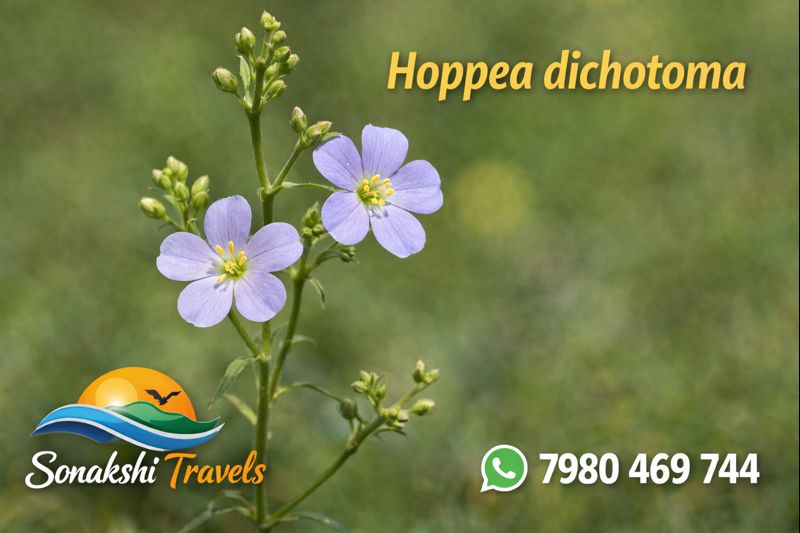
Hoppea dichotoma is a small, erect to semi-erect annual herb, typically reaching heights of 10–30 cm. Its fragile appearance and short life cycle make it easy to overlook, yet careful observation reveals a range of diagnostic features.
Stem and Growth Habit
The stem is slender, green to pale reddish, and distinctly dichotomously branched. Internodes are elongated, particularly in plants growing in partially submerged or waterlogged conditions. The branching pattern is one of the most reliable field characters for identification.
Leaves
Leaves are opposite, sessile or subsessile, narrow-lanceolate to linear, with entire margins and acute apices. The leaf surface is glabrous, and venation is faint but visible upon close inspection. Leaf size and shape may vary slightly depending on moisture availability.
Flowers and Reproductive Structures
Flowers are solitary or borne at the ends of dichotomous branches. The corolla is tubular with spreading lobes, typically pale blue to lavender or occasionally whitish. The calyx is deeply divided, and the stamens are inserted within the corolla tube. Flowering generally occurs shortly after monsoon onset.
The fruit is a small capsule containing numerous minute seeds, adapted for dispersal through water movement during seasonal flooding.
Habitat & Distribution
Hoppea dichotoma is a habitat-specific species, largely confined to moist, open environments that experience periodic inundation. Its distribution is closely linked to monsoonal hydrology and soil moisture regimes.
Global Range
The species is primarily distributed across South Asia, with confirmed records from India, Bangladesh, Nepal, and parts of Southeast Asia. Its global range is fragmented, reflecting the patchy availability of suitable habitats rather than broad climatic constraints.
Preferred Habitat
Preferred habitats include seasonal wetlands, marshy grasslands, riverbanks, paddy field margins, and low-lying floodplains. The plant thrives in open, sunlit locations with minimal competition from taller vegetation.
Wetland flora observations become more meaningful when paired with immersive field experiences. Thoughtfully designed Sundarban Tour Package itineraries allow visitors to explore seasonal plant diversity alongside mangrove landscapes.
Occurrence
In India, Hoppea dichotoma occurs sporadically across eastern, central, and southern regions. Its presence is highly seasonal, often appearing only for a few weeks following monsoon rains. Due to its short life span and habitat specificity, populations may fluctuate dramatically between years.
Preferred Habitat in the Sundarbans Region
Within the greater Sundarbans landscape, Hoppea dichotoma is most likely to occur in transitional zones rather than core mangrove forests. These include freshwater marshes, low-lying grasslands, canal edges, and agricultural fallows influenced by monsoonal flooding.
The species benefits from reduced salinity and periodic freshwater influx, conditions commonly found in buffer zones and inland tracts adjacent to the mangrove ecosystem.
Ecological Role
Despite its small size, Hoppea dichotoma plays an important role in seasonal wetland ecosystems. It contributes to early successional plant communities, stabilizing soil surfaces and reducing erosion during initial stages of flooding.
The flowers provide nectar resources for small insects, including bees and flies, while the seeds contribute to the wetland seed bank, supporting vegetation regeneration in subsequent seasons.
Habitat Alteration
Habitat alteration poses a significant challenge to the persistence of Hoppea dichotoma. Drainage of wetlands, conversion of seasonal marshes into permanent agriculture, embankment construction, and changes in flooding patterns reduce suitable microhabitats.
In deltaic regions like the Sundarbans, increasing salinity intrusion and altered freshwater flow further limit the species’ potential range.
For travelers interested in understanding subtle ecological transitions and rare wetland flora, curated Sundarban Private Tour experiences offer focused exploration with expert guidance.
Conservation Efforts
Hoppea dichotoma is not widely assessed under global threat categories, yet its habitat specificity suggests potential vulnerability. Conservation strategies should focus on wetland preservation, maintenance of natural hydrological cycles, and documentation of seasonal flora.
In the Sundarbans region, community-led wetland conservation and sustainable land-use practices indirectly support the survival of such ephemeral species.
Did You Know?
The name dichotoma refers to the plant’s repeatedly forked branching pattern.
The species often appears only for a short period during the monsoon season.
Its seeds are adapted for dispersal by shallow floodwaters.
Hoppea dichotoma is considered an indicator of seasonally inundated freshwater habitats.
External Reference
For further botanical classification and taxonomic notes, refer to the relevant entry on Wikipedia.