A Detailed Botanical Profile of a Tropical Climber
Introduction
Parsonsia alboflavescens is a lesser-known yet ecologically significant woody climber belonging to the family Apocynaceae. Distributed primarily across tropical and subtropical regions of South and Southeast Asia, this species contributes quietly but substantially to forest structure, microhabitat formation, and floral diversity. In mangrove-adjacent forests, riparian woodlands, and semi-evergreen tracts, the species exhibits remarkable adaptability, allowing it to thrive in complex and often disturbed environments. Despite its wide occurrence, Parsonsia alboflavescens remains underrepresented in popular botanical literature, making detailed documentation essential for ecological understanding and conservation planning.
Taxonomy & Classification
Systematic Position
Parsonsia alboflavescens is classified within the Apocynaceae family, a large and diverse group known for latex-bearing plants, specialized floral morphology, and significant ecological roles. The genus Parsonsia is characterized by climbing or scrambling woody species that rely on surrounding vegetation for mechanical support.
Taxonomically, the species is distinguished by its pale yellowish-white floral structures, woody climbing habit, and opposite leaf arrangement. Historical herbarium records indicate occasional confusion with closely related species, emphasizing the importance of careful morphological examination.
Morphology & Field Identification
Growth Form and Stem Characteristics
This species is a robust woody climber that often ascends tall trees using twining stems. Mature stems are lignified, cylindrical, and display a greyish-brown to pale bark surface. Younger branches are greenish and flexible, allowing efficient climbing and lateral spread through forest canopies.
Leaf Structure
Leaves are simple, opposite, and broadly elliptic to ovate in shape. The lamina is leathery with a smooth, glossy upper surface and a paler underside. Venation is prominent, with a distinct midrib and lateral veins that curve gently towards the margins. Petioles are short but sturdy, contributing to leaf stability in windy or exposed habitats.
Floral Characteristics
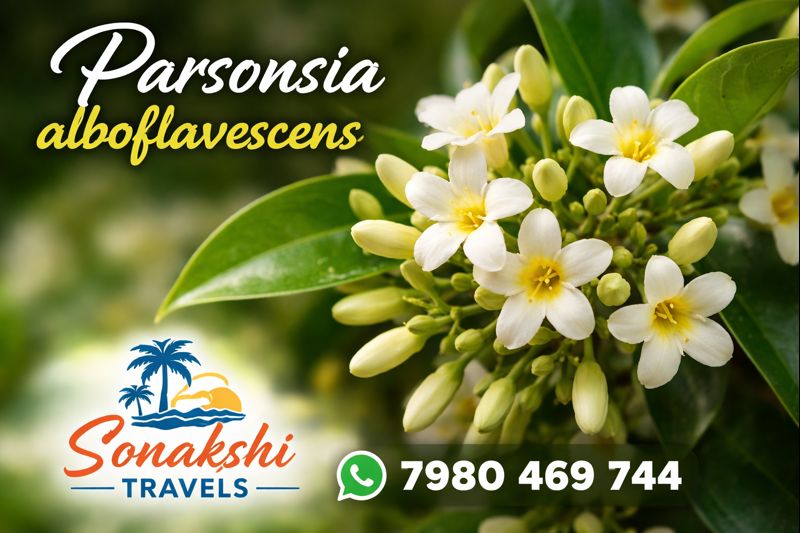
Flowers are arranged in axillary or terminal inflorescences, typically small to medium-sized, with a creamy-white to pale yellow coloration. The corolla is tubular with spreading lobes, a hallmark feature of many Apocynaceae members. Floral scent is subtle but effective in attracting insect pollinators, particularly bees and butterflies.
Fruit and Seed
The fruit is a paired follicle, elongated and tapering, containing numerous seeds. Seeds are equipped with silky hairs that facilitate wind dispersal, allowing colonization across fragmented forest patches and riverine corridors.
Habitat & Distribution
General Habitat Preferences
Parsonsia alboflavescens favors humid tropical environments with moderate to high rainfall. It is commonly observed in semi-evergreen forests, moist deciduous forests, forest edges, and along riverbanks. The species demonstrates tolerance to partial shade and thrives where vertical supports such as trees or large shrubs are abundant.
Altitudinal Range
The species typically occurs from lowland plains up to mid-elevation hill forests. Its ability to persist across a broad altitudinal gradient highlights its ecological plasticity.
Global Range
The geographical distribution of Parsonsia alboflavescens extends across the Indian subcontinent and parts of Southeast Asia. It has been recorded in eastern and northeastern India, Bangladesh, Myanmar, Thailand, and adjacent regions. The species is particularly associated with monsoon-influenced forest systems, where seasonal rainfall patterns support vigorous vegetative growth.
Preferred Habitat
This climber prefers areas with well-drained but moisture-retentive soils, often rich in organic matter. It is frequently encountered along forest margins, secondary growth forests, and transitional zones between dense woodland and open landscapes. Such habitats provide optimal light availability and structural support for climbing.
Occurrence
Occurrences of Parsonsia alboflavescens are typically scattered rather than forming dense populations. Individual plants may extend over large areas by climbing multiple host trees. This growth strategy reduces direct competition while maximizing access to sunlight and pollinators.
Preferred Habitat in the Sundarbans Region
Within the Sundarbans region, Parsonsia alboflavescens is more likely to be found in transitional zones rather than core mangrove forests. It occurs along elevated forest fringes, embankments, and areas where freshwater influence moderates salinity levels. These microhabitats provide suitable soil conditions and host vegetation for climbing.
Planning a guided mangrove exploration with nature interpretation? Discover curated itineraries under our Sundarban Tour Package options and experience the forest responsibly.
Ecological Role
Contribution to Forest Structure
As a climber, Parsonsia alboflavescens adds vertical complexity to forest ecosystems. Its presence enhances habitat heterogeneity, providing shelter and movement pathways for insects, reptiles, and small mammals.
Pollination and Food Web Interactions
The flowers serve as nectar sources for a variety of insects, supporting pollinator populations. Fruits and seeds, though not primary food sources for large fauna, contribute to the diet of smaller organisms and participate in nutrient cycling.
Habitat Alteration
Habitat alteration poses significant challenges to the survival of Parsonsia alboflavescens. Deforestation, conversion of forest land to agriculture, and infrastructure development reduce available climbing supports and fragment populations. In coastal regions, salinity intrusion and embankment construction further limit suitable habitats.
Conservation Efforts
Although not currently listed as threatened on a global scale, Parsonsia alboflavescens benefits indirectly from forest conservation initiatives. Protection of semi-evergreen forests, riparian buffers, and transitional woodland zones is crucial for its continued survival. Botanical surveys and long-term monitoring can help assess population trends and ecological health.
For travelers seeking privacy and expert-guided forest interpretation, explore our thoughtfully designed Sundarban Private Tour experiences.
Did You Know?
Parsonsia alboflavescens belongs to a family known for producing medicinally important compounds.
The wind-dispersed seeds allow the species to colonize newly formed forest edges rapidly.
Its climbing habit reduces the need for heavy structural investment in trunks, enabling efficient energy use.
The species often serves as an indicator of relatively undisturbed forest margins.
External Reference
For additional botanical background and taxonomic notes, readers may consult the general species overview available on Wikipedia: