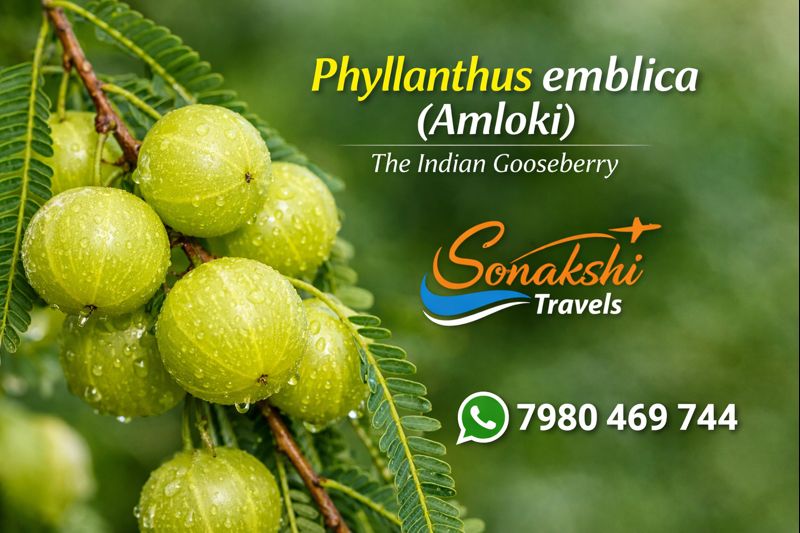
Phyllanthus emblica, commonly known as Amloki, Amla, or Indian Gooseberry, is one of the most revered fruit-bearing trees of South and Southeast Asia. Celebrated for its exceptional nutritional density, remarkable adaptability, and long-standing ethnobotanical relevance, this species occupies a unique position at the intersection of traditional knowledge systems and modern biological science. Beyond its medicinal fame, Phyllanthus emblica represents an ecologically significant component of tropical and subtropical forest systems, including the transitional landscapes adjoining the Sundarbans biosphere.
This article presents an in-depth, research-oriented exploration of Phyllanthus emblica, covering its taxonomy, morphology, habitat preferences, ecological functions, regional occurrence, conservation concerns, and notable scientific facts. The discussion is structured to provide a formal yet accessible reference for students, researchers, and nature enthusiasts alike.
Taxonomy & Classification
Systematic Position
Phyllanthus emblica belongs to the family Phyllanthaceae, a diverse lineage comprising herbs, shrubs, and trees widely distributed across tropical regions. Earlier botanical literature often placed the species under the family Euphorbiaceae; however, advances in molecular phylogenetics have clarified its distinct evolutionary lineage, leading to its current classification.
Kingdom: Plantae
Clade: Angiosperms
Clade: Eudicots
Order: Malpighiales
Family: Phyllanthaceae
Genus: Phyllanthus
Species:Phyllanthus emblica L.
The genus Phyllanthus encompasses several hundred species, many of which exhibit notable medicinal or ecological value. Among them, P. emblica is distinguished by its arborescent habit, edible fruit, and exceptionally high ascorbic acid concentration.
Morphology & Field Identification
General Growth Form
Phyllanthus emblica is a medium-sized deciduous tree, typically attaining heights of 8–18 meters under favorable conditions. The trunk is often crooked or slightly fluted, with a moderate girth and spreading crown. Its overall architecture lends the tree resilience against seasonal drought and periodic disturbance.
Bark and Stem Characteristics
The bark is thin, light grey to greenish-grey, exfoliating in irregular flakes. This peeling characteristic aids in field identification, particularly in mature individuals. Younger branches are glabrous and pale green, gradually turning brownish with age.
Leaves
The leaves are small, simple, and closely set along slender branchlets, giving the appearance of pinnate leaves. Each leaf is linear-oblong, measuring approximately 10–20 mm in length, with entire margins and a rounded apex. This leaf arrangement reduces transpiration, a key adaptation to dry seasonal climates.
Flowers
Flowers are inconspicuous, greenish-yellow, and unisexual, borne in axillary clusters. Male flowers typically occur in dense clusters, while female flowers are fewer and solitary. Flowering generally occurs during the dry season, enhancing pollination efficiency.
Fruits
The fruit is a nearly spherical drupe, 2–3 cm in diameter, with a smooth, thin, pale green to yellowish skin. Internally, the fruit contains a hard, hexagonal endocarp enclosing the seeds. The fruit’s exceptionally high vitamin C content is biologically significant, contributing to antioxidant defense mechanisms.
Habitat & Distribution
Natural Habitat
Phyllanthus emblica thrives in a wide range of ecological settings, from dry deciduous forests to mixed tropical woodlands. It demonstrates remarkable tolerance to soil variability, including lateritic, loamy, and slightly alkaline substrates. Its drought-hardiness allows survival in areas with pronounced dry seasons.
Altitudinal Range
The species is found from near sea level up to elevations of approximately 1,800 meters. This broad altitudinal range reflects its physiological adaptability and efficient water-use strategies.
Global Range
The native range of Phyllanthus emblica spans the Indian subcontinent, including India, Nepal, Bhutan, Bangladesh, Sri Lanka, and Pakistan. From this core region, it extends eastward into Myanmar, Thailand, Laos, Cambodia, Vietnam, southern China, and parts of Malaysia.
Due to its cultural and medicinal importance, the species has been widely cultivated and naturalized beyond its native range, including in parts of the Middle East, tropical Africa, and the Caribbean. In many of these regions, it persists primarily in managed or semi-wild conditions.
Preferred Habitat
Climatic Preferences
The species favors tropical to subtropical climates characterized by a distinct dry season. Optimal growth occurs under annual rainfall ranging from 600 to 1,500 mm. While frost-sensitive at the seedling stage, mature trees can withstand brief periods of low temperature.
Soil Conditions
Well-drained soils are essential for healthy root development. Although tolerant of nutrient-poor substrates, Phyllanthus emblica shows enhanced growth and fruiting in moderately fertile soils with good organic content.
Occurrence
In the Indian subcontinent, Phyllanthus emblica occurs both as a wild forest species and as a cultivated tree in agroforestry systems, home gardens, and community lands. Its presence in village commons and sacred groves underscores its socio-ecological integration.
The species is often associated with other deciduous forest taxa, contributing to multi-layered vegetation structure and seasonal resource availability for wildlife.
Preferred Habitat in the Sundarbans Region
Ecotonal Presence
Within the broader Sundarbans landscape, Phyllanthus emblica is not a core mangrove species. Instead, it occurs in ecotonal zones where mangrove forests transition into inland terrestrial vegetation. These areas experience reduced salinity and more stable soil conditions.
Adaptive Significance
Its ability to tolerate periodic water stress and variable soil chemistry allows it to persist along the fringes of the Sundarbans. In such settings, the tree contributes to landscape heterogeneity and supports species that move between mangrove and terrestrial habitats.
Exploring forest-edge flora adds depth to any nature itinerary. Discover immersive experiences with our Sundarban Tour Package options, thoughtfully designed for ecological exploration.
Ecological Role
Contribution to Biodiversity
Phyllanthus emblica plays a multifaceted ecological role. Its flowers provide nectar and pollen to a range of insects, while its fruits serve as a seasonal food source for birds, mammals, and primates. This trophic connectivity enhances local biodiversity and supports food-web stability.
Soil and Microclimate Regulation
Leaf litter from the tree contributes organic matter to the soil, improving moisture retention and microbial activity. The canopy offers shade, moderating ground temperature and creating microhabitats favorable for understory species.
Habitat Alteration
Habitat alteration poses increasing challenges to Phyllanthus emblica populations. Deforestation, agricultural expansion, and infrastructure development reduce suitable habitats, particularly in forest margins and ecotonal zones. In coastal regions, salinity intrusion linked to climate change further constrains natural regeneration.
Although the species is resilient, sustained habitat degradation can lead to population fragmentation, reduced genetic diversity, and long-term ecological imbalance.
Conservation Efforts
In-situ Conservation
Protection of dry deciduous forests and transitional habitats is essential for maintaining wild populations. Community-managed forests and protected areas play a crucial role in conserving mature individuals and supporting natural regeneration.
Ex-situ and Agroforestry Initiatives
Cultivation of Phyllanthus emblica in agroforestry systems serves dual objectives: conservation and livelihood support. Such practices reduce pressure on wild populations while enhancing landscape-level ecological resilience.
For travelers seeking privacy and deeper ecological insight, consider curated experiences through our Sundarban Private Tour selections, ideal for focused nature interpretation.
Did You Know?
The vitamin C content of Phyllanthus emblica fruit remains stable even after drying, an uncommon trait among fruits.
The species exhibits a unique leaf arrangement that mimics compound leaves, enhancing light capture efficiency.
Its longevity often exceeds 60–70 years, making it a long-term structural component of forest ecosystems.
The fruit’s sour taste is due to a combination of organic acids rather than simple citric acid dominance.
External Reference
For additional botanical and historical information, consult: