A Detailed Botanical, Ecological, and Conservation Study
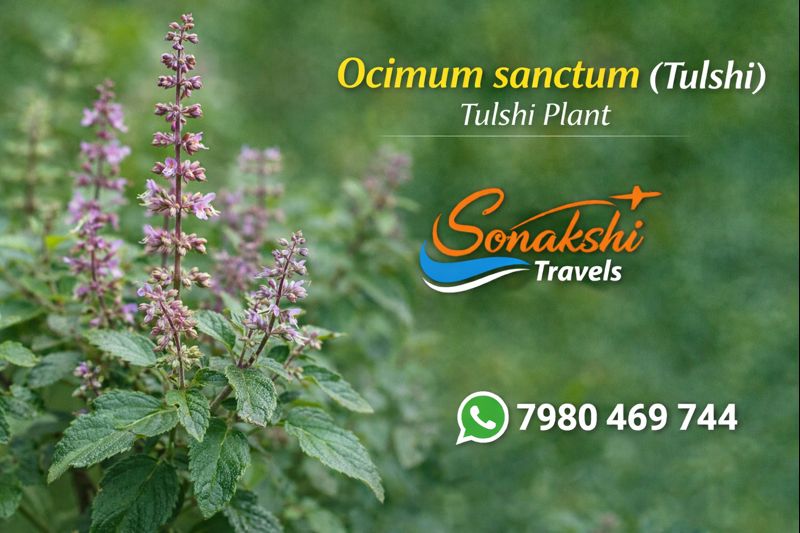
Ocimum sanctum, commonly known as Tulshi or Holy Basil, is one of the most culturally revered and biologically significant plants of the Indian subcontinent. Beyond its sacred status in traditional households, Tulshi is a biologically resilient aromatic herb with remarkable ecological adaptability. Its long history of domestication, coupled with its natural occurrence in semi-wild habitats, places Ocimum sanctum at a unique intersection of ethnobotany, ecology, and conservation biology.
From courtyard gardens and temple complexes to fallow lands and forest margins, Tulshi demonstrates extraordinary versatility. Scientific investigations now recognize the plant not merely for its traditional importance but also for its role in supporting pollinators, stabilizing microhabitats, and contributing to plant community dynamics. This comprehensive article examines the botanical identity, morphology, distribution, habitat preferences, ecological role, and conservation aspects of Ocimum sanctum, with special emphasis on its occurrence in the Sundarbans region.
Taxonomy & Classification
Systematic Position
Ocimum sanctum belongs to the family Lamiaceae, a family well known for aromatic herbs characterized by essential oil glands and quadrangular stems. The genus Ocimum comprises more than 60 species distributed across tropical and subtropical regions, many of which are economically and medicinally significant.
Kingdom: Plantae
Clade: Angiosperms
Clade: Eudicots
Order: Lamiales
Family: Lamiaceae
Genus: Ocimum
Species:Ocimum sanctum L.
Taxonomically, Ocimum sanctum is sometimes treated as Ocimum tenuiflorum in modern classifications. Both names are widely used in scientific literature, reflecting revisions based on morphological and molecular studies.
Morphology & Field Identification
Growth Habit
Tulshi is an erect, much-branched, aromatic perennial herb or sub-shrub, typically attaining a height of 30 to 90 centimeters. The plant exhibits a bushy growth form, with numerous lateral branches arising from the basal nodes. Its overall architecture allows efficient light interception in open and semi-shaded environments.
Stem Characteristics
The stems are quadrangular, a hallmark of the Lamiaceae family, and may be green or purplish depending on the variety and environmental conditions. Fine hairs cover the stem surface, providing protection against desiccation and herbivory.
Leaves
Leaves are opposite, ovate to elliptic, measuring 2–5 centimeters in length. The margins are serrated, and the surface is softly pubescent. Numerous glandular trichomes are present on the leaves, responsible for the plant’s strong aromatic scent. Leaf coloration ranges from bright green to deep purplish-green.
Inflorescence and Flowers
The flowers are small, bilabiate, and arranged in terminal racemes. Each flower is pale purple to whitish, with a tubular calyx and a two-lipped corolla. Flowering typically occurs during the warmer months and is influenced by photoperiod and soil moisture.
Fruits and Seeds
The fruit is a schizocarp that splits into four small nutlets upon maturity. These nutlets are dark brown to black and possess high germination potential under favorable conditions, contributing to the plant’s persistence in semi-wild habitats.
Habitat & Distribution
General Habitat
Ocimum sanctum thrives in warm, tropical climates and prefers open, sunny locations. It is commonly cultivated in household gardens, temple courtyards, and institutional landscapes. In semi-natural conditions, it grows along roadsides, village edges, and disturbed grounds.
Soil Preferences
The plant grows best in well-drained loamy soils rich in organic matter. However, it demonstrates considerable tolerance to poorer soils, provided waterlogging is absent. Slightly acidic to neutral soil conditions favor optimal growth.
Global Range
The native range of Ocimum sanctum is believed to encompass the Indian subcontinent, including India, Nepal, Bangladesh, Sri Lanka, and parts of Southeast Asia. Due to extensive cultivation and cultural exchange, the species is now found across tropical Africa, parts of the Middle East, and regions of the Americas.
In many countries, Tulshi persists as a cultivated plant with occasional escape into semi-wild habitats. Its global distribution reflects both human-mediated dispersal and the plant’s inherent ecological flexibility.
Preferred Habitat
Climatic Requirements
Tulshi prefers warm temperatures ranging between 20°C and 35°C. While it requires moderate rainfall, the plant is sensitive to prolonged waterlogging. Seasonal dryness is tolerated due to its deep root system and adaptive physiology.
Light and Microhabitat
Full sunlight enhances leaf aroma and flowering intensity. Partial shade is tolerated but may reduce overall vigor. The plant often thrives in microhabitats influenced by human activity, where soil fertility is relatively higher.
Occurrence
Across the Indian subcontinent, Ocimum sanctum is among the most commonly grown household plants. Its occurrence extends from urban terraces to rural homesteads and monastery gardens. In semi-wild settings, it appears sporadically along village boundaries, abandoned plots, and seasonal agricultural fallows.
The species exhibits a close association with human settlements, making it an important component of anthropogenic ecosystems.
Preferred Habitat in the Sundarbans Region
Peripheral and Inland Zones
Within the Sundarbans landscape, Ocimum sanctum is absent from core mangrove forests due to high salinity and tidal inundation. Instead, it is commonly found in inland villages, embankments, and elevated homestead gardens where soil salinity is low.
Adaptation to Local Conditions
Seasonal rainfall and freshwater availability play a critical role in supporting Tulshi growth in the Sundarbans periphery. The plant benefits from nutrient-rich soils enriched by organic household waste and composting practices.
Village gardens and forest-edge flora are integral to the Sundarbans ecosystem. Discover these living landscapes with a thoughtfully designed Sundarban Tour Package that blends nature and culture.
Ecological Role
Support to Pollinators
The flowers of Ocimum sanctum are rich in nectar and attract a variety of pollinators, including bees, butterflies, and small flies. By supporting pollinator populations, the plant indirectly contributes to the reproductive success of neighboring plant species.
Microclimate Regulation
Dense foliage helps moderate soil temperature and reduce moisture loss. In household gardens, Tulshi contributes to localized microclimatic stability, benefiting adjacent plants.
Chemical Ecology
Essential oils released by the plant possess allelopathic properties that may inhibit the growth of competing weeds, influencing plant community structure in its immediate vicinity.
Habitat Alteration
Urbanization, soil salinization, and changing land-use patterns influence the availability of suitable habitats for Ocimum sanctum. In coastal regions, increasing salinity intrusion poses challenges to cultivation in low-lying areas.
However, the species benefits from human stewardship, which often compensates for habitat loss through active cultivation.
Conservation Efforts
Current Conservation Status
Ocimum sanctum is not considered threatened due to its widespread cultivation and cultural importance. Nonetheless, preserving traditional cultivation practices is essential for maintaining its genetic diversity.
Sustainable Cultivation
Encouraging organic gardening, seed exchange among communities, and preservation of local varieties contributes to long-term conservation of the species.
For travelers interested in ecological nuances beyond mangroves, a personalized Sundarban Private Tour offers deeper insight into village flora and biodiversity.
Did You Know?
Tulshi is one of the few plants widely cultivated for cultural, ecological, and aromatic reasons simultaneously.
The plant’s essential oils vary in composition depending on soil, climate, and variety.
Its strong aroma helps repel certain insect pests, benefiting nearby crops.
Long-term household cultivation has led to the development of distinct local ecotypes.