A Comprehensive Botanical, Ecological, and Conservation Study
Ficus elastica, commonly known as the Rubber Fig or Indian Rubber Tree, is a large evergreen tree belonging to the diverse genus Ficus. Renowned for its broad, glossy leaves and impressive architectural form, this species has long attracted attention for both its ornamental appeal and its ecological significance. Although popularly cultivated as an indoor and landscape plant worldwide, Ficus elastica originates from tropical forest ecosystems where it plays an important role in structural complexity and biological interactions.
Beyond its aesthetic value, Ficus elastica exemplifies the ecological strategies of fig species, including latex production, mutualistic relationships with pollinating insects, and adaptability to a wide range of environmental conditions. This article provides a detailed, research-oriented examination of Ficus elastica, focusing on its taxonomy, morphology, habitat preferences, distribution, ecological role, and conservation considerations, with contextual reference to its presence in the Sundarbans region.
Taxonomy & Classification
Systematic Position
Ficus elastica belongs to the family Moraceae, a family characterized by latex-bearing trees and shrubs, many of which are ecologically dominant in tropical forests. The genus Ficus is one of the largest genera of flowering plants, comprising over 800 species distributed globally.
Kingdom: Plantae
Clade: Angiosperms
Clade: Eudicots
Order: Rosales
Family: Moraceae
Genus: Ficus
Species:Ficus elastica Roxb. ex Hornem.
The species epithet elastica refers to the latex once exploited as a source of natural rubber, prior to the dominance of Hevea brasiliensis in commercial rubber production.
Morphology & Field Identification
Growth Habit
Ficus elastica is a large, evergreen tree capable of reaching heights of 25–40 meters in natural forest conditions. In cultivated landscapes, growth is often more compact due to pruning and space limitations. The tree develops a strong central trunk with a broad, spreading crown.
Stem, Bark, and Latex
The trunk is stout, with smooth to slightly fissured greyish-brown bark. When injured, the bark exudes a thick, milky latex, a characteristic feature of the Moraceae family. This latex serves as a chemical defense against herbivores and pathogens.
Leaves
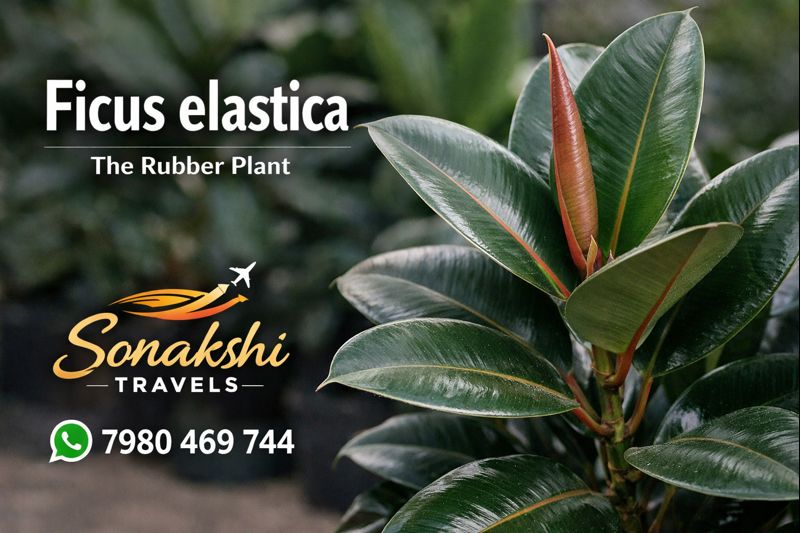
Leaves are large, leathery, elliptic to oblong, typically measuring 15–30 centimeters in length. They are dark green, glossy, and borne alternately along the branches. A prominent midrib and thick petiole provide mechanical strength, while the waxy surface reduces water loss.
Stipules
Young leaves are enclosed in conspicuous reddish or pinkish stipules, which fall off as the leaf expands. These stipules are a distinctive identification feature of many fig species.
Flowers and Syconia
Like all figs, Ficus elastica bears its flowers inside a specialized inflorescence called a syconium. The syconia are small, fig-like structures that contain numerous minute flowers. Pollination occurs through a highly specialized mutualism with fig wasps.
Fruits
The mature syconia resemble small figs, turning yellowish or reddish when ripe. Although not commonly consumed by humans, they are an important food source for birds and other wildlife in natural habitats.
Habitat & Distribution
Natural Habitat
In its native range, Ficus elastica inhabits tropical evergreen and semi-evergreen forests. It thrives in humid environments with ample rainfall and deep, well-drained soils. The species often establishes itself as a canopy or emergent tree.
Soil Preferences
The tree prefers fertile, loamy soils rich in organic matter. However, its extensive root system allows it to tolerate a variety of soil types, including slightly rocky and lateritic substrates.
Global Range
Ficus elastica is native to parts of South and Southeast Asia, including northeastern India, Nepal, Bhutan, Myanmar, and Indonesia. Due to its ornamental appeal, it has been widely introduced and cultivated across tropical and subtropical regions worldwide.
Today, the species is found in gardens, parks, and urban landscapes throughout Asia, Africa, Australia, and the Americas. In some regions, it has escaped cultivation and become locally naturalized.
Preferred Habitat
Climatic Requirements
Ficus elastica prefers warm, humid climates with temperatures generally above 15°C. It is sensitive to frost but tolerates short periods of cooler temperatures.
Light Conditions
The species thrives in bright, indirect sunlight but can also grow under partial shade. In forest environments, young plants often establish under canopy cover before reaching higher light levels.
Occurrence
In the Indian subcontinent, Ficus elastica is commonly encountered as an ornamental tree in urban areas, institutional campuses, and private gardens. It is also grown as a popular indoor plant in temperate regions.
In semi-natural conditions, the species occasionally occurs along forest edges and abandoned plantations, where suitable moisture and soil conditions exist.
Preferred Habitat in the Sundarbans Region
Peripheral and Inland Zones
Within the Sundarbans landscape, Ficus elastica does not occur in core mangrove forests due to high salinity and tidal inundation. Instead, it is found in inland settlements, village groves, and elevated areas where freshwater influence is dominant.
Human-Modified Landscapes
The species is often planted as a shade or ornamental tree in homesteads and institutional grounds around the Sundarbans periphery, benefiting from well-drained soils and protection from saline conditions.
Large fig trees and village groves add character to the delta’s inland landscapes. Discover these living environments through a thoughtfully curated Sundarban Tour Package designed for nature enthusiasts.
Ecological Role
Keystone Characteristics
Members of the genus Ficus are widely regarded as keystone species in tropical ecosystems. While Ficus elastica is less dominant than some wild figs, it still contributes significantly to habitat structure and food availability.
Wildlife Support
The fruits provide nourishment for birds, bats, and small mammals, aiding seed dispersal. Dense foliage offers shelter and nesting sites for avifauna.
Microclimate Regulation
The broad canopy moderates temperature and humidity beneath the tree, creating favorable microclimates for understory plants and soil organisms.
Habitat Alteration
Urban expansion, land-use change, and soil compaction influence the growth and longevity of Ficus elastica in many regions. While the species tolerates moderate disturbance, restricted root space and pollution can limit its development.
In coastal zones, increasing soil salinity poses a constraint on its cultivation and naturalization.
Conservation Efforts
Conservation Status
Ficus elastica is not currently considered threatened due to widespread cultivation and adaptability. However, preservation of wild genetic stock remains important.
Urban and Landscape Conservation
Encouraging the planting of large fig trees in suitable urban and peri-urban spaces supports biodiversity and enhances ecosystem services.
For travelers interested in forest-edge trees and village biodiversity, a personalized Sundarban Private Tour offers deeper ecological insights.
Did You Know?
The latex of Ficus elastica was once tested as a source of commercial rubber.
Young leaves emerge wrapped in colorful stipules that fall away as the leaf expands.
The species can live for several decades under favorable conditions.
Like all figs, it depends on a specific fig wasp for pollination.