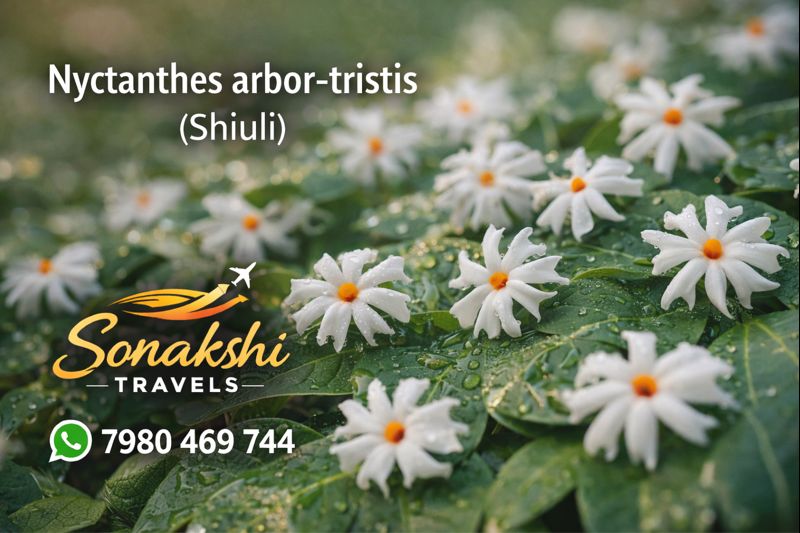
Nyctanthes arbor-tristis, widely known as Shiuli, Sephalika, or Night-flowering Jasmine, is a culturally revered and biologically significant flowering plant of the Indian subcontinent. Celebrated for its delicate white blossoms with vibrant orange corolla tubes, this species occupies a unique position at the intersection of ecology, traditional medicine, and cultural heritage. Unlike many ornamental plants, Shiuli flowers bloom at night and fall by morning, a characteristic that has inspired poetry, folklore, and spiritual symbolism for centuries.
Beyond its aesthetic and cultural value, Nyctanthes arbor-tristis plays an important ecological role in tropical and subtropical landscapes. Its adaptability to varied habitats, interaction with pollinators, and medicinal properties make it an essential component of traditional agroforestry and garden ecosystems. This article provides a comprehensive, research-based examination of Shiuli, focusing on its taxonomy, morphology, habitat preferences, distribution patterns, ecological functions, and relevance within the Sundarbans region.
Taxonomy & Classification
Systematic Position
Nyctanthes arbor-tristis belongs to the Oleaceae family, which includes several ecologically and economically important genera such as Olea, Jasminum, and Ligustrum. The genus Nyctanthes is relatively small and is distinguished by its nocturnal flowering behavior and distinctive floral morphology.
Kingdom: Plantae
Clade: Angiosperms
Clade: Eudicots
Clade: Asterids
Order: Lamiales
Family: Oleaceae
Genus: Nyctanthes
Species:Nyctanthes arbor-tristis
The species epithet arbor-tristis, meaning “sad tree,” refers to the phenomenon of flowers shedding at dawn, carpeting the ground beneath the plant.
Morphology & Field Identification
Growth Habit and Stem
Nyctanthes arbor-tristis is a large shrub or small tree, typically reaching heights of 4–10 meters. The stem is rough, greyish, and often irregularly branched. Young branches are quadrangular and slightly pubescent, becoming more cylindrical and woody with age.
Leaves
Leaves are opposite, ovate to elliptic, and possess a rough, slightly hairy surface. The leaf margins are entire, and the venation is prominent, especially on the underside. The deep green coloration and coarse texture make the leaves easily recognizable in the field.
Flowers and Fruits
The flowers are the most distinctive feature of Shiuli. Each flower consists of five to eight white lobes arranged around a bright orange tubular center. Blossoming occurs at night, accompanied by a strong, sweet fragrance that attracts nocturnal pollinators. By morning, the flowers detach and fall intact.
The fruit is a flat, heart-shaped capsule containing a single seed. Fruiting is relatively infrequent compared to flowering and usually follows successful pollination.
Habitat & Distribution
Natural Habitat
Nyctanthes arbor-tristis thrives in tropical and subtropical climates, favoring warm temperatures and moderate to high humidity. It is commonly found in open woodlands, forest edges, village groves, and home gardens.
The species exhibits a preference for well-drained soils and is moderately drought-tolerant once established. It does not tolerate prolonged waterlogging but can survive short periods of seasonal flooding.
Global Range
The native range of Nyctanthes arbor-tristis includes the Indian subcontinent, particularly India, Nepal, Bangladesh, and Sri Lanka. It has also been introduced to Southeast Asia and parts of tropical Africa as an ornamental and medicinal plant.
In cultivated landscapes, the species has adapted well to varied climatic conditions, contributing to its widespread presence beyond its native range.
Preferred Habitat
Soil and Climatic Requirements
Shiuli grows best in loamy to sandy-loam soils rich in organic matter. A neutral to slightly alkaline pH favors optimal growth. The plant requires ample sunlight for flowering but can tolerate partial shade.
Seasonal rainfall patterns, particularly monsoonal moisture, support vigorous vegetative growth and prolific flowering during late summer and autumn.
Occurrence
Nyctanthes arbor-tristis is widely cultivated near human settlements due to its religious and ornamental importance. In natural settings, it often appears as a scattered component of secondary forests and woodland margins.
The species shows strong regenerative capacity through seeds and vegetative cuttings, making it a resilient component of semi-natural ecosystems.
Preferred Habitat in the Sundarbans Region
Ecotonal Distribution
Within the Sundarbans region, Shiuli is not a true mangrove species but occurs in peripheral zones, village landscapes, and elevated areas with reduced salinity. These transitional zones between human habitation and mangrove forests provide suitable conditions for its growth.
The humid climate, fertile alluvial soils, and moderate freshwater influence support healthy flowering and vegetative development.
Cultural Integration
In Sundarbans-adjacent communities, Shiuli is commonly planted near homes and temples, reflecting its cultural significance and adaptability to the local environment.
Ecological Role
Pollinator Support
The nocturnal blooming pattern of Nyctanthes arbor-tristis attracts moths and other night-active insects, contributing to pollinator diversity. This temporal niche reduces competition with daytime-flowering species.
Soil Enrichment
Fallen flowers and leaf litter decompose rapidly, adding organic matter to the soil and enhancing microbial activity. This process improves soil structure and nutrient availability.
Microclimatic Regulation
As a shrub or small tree, Shiuli contributes to shade and humidity regulation, creating favorable conditions for understory plants and associated fauna.
Habitat Alteration
Human-Induced Changes
Urbanization, land-use change, and replacement of traditional gardens with modern landscaping reduce available habitats for Nyctanthes arbor-tristis. Loss of green spaces directly impacts its natural regeneration.
Environmental Stressors
Increased soil salinity, prolonged droughts, and pollution can negatively affect growth and flowering. Although the species is resilient, cumulative stress may reduce its ecological and ornamental value.
Conservation Efforts
Community-Based Conservation
Conservation of Shiuli largely depends on traditional cultivation and community awareness. Encouraging its planting in home gardens, schools, and public spaces supports both biodiversity and cultural continuity.
Sustainable Utilization
The leaves and flowers are used in traditional medicine and rituals. Sustainable harvesting practices ensure continued availability without compromising plant health.
Did You Know?
Shiuli flowers bloom at night and naturally detach by morning without wilting.
The orange center of the flower has traditionally been used as a natural dye.
The plant is associated with autumn festivals and cultural rituals across eastern India.
Its strong nocturnal fragrance is specifically adapted to attract night pollinators.
Discover the living landscapes where plants like Shiuli flourish naturally. Explore immersive itineraries through our
Sundarban Tour Package experiences designed for nature lovers.
For a personalized journey into mangrove-edge biodiversity and cultural landscapes, explore our curated
Sundarban Private Tour options guided by local expertise.
External Reference
For additional botanical and taxonomic information, refer to the Wikipedia entry on Nyctanthes arbor-tristis.