Botanical Identity, Ecological Role, and Presence in the Sundarbans
Streblus asper, commonly known as Sheora, is a hardy evergreen tree widely recognized for its ecological resilience, medicinal relevance, and cultural importance across South and Southeast Asia. Belonging to the mulberry family, this species thrives in diverse environmental conditions, ranging from dry deciduous forests to coastal and deltaic ecosystems. In the context of the Indian subcontinent, Sheora represents an important native taxon contributing to habitat stability, biodiversity support, and traditional knowledge systems.
This article presents a comprehensive, research-based exploration of Streblus asper, covering its taxonomy, morphology, distribution, ecological significance, and conservation outlook, with particular emphasis on its occurrence within the Sundarbans region.
Taxonomy & Classification
Streblus asper is taxonomically positioned within the family Moraceae, a lineage known for ecologically significant trees such as figs and mulberries. The species exhibits morphological and physiological traits that reflect both evolutionary adaptation and environmental tolerance.
Scientific Classification
Kingdom: Plantae
Clade: Angiosperms
Clade: Eudicots
Clade: Rosids
Order: Rosales
Family: Moraceae
Genus: Streblus
Species: Streblus asper Lour.
The genus Streblus is distinguished by latex-producing tissues and small, often inconspicuous flowers, traits typical of many Moraceae members. Streblus asper is one of the most widely distributed and studied species within this genus.
Morphology & Field Identification
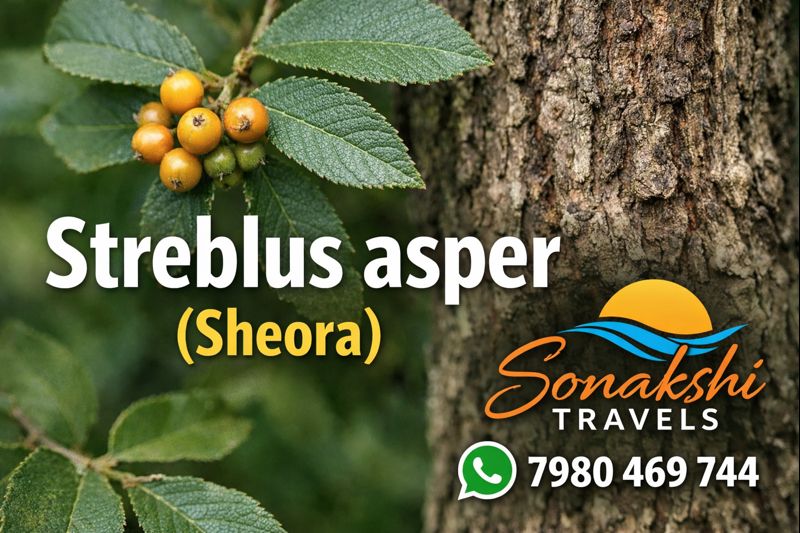
Streblus asper is a slow-growing, medium-sized evergreen tree or large shrub, typically reaching heights of 8–15 meters under favorable conditions. Its physical structure reflects a high degree of mechanical strength and drought tolerance.
Stem and Bark
The trunk is short to moderately tall, often branching at low height. Bark texture is rough, fissured, and grayish-brown, exuding a milky latex when injured. The fibrous bark has historically been used in paper-making and cordage in parts of Southeast Asia.
Leaves
Leaves are simple, alternate, elliptic to obovate, measuring 5–12 cm in length. A defining characteristic is their extremely rough, sandpaper-like surface caused by stiff trichomes. This trait has made the leaves traditionally useful as natural abrasives for polishing wood and metal.
Flowers and Fruits
The species is dioecious, bearing male and female flowers on separate plants. Flowers are small, greenish-yellow, and arranged in axillary clusters. Fruits are small drupes, turning yellow to orange upon maturity, and are consumed by birds and small mammals.
Habitat & Distribution
Streblus asper demonstrates remarkable ecological plasticity, allowing it to colonize varied habitats including plains, hill slopes, forest margins, and coastal regions. It is frequently found in secondary forests and anthropogenically influenced landscapes.
Ecological Amplitude
The species tolerates a wide range of soil types, from sandy loam to lateritic and calcareous substrates. It exhibits moderate drought resistance and can withstand periodic inundation, making it suitable for transitional ecosystems.
Global Range
The natural range of Streblus asper spans South Asia and Southeast Asia. It is native to India, Bangladesh, Sri Lanka, Nepal, Myanmar, Thailand, Laos, Cambodia, Vietnam, Malaysia, and parts of southern China. Due to its utility, the species has also been introduced into other tropical regions.
Within India, Sheora is commonly encountered in West Bengal, Odisha, Bihar, Uttar Pradesh, the Deccan Plateau, and the eastern Himalayan foothills.
Preferred Habitat
Streblus asper favors open woodland, scrub forests, and forest edges where sunlight penetration is moderate to high. It performs well in disturbed habitats and often acts as an early successional species aiding forest regeneration.
Soil and Climate Preferences
Optimal growth occurs in well-drained soils with neutral to slightly alkaline pH. The species thrives in tropical monsoon climates with distinct wet and dry seasons, although it remains evergreen throughout the year.
Occurrence
In eastern India, Streblus asper is commonly observed along village outskirts, temple groves, roadside plantations, and forest buffer zones. Its resilience to grazing and pruning has enabled its persistence in human-dominated landscapes.
Exploring forest biodiversity alongside mangrove landscapes is best done with expert guidance. Discover curated itineraries under our Sundarban Tour Package options and plan your journey with confidence.
Preferred Habitat in the Sundarbans Region
Although not a true mangrove species, Streblus asper occurs in the peripheral and transitional zones of the Sundarbans Biosphere Reserve. It is particularly associated with elevated grounds, village forest patches, embankments, and mixed woodland areas bordering mangrove forests.
In these zones, Sheora benefits from reduced salinity and better soil aeration compared to core mangrove areas. Its presence contributes to ecological buffering between human settlements and fragile mangrove ecosystems.
Ecological Role
Streblus asper plays multiple ecological roles within its native range. As a hardy evergreen tree, it provides year-round foliage cover, microhabitat stability, and food resources for wildlife.
Faunal Interactions
Birds, bats, and small mammals consume the fruits, aiding in seed dispersal. The dense foliage offers nesting sites and shelter for avifauna and insects. The tree also supports pollinator communities through its flowering cycle.
Soil and Landscape Stability
The root system contributes to soil binding, reducing erosion in exposed landscapes. In deltaic fringes, this function becomes particularly important for protecting embankments and village lands.
Habitat Alteration
Despite its adaptability, Streblus asper faces habitat pressures due to urban expansion, agricultural intensification, and infrastructure development. Removal of secondary forests and village groves has led to localized population declines.
In the Sundarbans periphery, embankment reinforcement and land conversion reduce available transitional habitats where this species typically thrives.
Conservation Efforts
Streblus asper is not currently classified as threatened on a global scale. However, its ecological and ethnobotanical value has prompted inclusion in community-based conservation and agroforestry initiatives.
Restoration and Awareness
Plantation of Sheora in degraded forest margins, village commons, and buffer zones is encouraged due to its low maintenance requirements. Traditional knowledge systems continue to play a crucial role in sustaining local populations.
For travelers seeking privacy, flexible schedules, and expert-led exploration, our Sundarban Private Tour Packages offer an immersive experience into forest ecology and riverine landscapes.
Did You Know?
The leaves of Streblus asper were traditionally used as natural sandpaper due to their abrasive texture.
The bark fibers were historically employed in handmade paper production in parts of Thailand.
In several South Asian cultures, the tree is associated with folk medicine and spiritual practices.
Despite growing in challenging environments, the species remains evergreen throughout the year.