Updated: March 13, 2026
A Quiet Surrender to Tide and Silence : Understanding the True Soul of a Sundarban Tour
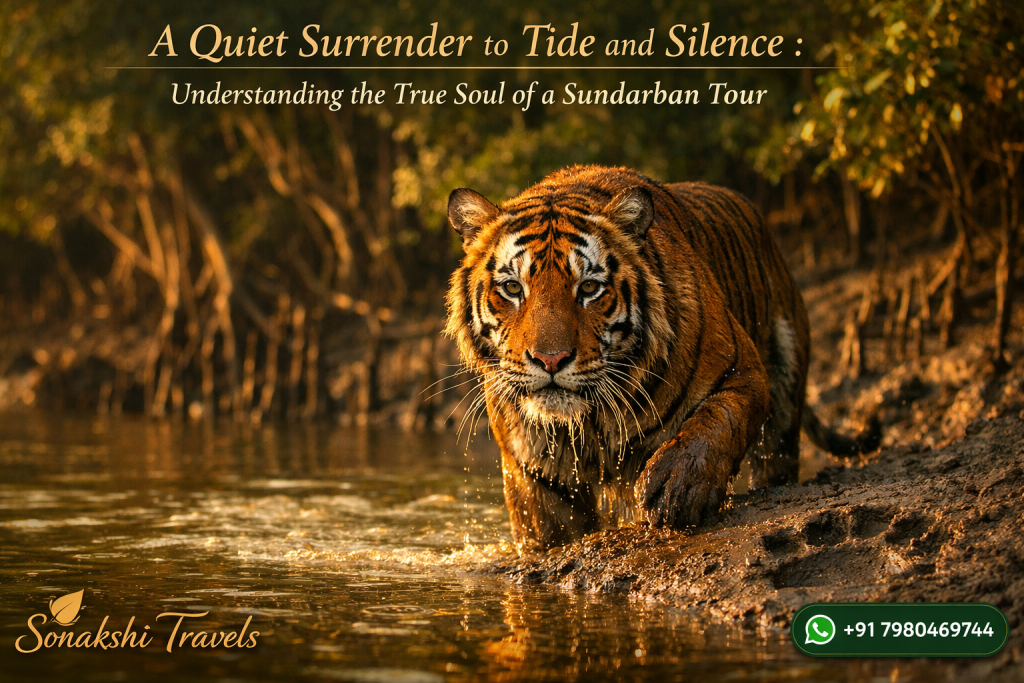
There are journeys that impress by abundance, and there are journeys that reveal themselves through subtraction. The Sundarban belongs to the second order. It does not persuade the mind with spectacle delivered at once. It does not present its meaning in a single panoramic gesture. Instead, it asks for relinquishment. A Sundarban tour becomes meaningful only when the traveler stops demanding constant confirmation and begins to accept uncertainty, pause, distance, and silence as part of the landscape’s truth. The real experience is not built from noise, speed, or accumulation. It is built from attentiveness.
To understand the soul of this environment, one must begin with the fact that the delta is never fully still, yet rarely dramatic in an obvious way. Its movements are dispersed through tide, mud, current, leaf, call, reflection, and withdrawal. Much of what matters here appears at the edge of perception rather than at its center. This is why the experience often feels inward as much as outward. The traveler is not merely seeing a place. One is also becoming aware of one’s own habits of expectation, impatience, interpretation, and fear. That inward adjustment is central to the finest Sundarban travel experience.
Silence Here Is Not Emptiness
Many people use the word silence carelessly, as though it means absence. In the Sundarban, silence is not absence at all. It is structure. It is a field of relation in which every small sound gains significance. Water touching the side of a boat, the shift of wind through mangrove leaves, the crack of a branch somewhere beyond direct sight, the call of a distant bird, the sudden stilling of one zone while another continues in low motion—these do not interrupt silence. They define it. A serious Sundarban eco tourism experience depends on this understanding, because the environment cannot be entered responsibly if one treats quiet merely as a gap to be filled.
Ecologically, such quiet is meaningful. In mangrove systems, life is often distributed rather than concentrated. Activity does not always announce itself in grand visible clusters. It may remain concealed in mud margins, root shadows, tidal edges, or upper foliage. The traveler who learns to value silence begins to perceive that restraint is not emptiness but density held in another form. The forest often withholds obvious evidence while remaining intensely alive. This is one reason the region leaves such a lasting impression on reflective visitors. It teaches that significance is not always loud.
The mind responds to this in subtle ways. At first, silence can produce discomfort. People search for a highlight, a climax, a singular proof that they are in an extraordinary place. Yet the deeper truth of a Sundarban nature tour lies in the gradual surrender of that demand. Once the mind relaxes its insistence on constant event, it starts to register pattern. The changing pace of water, the slight alteration of light on silt, the measured patience of the landscape, and the atmosphere of alert quiet begin to form an experience far richer than theatrical excitement.
The Tide as the Region’s Hidden Language
If silence is the emotional structure of the Sundarban, tide is its grammar. This landscape is not simply bordered by water; it is authored by it. The visible world here is continually revised by tidal movement. Banks expand and recede. Mud changes texture and shape. Reflections gather and break. Edges become unstable. What seems settled in one hour appears altered in another. The traveler slowly realizes that certainty itself is temporary here. That realization is not merely scenic. It is philosophical. A Sundarban exploration tour acquires depth when one understands that the delta is a living process rather than a fixed view.
The mangrove ecosystem depends on this rhythm. Tidal exchange shapes salinity, sediment movement, nutrient distribution, and habitat conditions. What appears to a casual eye as repetitive water movement is in fact a highly consequential ecological rhythm. Such processes govern the life of roots, fish, crustaceans, birds, reptiles, and mammals that inhabit or interact with the terrain. The experience of the traveler therefore becomes more meaningful when the tide is understood not as background scenery but as the force that writes and rewrites the ground itself.
This is also why the true soul of a Sundarban tourism experience cannot be reduced to fixed expectation. The delta does not promise repetition in a neat human sense. It offers recurrence without sameness. Tides return, but never as exact copies. Silence returns, but in altered combinations of sound, light, depth, and direction. To move through such a place is to encounter a form of order that remains fluid. The traveler who accepts this begins to feel less like a consumer of scenes and more like a temporary witness to a system older and more patient than individual desire.
Why the Landscape Feels Psychologically Different
Some destinations excite the eye while leaving the mind essentially unchanged. The Sundarban often works in the opposite direction. Its strongest effects are psychological. The place influences attention itself. Because visibility is frequently partial, the mind becomes more alert to implication. Because movement is often indirect, one begins to notice hesitation, pause, margin, and trace. Because silence is structured, sound acquires weight. A thoughtful Sundarban wildlife safari is therefore not only a matter of wildlife expectation. It is also an education in altered perception.
The forest edge plays a central role in this change. In many landscapes, the eye seeks open revelation. In the mangrove delta, the edge matters more than the center. What lies half-concealed often feels more powerful than what stands exposed. This creates a heightened state of awareness. The imagination is activated, but not wildly. Rather, it becomes disciplined by the need to observe carefully. One begins to notice intervals, shadows, and movements that would be dismissed elsewhere. The mind learns humility because the environment cannot be mastered through a quick glance.
This psychological quality explains why the most serious travelers often prefer a Sundarban private tour when seeking the deepest relation with the landscape. Privacy, in this sense, is not only about exclusivity. It is about preserving the conditions necessary for attention. Too much chatter, crowding, or performative excitement interrupts the subtle rhythm through which the place reveals itself. The soul of the delta does not arrive by force. It emerges in proportion to the quiet one is able to maintain before it.
Mangrove Form and the Ethics of Looking
The mangrove world has a distinctive visual logic. Roots rise, descend, twist, and brace themselves in ways that make the ground appear both supported and unsettled. Trunks do not always produce the straightforward vertical clarity associated with inland forests. Branches seem adapted to strain, salt, and repeated tidal negotiation. Mud records marks but also erases them. Water reflects surfaces while concealing depth. Together, these features create a terrain that resists superficial reading. A refined Sundarban private boat tour or private Sundarban river cruise becomes memorable when one allows these forms to be studied slowly rather than consumed as decorative scenery.
There is also an ethical dimension to looking in such an environment. When a landscape is fragile, observation should not become possession. The desire to extract a perfect image, a guaranteed moment, or a simplified story can easily distort what is actually there. The true soul of a Sundarban private wildlife safari lies in respectful incompleteness. One may not see everything. One should not expect to dominate the scene. What matters is the quality of contact: careful, patient, and proportionate to the ecosystem’s own terms.
This attitude aligns with the deeper principles of Sundarban eco tourism. Ecological travel at its most meaningful is not decorative virtue. It is disciplined perception. It requires the traveler to recognize that the landscape has its own pace, logic, and vulnerability. When this recognition becomes sincere, the journey changes character. It is no longer about moving through nature as though through a staged exhibit. It becomes an encounter with a living system whose dignity depends partly on human restraint.
The Role of Water in Creating Emotional Depth
In mountainous places, emotional intensity often comes from height. In deserts, it may come from vast exposure. In the Sundarban, emotional depth arises from water. Yet the effect is not only visual. Water carries uncertainty. It interrupts the human desire for stable boundaries. It blurs, reflects, absorbs, and redirects attention. A luxury Sundarban cruise may offer comfort and quiet, but the deeper significance of the experience does not come from comfort alone. It comes from being carried through a landscape whose very medium teaches impermanence.
Because water is everywhere implicated in the experience, one’s sense of position becomes less rigid. Shore and channel, nearness and distance, surface and depth—these relations continually shift. This produces a meditative quality unlike that of static scenery. The traveler is reminded that orientation is provisional. In psychological terms, such provisionality can be deeply restorative. It loosens the hardened habits through which modern life often compels control, speed, and overdefinition. The delta, by contrast, educates through ambiguity.
That is why a meaningful Sundarban luxury tour should never be understood merely as a polished version of ordinary sightseeing. Its greatest refinement lies in protecting the traveler from interruption so that the tidal environment can be experienced with seriousness. Luxury, in the truest sense here, is not excessive decoration. It is the preservation of space, stillness, and clarity before a landscape that reveals itself slowly.
Wildness in the Sundarban Is Often Indirect
People sometimes imagine wildness as obvious display: immediate visibility, sudden impact, open confrontation. The Sundarban offers another model. Its wildness is frequently indirect. It is present in the tension between seen and unseen, in the persistence of tracks and calls, in the alert posture of birds, in the secrecy of channels, in the charged quiet of certain stretches of bank. A careful Sundarban private safari tour teaches that the absence of direct spectacle does not mean the absence of presence. Quite often, the opposite is true.
This indirectness is precisely what gives the region such unusual dignity. The ecosystem does not perform itself for the observer. It remains self-possessed. The traveler must earn understanding through attention. Even a Sundarban luxury wildlife safari gains meaning only when it respects that principle. The forest is not diminished by withholding. Rather, withholding is one of the ways it teaches scale. Human beings are not the center here. They are passing witnesses within an older arrangement of water, silt, root, and instinct.
For this reason, the most memorable Sundarban travel experience is often composed of layered impressions rather than one dominant event. A particular quiet stretch of river, the geometry of roots at a receding bank, a sudden pattern of bird movement, the concentration of listening among fellow travelers, the feeling that the landscape remains alert even when apparently still—these may stay in memory longer than any single dramatic moment. The soul of the place lives in accumulation without noise.
Why Surrender Matters More Than Control
The title of this reflection speaks of surrender, and that word matters. Surrender does not mean passivity or carelessness. It means the intelligent release of unsuitable expectation. Many travel habits are based on control: fixed outcome, rapid confirmation, constant stimulation, immediate explanation. The Sundarban resists all of these. To insist on them is to remain outside the real experience. To relinquish them is to enter the environment more truthfully. A mature Sundarban personalized travel package or Sundarban tailor-made tour becomes valuable when it creates the conditions for this surrender rather than distracting from it.
Surrender is especially important because the delta teaches relational thinking. Nothing here is fully separate from what surrounds it. Water influences soil, soil supports root, root stabilizes edge, edge conditions habitat, habitat shapes movement, and movement alters perception. The traveler who notices this begins to think less in isolated attractions and more in living interdependence. That shift in understanding is one of the most important gifts a Sundarban nature tour can offer.
There is also moral seriousness in this surrender. A fragile ecosystem cannot be approached with arrogance. The correct response is not conquest but disciplined presence. When travelers understand this, the journey acquires a rare integrity. The environment is not used merely as a backdrop for self-display. It becomes a teacher of proportion, patience, and humility. This is why the deeper soul of a Sundarban exploration tour is inseparable from quietness of conduct.
The Truest Meaning of the Journey
In the end, the true soul of the Sundarban is not a singular object that can be pointed out. It is a mode of relation. It appears when tide is understood as living rhythm, when silence is understood as density rather than emptiness, when wildness is accepted in indirect form, and when the traveler allows observation to become slower, finer, and less possessive. That is why the place remains difficult to summarize yet impossible to forget.
A thoughtful Sundarban tour package may arrange entry into the region, and a carefully designed Sundarban luxury private tour may preserve the quiet conditions necessary for deeper reflection, but the real meaning of the journey is completed only within the traveler’s own perception. One must allow the mind to be changed by what does not announce itself. One must accept that the most profound parts of the experience may arrive softly.
To surrender to tide and silence in the Sundarban is therefore not to lose something. It is to recover a more exact way of seeing. The rivers, roots, mudbanks, passing calls, and measured stillness together form a world that asks not for hurried admiration but for disciplined receptivity. In that receptivity, the landscape ceases to be mere destination. It becomes presence. And within that presence, the finest meaning of a Sundarban travel guide, a Sundarban wildlife safari, or even an intimate Sundarban private mangrove cruise is finally understood: not as a list of sights, but as an encounter with a living silence shaped by tide, patience, and attention.