Updated: March 13, 2026
Sundarban Luxury Tour – A Refined Private Expedition Through the Mangrove Delta
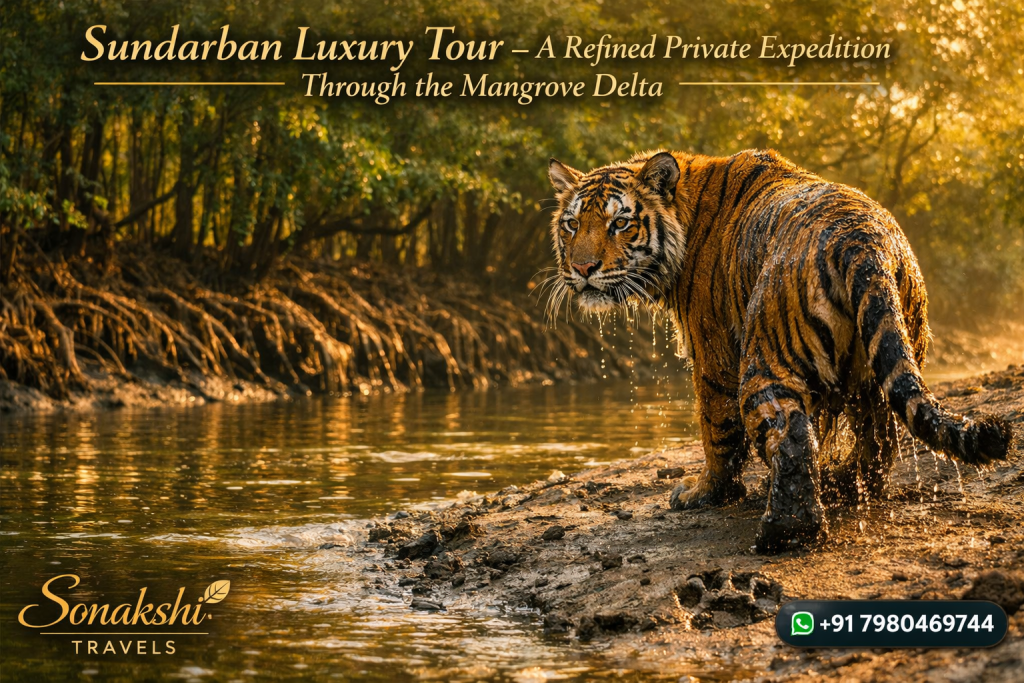
A refined journey through the Sundarban is not defined merely by comfort, privacy, or visual appeal. It is defined by the quality of attention the landscape demands and the manner in which that attention is protected from noise, haste, and unnecessary distraction. A Sundarban luxury tour becomes meaningful when it allows the traveler to enter the delta with patience, to observe the mangrove world at its own pace, and to experience the forest not as spectacle, but as a living system of tide, silence, texture, and hidden motion. In that sense, refinement in the Sundarban is not an artificial layer placed upon nature. It is a disciplined way of encountering nature without diminishing its dignity.
The mangrove delta does not reveal itself all at once. It works through gradual disclosure. Waterways bend without announcing what lies beyond them. Mudbanks appear empty until one notices tracks, burrows, roots, and subtle movement. The light changes not only the appearance of the forest but also the meaning of distance, shape, and stillness. A traveler seeking a thoughtful encounter rather than a hurried excursion often finds that a Sundarban luxury private tour offers the proper conditions for genuine attention. Privacy reduces interruption. Comfort reduces fatigue. A measured pace restores the ability to notice what hurried tourism often misses.
The Meaning of Refinement in a Wild Landscape
Luxury in the Sundarban should not be understood through decorative excess. The mangrove delta does not reward flamboyance. It rewards restraint. A refined expedition here is one in which every element supports clarity of perception. Seating that allows unbroken observation, quiet movement across tidal channels, carefully arranged meals that do not interrupt the rhythm of the day, and an atmosphere free from crowd noise all contribute to a more serious and immersive experience. This is why a high-quality Sundarban luxury travel experience depends less on display and more on intelligent design.
In many destinations, luxury separates the traveler from the environment. In the Sundarban, the opposite principle is more appropriate. The most valuable form of refinement is the one that reduces friction between the observer and the landscape. A well-conceived luxury Sundarban safari does not place comfort in opposition to wilderness. It uses comfort to sustain concentration. When the body is at ease, the senses become more available. The ear begins to distinguish layered sounds. The eye becomes patient with distance. The mind becomes capable of waiting without demanding immediate reward.
This is also where the idea of a luxury Sundarban cruise acquires its real significance. The word “cruise” in this context should not suggest theatrical leisure detached from ecological seriousness. It should suggest a calm and composed passage through an environment whose complexity cannot be understood through speed. The waterway is not merely a route. It is the primary medium through which the forest is read. Its tides carry scent, reflection, suspended light, and signs of life. To move slowly across it is to read the delta sentence by sentence rather than glance at it as a surface.
Privacy as a Condition of Deeper Perception
The private character of the journey matters for reasons beyond exclusivity. A Sundarban private tour changes the psychological quality of travel. Shared crowd energy often pulls attention outward into chatter, reaction, comparison, and interruption. In contrast, privacy restores a more contemplative relation to place. The traveler is not continually negotiating the presence of strangers. Silence becomes possible. Observation becomes continuous. Small details remain unbroken by distraction.
That privacy is especially valuable in a landscape whose most important truths are subtle. A branch moving at the edge of a creek, a sudden alertness among birds, the geometry of exposed roots at low water, the layered stillness before a disturbance in the channel—these are not dramatic events in the usual tourist sense, yet they are central to the meaning of the Sundarban. A carefully arranged Sundarban private boat tour allows such moments to retain their quiet force. They do not need to compete with group conversation or hurried narration. They can unfold at their natural scale.
The same principle explains the appeal of an exclusive Sundarban private tour. Exclusivity, in its best sense, is not social display. It is the protection of atmosphere. It gives the traveler room to think, to watch, and to feel the measured pressure of the environment. The Sundarban is not emotionally neutral. Its silence has weight. Its tidal intervals carry suspense. Its visible emptiness often feels inhabited. These impressions grow clearer when the journey is private enough to preserve them.
The Delta as a Moving Architecture of Water and Root
The Sundarban is often described as a forest, yet that description is incomplete unless one adds that it is also a hydrological architecture. The mangrove system is shaped by salinity, sediment, tidal exchange, root adaptation, and constant negotiation between land and water. A refined expedition through this environment is therefore not simply scenic. It is instructive. Each creek, embankment, mudflat, and root structure reveals a logic of survival. The famous aerial roots of mangroves are not decorative curiosities. They are functional responses to oxygen-poor soil. Their presence changes the visual texture of the landscape and also reveals the ecological intelligence of the forest.
This is where a well-designed luxury mangrove forest tour becomes more than a premium outing. It becomes an act of serious observation. The traveler begins to understand that beauty here is inseparable from adaptation. The exposed root fields, the shifting edge between channel and mudbank, and the dense interlocking vegetation all communicate the conditions under which life persists in a tidal zone. Elegance in such a setting lies not in softness but in complexity. The forest is beautiful because it is exacting, and because every visible form has been shaped by pressure.
A thoughtful Sundarban exploration tour within this refined private context also reveals how unstable boundaries are in the delta. Shoreline, waterline, and vegetation line do not hold fixed positions in the way inland landscapes often do. They advance, recede, soften, and reform under tidal influence. As a result, the eye cannot rely on static interpretation. One must continue reading the scene as it changes. This creates a different kind of visual intelligence, one based on rhythm rather than permanence.
Silence, Suspense, and the Psychology of the Mangrove World
The Sundarban has a distinct psychological atmosphere. It does not merely present objects to be looked at; it alters the manner in which looking itself occurs. Silence here is not emptiness. It is structure. It organizes attention. It sharpens the relationship between hearing and seeing. In a carefully paced Sundarban nature tour, one discovers that much of the forest is first encountered as expectancy. Something may happen, but often nothing visible happens at once. The significance lies in how the environment holds that possibility.
This sense of suspended possibility is one of the defining qualities of a refined private expedition. A Sundarban private wildlife safari is powerful not only because of what may be seen, but because of the field of tension within which seeing occurs. The traveler becomes aware that the forest is full of agency not immediately visible. The mud records crossings. The water conceals movement. The vegetation hides more than it reveals. Even when no large animal appears, the landscape remains charged with life.
Such experience is often misunderstood by travelers accustomed to destinations that offer immediate and continuous display. The Sundarban does not perform. It withholds. That withholding is not deficiency; it is character. A refined Sundarban luxury wildlife safari recognizes this and gives the traveler enough composure to value indirect knowledge. Broken ripples, sudden flight paths, subtle alarm calls, resting stillness among branches, and the long visual pause before a creek opens—these become part of the emotional architecture of the journey.
Why Waiting Matters
Waiting in the Sundarban is not idle. It is interpretive work. The longer one remains attentive, the more the landscape ceases to look flat. Surfaces acquire depth. Repetition gives way to differentiation. What seemed like simple mud becomes a record of passage. What seemed like still water becomes a reflective skin carrying evidence of current below. In this sense, a refined Sundarban private safari tour values time not as duration alone, but as a condition for revelation.
Luxury makes that waiting possible because it removes many of the irritations that shorten attention. When movement is calm, seating is comfortable, service is discreet, and the environment is free of crowd pressure, the mind becomes capable of patience. The traveler no longer needs constant stimulation. This is why the structure of a true Sundarban premium wildlife tour is inseparable from the psychological demands of the place.
Wildlife Observation Without Sensationalism
The Sundarban is one of the world’s most discussed wildlife landscapes, yet serious observation here requires restraint. The refined traveler learns quickly that the forest should not be reduced to a single expectation. A meaningful Sundarban wildlife safari is not a hunt for proof. It is an encounter with a habitat whose life expresses itself through patterns, intervals, signs, and ecological relations. Birds, crustaceans, reptiles, fish-linked activity, changing soundscapes, and tidal marks all contribute to the experience. The intelligence of the safari lies in reading the habitat rather than demanding a theatrical sequence of appearances.
That is why a well-conceived Sundarban luxury eco tour should remain ethically composed. It should avoid noise, crowding, and exaggerated pursuit. The value of the experience lies in respectful proximity to ecological complexity. Wildlife is not there to validate the traveler. The traveler is there to witness, with discipline, the fragile organization of a mangrove system under constant natural pressure. This perspective produces a more mature and ultimately more memorable form of engagement.
Within a private setting, such observation often becomes more nuanced. The absence of group urgency allows more attention to be given to transitions between moments. One becomes aware of how birds use edge habitats, how small disturbances move across the waterline, how root structures create zones of concealment, and how the visual texture of the forest shifts according to light and tide. A refined Sundarban private mangrove cruise thus supports not only comfort, but ecological literacy.
The Elegance of Measured Movement
The delta is best understood through movement that never feels aggressive. Its channels invite a measured progression in which direction, speed, and pause all matter. A genuine luxury Sundarban river cruise is elegant because it respects scale. It does not rush through creeks as if the destination lies elsewhere. It treats each passage as the experience itself. The bends of the waterway, the reflective plane of the channel, and the slow unveiling of vegetation ahead create a sense of unfolding architecture. Motion becomes contemplative rather than consumptive.
In this context, even the vessel acquires interpretive importance. A carefully arranged Sundarban private luxury boat should not dominate the experience with noise or decorative excess. It should serve as a stable and quiet platform for observation. The traveler should feel held, not separated; protected, not insulated; comfortable, yet fully available to the surrounding environment. Refinement lies in proportion.
This principle extends to the human atmosphere onboard as well. Service, conversation, and pacing all matter. The best experiences preserve spaciousness around perception. They do not fill every interval with explanation. They allow silence to do part of the work. In a landscape as psychologically charged as the Sundarban, too much mediation weakens the encounter. A truly mature Sundarban luxury nature tour knows when to remain quiet.
Emotional Tone: Intimacy Without Softening the Wild
A refined expedition through the Sundarban can feel intimate, but that intimacy should never be mistaken for domestication. The delta remains indifferent to human desire. Its beauty does not depend on welcome. This is precisely why its intimacy feels profound. It does not flatter the visitor. It allows brief proximity to a world organized by other laws. A serious Sundarban luxury tour package should therefore preserve the dignity of wildness rather than soften it into decorative scenery.
This emotional balance is especially meaningful for travelers seeking privacy with depth. A quiet couple may experience a Sundarban couple private tour not as an escape into softness, but as a shared discipline of attention. Families may discover through a Sundarban family private tour that the most valuable moments are often the stillest ones, when everyone falls silent and the landscape begins to speak through rhythm rather than language. In both cases, privacy strengthens human connection because it orients people toward something larger than themselves.
The same may be said of a Sundarban honeymoon tour when approached with maturity. Romance in the delta is not manufactured through ornament. It emerges through quiet nearness, through shared watching, through the beauty of suspended light over water, through the awareness that one is passing gently through a place ancient, adaptive, and inwardly alive. The experience becomes memorable because it is not overstated.
Refinement as Ecological Respect
There is a final and important sense in which refinement must be understood: as ecological respect. A high-quality Sundarban eco tourism experience is not simply one that speaks about conservation in broad language. It is one that behaves conservationally in practice. Quiet operation, measured presence, minimal disturbance, and interpretive seriousness are all part of that ethic. Luxury without restraint would be inappropriate here. Refinement worthy of the landscape must remain answerable to the ecological vulnerability of the mangrove system.
For that reason, the best version of a refined private journey combines privacy, calm, and discipline. It gives the traveler access without entitlement. It allows beauty to remain complex. It keeps the forest from being reduced to an item of consumption. A thoughtful Sundarban tourism experience at the luxury end of the spectrum should never feel loud, hurried, or performative. It should feel precise, quiet, and observant.
Seen in this light, a private expedition through the delta becomes an education in scale, patience, and relation. It teaches that wild beauty is not always immediate, that silence can be dense with meaning, and that movement through a living estuarine system requires humility. A refined Sundarban tour of this kind is memorable not because it overwhelms the traveler, but because it recalibrates perception. It restores seriousness to seeing.
That is the true promise of a Sundarban luxury tour when it is designed with intelligence. It offers privacy without isolation, comfort without artificiality, and elegance without detachment from the ecological truth of the mangrove delta. Above all, it allows the traveler to enter the Sundarban with enough quiet to understand that refinement here is not an added layer. It is the disciplined art of meeting a difficult and beautiful landscape on terms worthy of its complexity.