Why the Most Meaningful Sundarban Journey Is Shaped by Silence, Season, Slow Travel, and the Living Soul of the Delta
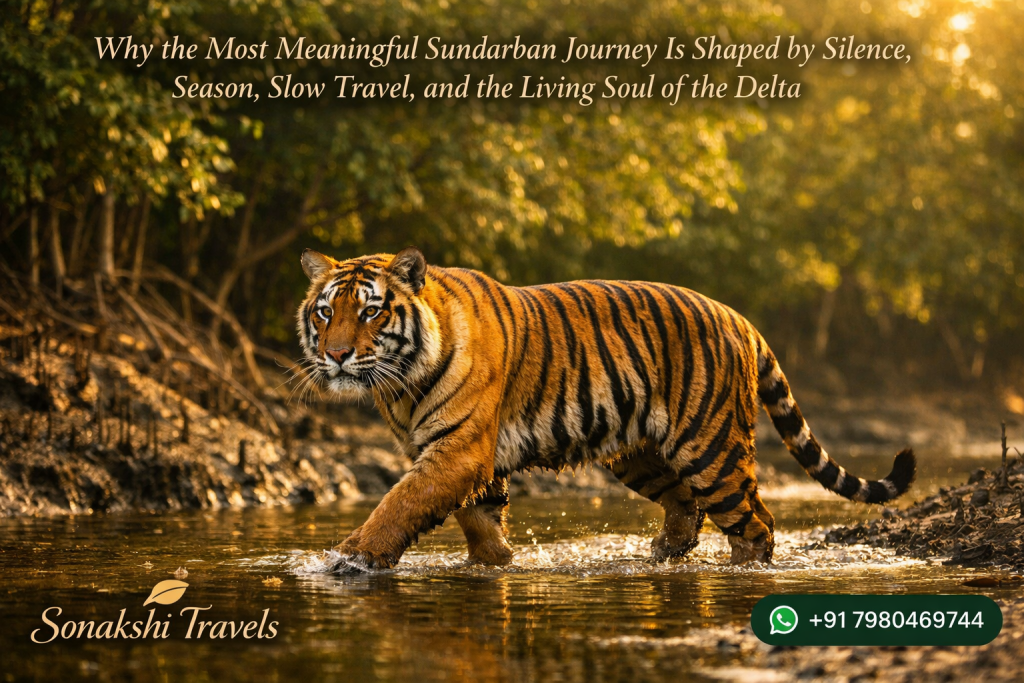
There are destinations that can be understood through a simple list of attractions, and there are destinations that ask for a more patient form of attention. The Sundarban belongs firmly to the second category. It is not merely a forest to be seen, a river route to be crossed, or a wildlife region to be photographed from a distance. It is a living delta where water, weather, memory, ecology, livelihood, and belief exist in a continuous relationship. For that reason, the most rewarding journey here is never created by speed, crowd, or superficial sightseeing. It emerges through stillness, timing, sensitivity, and the willingness to experience the region as something more profound than a touristic backdrop.
A truly memorable Sundarban tour is shaped by the understanding that this landscape has its own rhythm. Tides alter perspective. Rain transforms mood. Light changes the emotional texture of the rivers. Silence becomes a form of knowledge. Even the smallest details—how one travels, when one travels, and how carefully one observes—can determine whether the journey remains ordinary or becomes deeply meaningful. In this sense, the delta is not simply visited. It is gradually revealed.
This is why thoughtful travelers increasingly seek experiences that feel slower, quieter, and more immersive. A well-designed journey through the mangrove world is not built around noise or excess. It is built around relation: relation to place, relation to time, and relation to the subtle life of riverine wilderness. Whether one chooses a Sundarban private tour that offers a deeper, slower, and more meaningful way to experience the living delta or prefers a carefully structured broader itinerary, the essence remains the same. The finest journeys are those that allow the traveler to move in harmony with the character of the region rather than against it.
The Sundarban Is Not a Destination of Speed, but of Gradual Understanding
The first mistake many travelers make is expecting the Sundarban to behave like a conventional tourist destination. In most popular travel circuits, experience is organized around quick visibility: landmarks, photo points, fast movement, and easily consumable impressions. The Sundarban resists that logic. Its beauty is layered, and its meaning unfolds progressively. What appears at first as a wide river may later reveal itself as a corridor of ecological tension. A quiet stretch of mangrove edge may seem uneventful until one begins to understand its silence as a sign of presence, uncertainty, and balance.
This difference is essential. The delta does not reward impatience. It rewards perception. To travel well in such a landscape, one must allow time for observation and emotional adjustment. The boat’s motion, the muted horizon, the changing salinity of air, the dispersed village life along embankments, and the intermittent call of birds all begin to form a single sensory environment. Only then does the traveler move beyond sightseeing into understanding.
This is also why privacy and pace matter so much. A crowded itinerary can reduce the Sundarban to fragments. A slower experience, by contrast, makes room for continuity. One begins to sense how river light influences mood, how silence becomes a medium of attention, and how the apparent simplicity of the landscape conceals immense ecological complexity. In many ways, the value of the journey lies not in how much one covers, but in how deeply one can receive what the delta is already expressing.
That deeper emotional register is beautifully aligned with the idea of a Sundarban private tour that becomes a journey into silence, mystery, and the living soul of the delta. Such a perspective moves beyond the language of convenience and toward the language of immersion. It recognizes that the region is not simply scenic. It is atmospheric, symbolic, and alive with forms of meaning that only emerge through attentive travel.
Why Silence Is One of the Most Important Elements of the Experience
In many travel destinations, silence is treated as absence. In the Sundarban, silence is presence. It is one of the strongest interpretive keys available to the traveler. Silence is what allows sound to acquire significance: the distant movement of water against the hull, the rustle of mangrove leaves in the wind, the sudden wingbeat of a bird rising from the creek, the human voices from a far-off settlement fading into the open river. In the absence of urban noise and excessive tourist distraction, the environment begins to speak with unusual clarity.
This is not merely a poetic observation. It has practical and experiential implications. Silence enables concentration, patience, and wildlife awareness. It sharpens the mind. It also restores proportion. The traveler ceases to dominate the journey and begins instead to participate in it humbly. One realizes that the forest is not performing for visitors. The rivers are not theatrical settings. They are part of a living system that continues according to its own law, whether observed or not.
There is also an inward dimension to this silence. The delta creates a rare psychological condition in which reflection becomes easier. Removed from the pressure of constant stimulation, the traveler begins to feel the difference between movement and meaningful travel. The river becomes not only a physical route but also a reflective space. This is why many journeys through the Sundarban remain memorable long after specific details fade. What persists is often not a single sighting or meal, but a felt sense of depth, humility, and altered awareness.
For travelers seeking quiet luxury, this matters enormously. Luxury in the Sundarban is not best defined by ornament or excess. It is better defined by room to breathe, time to observe, safety without disturbance, and the privilege of engaging the landscape without being rushed through it. In that sense, privacy and silence are not secondary comforts. They are central conditions for truly experiencing the region.
River Light, Seasonal Timing, and the Art of Entering the Delta at the Right Moment
No journey through the Sundarban can be separated from time. Timing shapes atmosphere, visibility, mood, and even philosophical tone. Morning light on the river creates one kind of world; afternoon heat creates another; monsoon skies, winter clarity, and pre-summer humidity each produce their own emotional and visual language. A thoughtful traveler understands that seasonal travel is not just about convenience or climate. It is about interpretation.
A journey planned with sensitivity to seasonal character becomes richer at every level. Wildlife activity, bird movement, river color, cloud formations, village rhythms, and culinary texture all shift throughout the year. These changes alter not only what the traveler sees, but how the traveler understands the place. A well-timed itinerary can therefore transform a standard trip into a deeply nuanced experience.
This is why the thematic idea behind a thoughtfully timed Sundarban tour through wildlife, river solitude, seasonal flavor, and the deeper meaning of delta travel is so compelling. It acknowledges that the delta cannot be reduced to a static image. It is a changing environment where season acts like a co-author of the journey. Rain softens outlines and deepens feeling. Winter clarifies distance and visibility. Transitional months produce subtler textures, where the traveler can sense the land moving between moods.
River light deserves special attention here. In the Sundarban, light is never merely visual. It is narrative. The same river can appear meditative in the morning, austere at noon, luminous at dusk, and mysterious under overcast skies. These shifts create different emotional readings of the landscape. A carefully designed itinerary that respects such transitions helps the traveler encounter the delta as an evolving presence rather than a fixed scene.
For this reason, itinerary design should never be mechanical. The best journeys align movement, rest, observation, and meal timing with the natural rhythm of the place. This is not indulgence. It is intelligence. It allows the traveler to meet the delta at its most expressive moments and to absorb its transitions without hurry.
Beyond Wildlife and Cuisine: Understanding the Deeper Meaning of Delta Travel
The Sundarban is rightly known for its wildlife and for the distinctive food culture associated with the delta. Yet a meaningful journey cannot end there. To experience the region only as a site of animal expectation or culinary novelty is to remain at the surface. Wildlife is important, certainly, because it reveals the ecological tension and vitality of the mangrove world. Food is important because it expresses locality, season, memory, and livelihood. But neither category alone can explain why the Sundarban feels so singular.
The deeper meaning of delta travel lies in the relationship between natural systems and human reverence. Here, daily life is shaped by tide, erosion, uncertainty, adaptation, and inherited knowledge. Villages at the edge of the forest exist in conversation with risk. Religious imagination, local custom, and practical wisdom are woven into the landscape. This creates an experience that is not merely scenic or recreational, but civilizational in a quiet and grounded sense.
That is why the most resonant journeys are those that recognize the Sundarban as a lived environment, not an abstract wilderness. The forest is close to households, work, weather, and prayer. The river is not just beautiful; it is infrastructural, emotional, and sometimes dangerous. Rain is not merely romantic; it can signify fertility, uncertainty, relief, or disruption. Reverence is not decorative culture; it is part of how communities endure an environment that demands respect.
This layered understanding is reflected powerfully in the idea that the most meaningful Sundarban journey is never only about wildlife or food, but about rain, reverence, river silence, and the living presence of the delta. The phrase points toward a more complete travel philosophy. It tells us that true experience lies in interconnection. Wildlife, cuisine, weather, ecology, faith, memory, and silence do not exist as separate attractions. They form a single field of meaning.
For the traveler, this has an important consequence. One must learn to value subtlety. The success of the journey cannot be measured only by dramatic moments. Sometimes the most lasting memory comes from something quiet: a grey sky over a broad river, a brief pause near the mangroves, a meal whose simplicity reflects seasonal truth, or the awareness that human life here is shaped by forces far larger than tourism. Such moments create depth precisely because they resist spectacle.
Why Thoughtful Design Changes the Entire Character of a Sundarban Journey
If the Sundarban is a place of nuance, then travel design becomes ethically and experientially important. The structure of the journey influences not only comfort, but interpretation. A poorly designed tour can flatten the delta into a checklist. A thoughtfully designed one can open the traveler to layered understanding. This is especially true when privacy, pace, and route planning are handled with care.
The design of a meaningful Sundarban luxury tour or Sundarban private tour package should therefore begin with principles rather than logistics alone. The first principle is respect for the place. This means allowing sufficient time for immersion and minimizing noise or haste. The second principle is coherence. Travel, rest, food, and observation should support each other rather than compete. The third principle is atmosphere. The itinerary should create space for stillness, changing light, reflective moments, and gradual revelation.
When these principles are respected, the traveler experiences the delta not as a scattered sequence of events but as a unified journey. This is precisely why the concept of a thoughtfully designed Sundarban tour through river light, wild nature, cultural memory, and the deep poetry of the delta carries such interpretive strength. It suggests that design is not cosmetic. It is the framework through which meaning becomes possible.
Such design also refines the role of comfort. Comfort is important, but in the Sundarban it should support awareness rather than distract from it. The best forms of comfort are those that help the traveler remain receptive: well-paced schedules, calm movement, attentive hosting, and an environment where one can reflect without fatigue. This is a different understanding of Sundarban luxury. It values depth over display and experience over excess.
For families, couples, photographers, writers, naturalists, and thoughtful leisure travelers, this form of design makes all the difference. It transforms the journey from a tour into an encounter. It allows the landscape to retain its integrity while offering the traveler genuine access to its atmosphere and complexity.
The Lasting Value of a Journey That Teaches Humility
Perhaps the greatest gift of the Sundarban is that it quietly changes the traveler’s scale of perception. Modern life often encourages speed, control, and constant assertion. The delta offers another lesson. Here, one becomes aware of dependence, fragility, and balance. Water reshapes land. Weather alters plans. Silence reveals the limits of human noise. The forest remains partially hidden. The river teaches patience. In such a setting, travel becomes a form of education in humility.
This humility does not diminish the traveler. It enlarges the experience. It opens the mind to complexity and the heart to reverence. One returns from the Sundarban with more than photographs or itinerary memories. One returns with a sharpened sense that meaningful travel is not about collecting places, but about entering them truthfully. The delta teaches that presence matters more than performance, and that depth often appears in forms the hurried eye cannot see.
For this reason, the most memorable journey through the Sundarban is rarely the loudest, busiest, or most visibly dramatic. It is the one that allows river silence to work slowly on the mind, lets seasonal mood shape perception, respects the living relationship between ecology and community, and accepts that the place cannot be mastered in a single glance. A journey of this kind becomes more than travel. It becomes an act of attention.
And that, ultimately, is why the Sundarban continues to linger in memory. It is not because it offers isolated attractions, but because it offers a rare totality: wildlife, river solitude, cultural depth, seasonal atmosphere, private travel comfort, and an unmistakable sense of being in the presence of a living delta. The traveler who understands this does not merely visit the Sundarban. The traveler begins, however briefly, to listen to it.