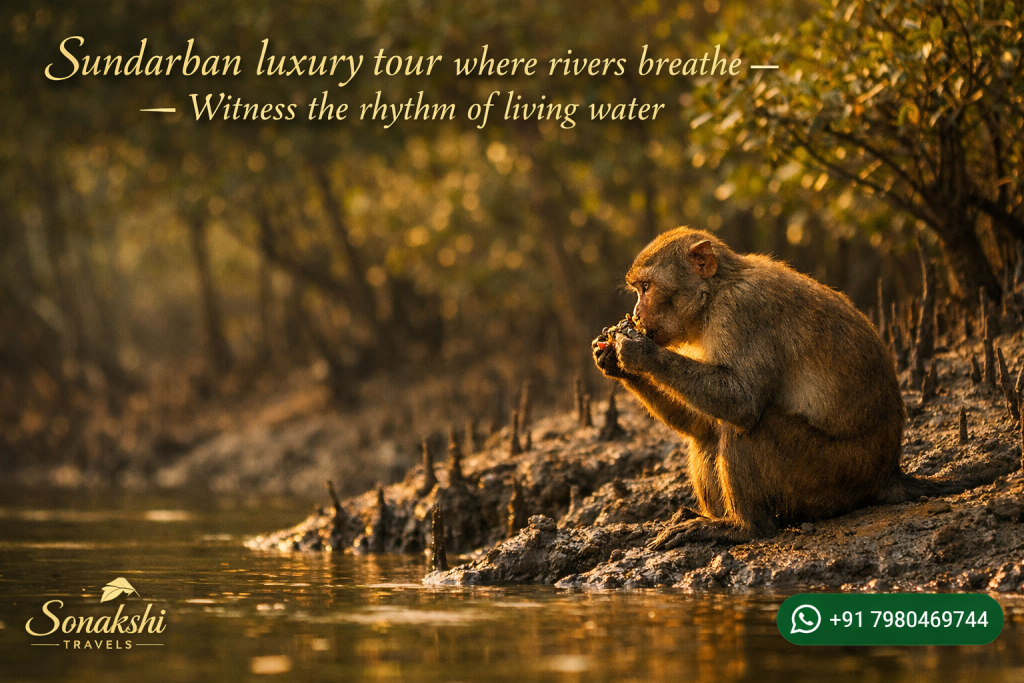
Sundarban luxury tour where rivers breathe – Witness the rhythm of living water
There are landscapes that impress the eye in a single moment, and there are landscapes that work more slowly, entering the mind through repetition, silence, and movement. The Sundarban belongs to the second kind. Its deepest power does not come from one fixed scene. It comes from flow. Water shifts, light changes, mudbanks appear and disappear, and the entire landscape seems to breathe through tide and current. That is why a Sundarban luxury tour feels different from ordinary travel. It is not simply a comfortable way to enter a famous delta. It is a way of experiencing a living water world with patience, clarity, and a refined sense of attention.
In this region, rivers are not passive background elements. They are the active force that shapes everything. They define the edges of land, carry salt and silt into the forest, guide the behavior of animals, influence plant life, and create the unusual rhythm through which the landscape reveals itself. A serious observer soon understands that the Sundarban cannot be read like dry land. It must be read through movement. That is why thoughtful Sundarban travel becomes most meaningful when one begins to notice how water directs mood, pace, and perception.
Why the rivers feel alive in the Sundarban
The phrase “rivers breathe” may sound poetic at first, yet in the Sundarban it is also a practical truth. This mangrove delta lives through tidal exchange. Water enters and withdraws in cycles, and that motion transforms the appearance of the same place hour by hour. A creek that looks narrow and quiet can later widen and brighten. A muddy edge can disappear beneath reflective water. Roots that were exposed become hidden again. Even the air seems to change with the pulse of the tide. The result is a landscape that never feels still, even when it appears silent.
This is what gives the region its rare emotional character. One does not simply look at the river. One senses its action everywhere. The banks are shaped by it. The mangroves stand because of it. The channels curve according to it. Birds and aquatic life respond to it. Human presence also adjusts to it, whether in navigation, timing, or observation. A well-designed luxury Sundarban river cruise allows the traveler to remain inside this moving system long enough to feel its order. Comfort matters here not as display, but as a condition that makes deeper attention possible.
The idea of breathing also fits the way the river seems to expand and contract before the eye. Wide channels can feel like open lungs under the sky. Smaller creeks feel like veins carrying energy into hidden parts of the forest. The comparison is not only literary. Estuarine environments work through exchange, circulation, and constant transformation. In the Sundarban, that ecological truth becomes visible. The traveler begins to understand that water is not crossing the forest from outside. Water is the medium through which the forest lives.
The rhythm of movement, not the drama of speed
Many travel experiences are built around rapid change. They move the traveler quickly from one attraction to another and depend on variety to hold attention. The Sundarban creates meaning in the opposite way. Its rhythm is slow, layered, and cumulative. The boat moves, but without aggression. The eye travels across water, shadow, root, branch, and sky. Meaning builds through recurrence. One begins to notice repeated patterns: the lean of mangrove trunks, the texture of banks cut by tide, the silence before birds rise, the changing shine of water under shifting light.
This is why a refined Sundarban luxury travel experience can feel mentally restorative. The landscape does not demand constant reaction. Instead, it trains perception. It invites the traveler to become more observant, more patient, and more aware of gradual change. The river’s rhythm works on the mind in a quiet way. It reduces noise without emptiness. It slows thought without dullness. It creates a state in which attention becomes steady rather than scattered.
There is also a physical rhythm to the journey. Boat movement across tidal water creates a gentle continuity that differs from road travel. The body feels the surface below. One senses gliding rather than jolting. That smoothness changes the way the landscape is received. Instead of looking at nature in fragments, the traveler experiences continuity. Water, forest, reflection, and sky are joined in one slow unfolding visual field. That is one reason why a serious Sundarban tour through these waters can feel less like sightseeing and more like entering a complete environmental rhythm.
Living water and the character of mangrove space
Mangrove forests are shaped by instability, but not by disorder. They are highly organized ecosystems adapted to saline water, sediment movement, and tidal fluctuation. The Sundarban expresses this adaptation in visible forms. One sees roots designed to endure difficult ground conditions. One sees trees arranged according to subtle differences in salinity, water depth, and soil type. One sees banks that look fragile yet support a complex web of life. When the river rises and falls, these relationships become easier to understand. The forest does not resist water. It lives through water.
That ecological truth gives emotional depth to the scene. The landscape feels strong without looking rigid. It feels vulnerable without looking weak. The river appears gentle on the surface, yet it is constantly making and remaking boundaries. This tension between softness and force is one of the most memorable features of the region. A thoughtful Sundarban luxury nature tour allows the traveler to appreciate this balance without rushing past it.
Even the color language of the place supports the sense of living rhythm. The green of the mangroves is rarely flat. It changes according to angle, moisture, and time of day. The water rarely holds one tone. It can look silver, grey, green, bronze, or muted blue within the same stretch of travel. Mudbanks add earth colors that ground the scene, while the sky opens the composition with light and scale. These changing visual relations make the river feel active, responsive, and almost expressive.
Silence as part of the water’s language
One of the most striking facts about the Sundarban is that its silence is not empty. It is filled with environmental signals. The sound of water touching the hull, the distant call of birds, the brushing of breeze across foliage, and the occasional movement near the bank all become meaningful in a setting where noise is reduced. On a crowded or hurried trip, such details may pass unnoticed. But in a composed and observant setting, silence becomes one of the main ways the landscape speaks.
This matters because rivers in the Sundarban are understood not only by sight, but by atmosphere. Their curves create expectation. Their surfaces hold tension. Their stillness is often temporary. A narrow creek can feel secretive; a broad river can feel calm but alert. The traveler learns to read mood through sound and absence of sound. In this way, the water acquires psychological presence. It is no longer scenery. It becomes a medium of feeling.
That is why a strong Sundarban private mangrove cruise or premium river-based journey is often remembered less for one dramatic event and more for a sustained emotional impression. The memory that remains is often one of relation: boat and tide, silence and movement, light and reflection, human stillness and ecological life. The experience feels personal because the river does not overwhelm the traveler. It gradually draws the traveler into its rhythm.
How luxury changes the quality of observation
Luxury in a place like the Sundarban should not be misunderstood as excess. Its highest value lies in refinement, space, quiet, and ease of attention. When the environment itself is subtle, the mode of travel should support subtle perception. A calm deck, an uncluttered visual experience, thoughtful service, and a measured pace help the traveler observe more deeply. Comfort here becomes a tool of concentration.
This is one of the reasons why a carefully planned Sundarban luxury tour package can produce a different quality of memory than a hurried journey. The point is not to separate the traveler from the raw truth of the delta. The point is to remove unnecessary disturbance so the delta can be perceived more clearly. Fine travel in the Sundarban is not about creating distance from nature. It is about creating the right conditions in which nature can be felt without distraction.
There is also a psychological shift that comes with this mode of travel. When the body is at ease, the mind becomes more available to nuance. Reflection becomes easier. The traveler notices transitions rather than only highlights. The changing mood of the river from one hour to the next becomes meaningful. Small ecological details become interesting rather than invisible. A layered luxury mangrove forest tour therefore depends not on noise or ornament, but on restraint.
The river as a guide to perception
In many places, land teaches the traveler how to move. In the Sundarban, the river teaches the traveler how to see. Its curves deny long, simple views and replace them with unfolding perspective. Nothing is fully revealed at once. One sees in stages. A bank appears, then a line of roots, then a shadow behind foliage, then a widening of open water beyond the bend. This pattern of partial revelation trains the eye to remain attentive.
The result is a special form of anticipation. The traveler is not waiting for entertainment. The traveler is reading change. This makes the experience intellectually satisfying as well as beautiful. Estuarine environments are dynamic systems, and the Sundarban shows that dynamism in visible form. Currents carry sediment, sediments reshape edges, and those reshaped edges influence life patterns. The river is therefore not merely a path through the region. It is an interpreter of ecological process.
A mature Sundarban exploration tour should recognize this quality. The richest encounters often come from staying with the mood of the river long enough to see relation rather than isolated detail. One begins to understand that every visual element belongs to a larger pattern: the tree line, the water color, the breathing space between banks, the tension between openness and concealment. That is where the true intelligence of the landscape becomes visible.
The emotional depth of tidal repetition
Repetition is often underestimated in travel writing, yet in the Sundarban repetition is central to meaning. Tides rise and fall. Water returns. Light touches the same channel differently at different times. Reflections repeat with variation. Similar banks appear, yet each carries its own slight difference in angle, shadow, and texture. This repeated variation creates depth of feeling. The traveler begins to sense continuity rather than novelty alone.
This continuity can have a profound calming effect. Modern life often fragments attention. The Sundarban, by contrast, reintroduces pattern. It offers movement without chaos and repetition without boredom. The mind starts to settle into environmental rhythm. That is one reason why a quiet Sundarban private luxury boat experience can feel unexpectedly intimate. The journey does not force emotion. It allows emotion to arise from prolonged contact with a living pattern.
There is also something humbling in this repetition. The river was moving before the traveler arrived and will continue after the traveler leaves. The tides do not perform for human presence. They follow larger ecological laws. That awareness gives dignity to the experience. It reminds the traveler that beauty here is not manufactured. It is systemic, ancient, and continuously renewed through natural process.
When water becomes memory
The most lasting travel memories are often not the loudest ones. They are the ones that alter the inner tempo of thought. The Sundarban can do this because its rivers do not simply offer views; they establish rhythm. After such a journey, many travelers remember not one image but a sequence of sensations: the measured glide of the boat, the living line of the mangrove edge, the changing reflective skin of the water, the strange peace of silent forward movement, and the feeling that the landscape was breathing around them.
That is why the title of this experience matters. “Witness the rhythm of living water” is not decorative language. It describes the central truth of the journey. A Sundarban premium wildlife tour may attract attention through the promise of rare observation, but the deeper gift often lies in learning how to inhabit a water-shaped world with patience. The rivers become memorable because they are never static. They seem to think, respond, and transform in front of the eye.
In the end, a Sundarban luxury eco tour centered on living water offers something unusually complete. It joins ecology, mood, movement, and reflection in one coherent experience. It shows that luxury can be quiet, that beauty can be tidal, and that the finest journeys are sometimes those in which the traveler does not try to conquer the landscape, but instead learns to listen to its rhythm. In the Sundarban, the rivers do not merely carry the journey forward. They give the journey its meaning.