Sundarban Ilish Utsav Photography Tour – Capture food, culture, and nature
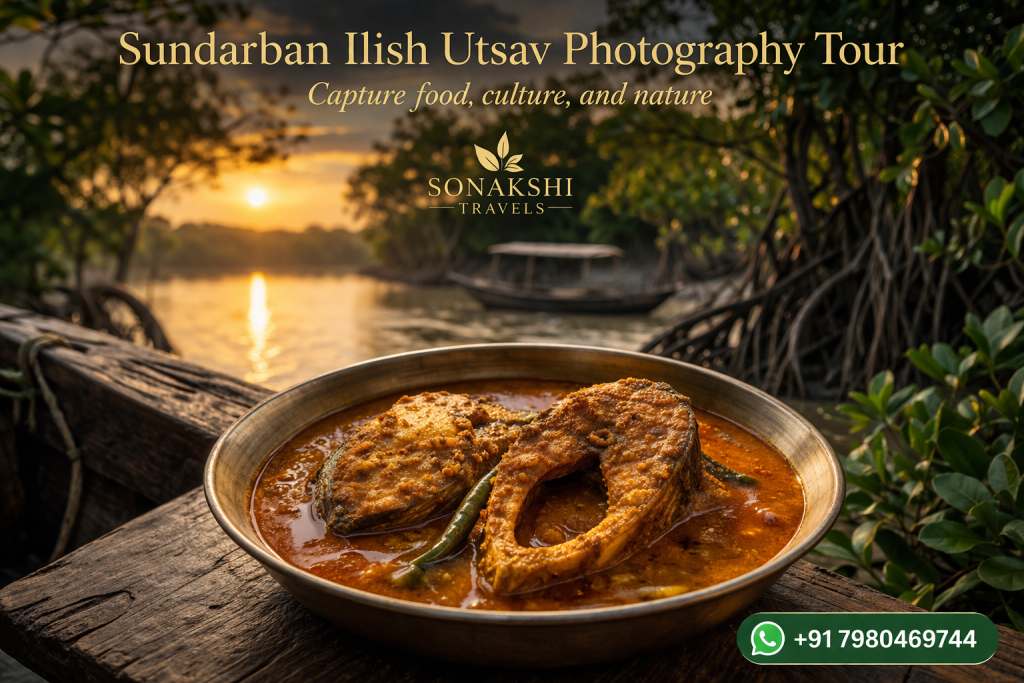
A photography journey becomes more meaningful when the subject is not limited to one frame or one mood. That is the true appeal of a Sundarban Ilish Utsav photography tour. It brings together several visual worlds in one moving experience. There is food with texture, steam, color, and ritual. There is culture with human expression, gesture, costume, and evening light. There is nature with tidal water, mangrove edges, changing sky, village rhythm, and river silence. A camera does not simply record these things. It helps the traveler notice their connection.
The value of such a tour is not only in taking beautiful pictures. It is in learning how one place can hold many kinds of visual stories at once. During the festival, the Sundarban is not reduced to a wildlife route or a food event alone. It becomes a living field of observation. A plate of hilsa on a banana leaf, a folk singer under soft lights, a boat cutting through calm tidal water, and a fisherman standing near the jetty can all belong to the same visual journey. That is why this kind of tour deserves careful attention from anyone interested in travel photography, documentary-style photography, and cultural storytelling.
The festival setting also rewards patience. The best pictures often come not from speed, but from waiting for the right gesture, the right line of smoke from a kitchen, the right turn of the boat, or the right expression during a song. In that sense, the experience is ideal for photographers who want depth rather than noise. It suits people who want to observe closely, move slowly, and build a visual narrative instead of collecting random images.
Why this festival is ideal for photography
Many festivals offer color and movement, but not all of them offer visual variety with emotional balance. The Sundarban Ilish Utsav does. It has the richness of food photography, the intimacy of local performance, and the atmospheric strength of river landscape photography. These elements do not compete with one another. They support one another. A plate of hilsa becomes more meaningful when the viewer also sees the river from which the story of the fish begins. A cultural performance becomes stronger when it is placed within the larger setting of a delta evening.
This is why a festival photography tour in the Sundarban can produce a more complete body of work than a standard sightseeing trip. The visual material is layered. Morning light may give you soft river reflections and village activity. Afternoon may bring food preparation, plated meals, and boat-side details. Evening may open the door to song, dance, audience reaction, and warm lighting. Even the quiet hours between these events carry photographic value, because the delta itself is full of textures, surfaces, and transitions.
Those who wish to understand the emotional side of the event should also pay attention to the role of local performance. The atmosphere described in Sundarban Ilish Utsav cultural evenings is especially important for photographers because it shows how music, dance, and spoken memory shape the visual identity of the festival after sunset. These evening scenes often create some of the most human and memorable frames of the journey.
The food story through the lens
Food photography during the Ilish Utsav is not only about making dishes look attractive. It is about showing preparation, mood, care, and setting. Hilsa is deeply tied to Bengali food memory, and that cultural depth can be felt in the way the dish is cooked, served, and shared. A strong photographer will not only frame the final plate. The stronger work often includes the entire process: marination, mustard paste, steam rising from a hot dish, hands arranging the meal, and faces waiting to eat.
In the Sundarban, this process becomes even richer because the environment adds meaning. Meals are not isolated from place. They are often experienced near river air, boat decks, village kitchens, or festival dining spaces. That allows the photographer to build context. Instead of taking a flat food image, one can show a plate of hilsa against a blurred river backdrop, or capture the contrast between rustic serving style and the delicacy of the fish itself. This approach creates food storytelling photography rather than simple menu photography.
The best visual results often come from attention to natural light. Early lunch settings, window-side preparation areas, and shaded open spaces can produce gentle highlights without harsh glare. Texture matters greatly when photographing hilsa dishes. The mustard coating, the glisten of oil, the softness of steamed fish, and the contrast of green chili or banana leaf all contribute to the image. The photographer should think about depth, detail, and appetite, but also about cultural truth. A genuine frame is more powerful than an over-styled one.
There is also human value in photographing meals as shared experience. A hand serving rice, a family leaning forward, a cook checking the dish, or guests discussing flavor can say more than a perfectly centered plate. This is especially true during a festival where food is not separate from celebration. The camera should therefore look not only at the dish, but at the relationship between the dish and the people around it. That is where authentic food photography becomes meaningful.
Culture, expression, and evening atmosphere
A major strength of this photography tour lies in the transition from day to evening. When daylight begins to soften, the festival moves into a different emotional register. The human presence becomes stronger. The sound of folk music, the rhythm of dance, the movement of hands, and the changing expression of both performers and viewers create a rich visual field. This is not the kind of photography that depends only on scenery. It depends on timing, sensitivity, and attention to expression.
Evening photography during the festival allows the photographer to work with contrast and mood. There may be warm lights, dark backgrounds, bright costumes, shadowed faces, and moments of sudden movement. Such conditions can be challenging, but they are also rewarding. They produce frames that feel alive. A singer with closed eyes, a dancer mid-turn, a child watching from the side, or an elder listening quietly can all become powerful images because they carry emotion as well as form.
This is where the tour becomes more than a record of events. It becomes a study of cultural photography. The camera is not merely documenting performance. It is observing how local art lives within place and community. The stories behind songs, the gestures used in dance, the arrangement of the audience, and the atmosphere of the river evening all help create visual meaning. Good photographs from this part of the tour often feel intimate even when they are taken in a public setting.
For this reason, photographers benefit from understanding the flow of the event before they start shooting. Knowing when performances begin, how lighting changes, and where the audience gathers helps in building stronger compositions. The goal is not to chase every movement. It is to wait for frames where emotion, light, and setting come together naturally.
Nature as the quiet third subject
The title of this tour includes food, culture, and nature, and that balance is important. Without nature, the visual story would lose its foundation. The Sundarban is not a simple backdrop. It is a living presence that shapes the entire experience. The light on the water, the lines of the mangroves, the jetty activity, the distant boats, and the open sky all provide rhythm between the more active moments of the festival.
Nature photography in this setting is often subtle. It is not always about dramatic wildlife sightings. Sometimes the strongest pictures come from stillness. A narrow creek under a pale sky, reflections broken by a passing boat, exposed roots near muddy banks, or birds crossing the late afternoon light can give the photo essay visual breathing space. These quieter images are essential because they help connect the human festival with the delta environment that gives it identity.
A good Sundarban nature photography sequence during the festival should therefore include both wide and intimate views. Wide frames establish atmosphere. Close frames reveal detail. Water patterns, mangrove textures, fishing nets, wooden jetties, and weathered boat surfaces all support the narrative. These are not decorative extras. They show the physical world in which the festival exists.
This becomes even more important when the traveler arrives through a structured route from the city. The movement explained in Sundarban Ilish Utsav from Kolkata helps photographers understand how the visual story begins long before the main festival moments. The road journey, the transfer point, the first sight of the river, and the shift from urban rhythm to delta rhythm can all become part of the photographic narrative.
Building a complete visual narrative
A successful photography tour should not leave the traveler with disconnected images. It should help create a visual sequence with logic and emotional flow. In the case of the Sundarban Ilish Utsav, the natural sequence often begins with arrival, then opens into river atmosphere, food preparation, shared meals, cultural performances, and quiet environmental details. This order gives shape to the story.
Photographers who think in narrative form usually produce more memorable work. Instead of asking only, “Is this frame attractive?” they ask, “What part of the story does this frame hold?” A boat approaching the jetty may function as an opening image. A close photograph of cooking may deepen the food chapter. A singer under evening light may become the emotional center. A final river image at dawn or dusk may act as closure. When images are made with this awareness, the tour becomes visually complete.
This method also prevents overdependence on a single subject. Some travelers may arrive thinking only about photographing hilsa dishes. Others may care only about nature. Yet the true strength of the festival lies in its combined character. The most satisfying visual work usually comes from respecting this balance. A photo essay built from food, people, performance, and environment feels richer than a gallery made from one category alone.
Such balance is also useful for travel publications, blogs, and social storytelling. A single dish can attract attention, but a broader sequence keeps the audience engaged. A reader or viewer understands the place more deeply when they see not just what was eaten, but where the journey moved, who participated, how the evening felt, and what the surrounding landscape looked like.
The role of timing, patience, and observation
A photography tour of this kind rewards those who can slow down. Many good images are lost when the photographer becomes restless. The Sundarban is a place of gradual change. Light shifts gently. Boats move at their own pace. Performances build in layers. Cooks repeat meaningful gestures. The river reveals its mood slowly. All of this demands observation.
Patience is especially important when working with people. Strong cultural and documentary photographs rarely come from interruption. They come from respectful presence. When travelers spend time quietly within the setting, people become more natural, and the camera begins to record real moments instead of self-conscious poses. This is important during meals, performances, and local interactions. A respectful photographer often receives better images because the environment begins to trust the lens.
Observation also helps in managing visual overload. A festival can offer many subjects at once. Music, food, movement, color, and crowd can easily become confusing inside the frame. The answer is not to photograph everything. The answer is to choose clearly. One plate, one face, one gesture, one reflection, one boat edge, one dancer’s hand. Strong photographs are often made by deciding what not to include.
This principle matters greatly in the Sundarban, where beauty is often quiet rather than loud. A misty morning jetty, a small kitchen detail, or a pause between songs may carry more emotional value than a crowded frame. For the thoughtful traveler, this makes the tour especially rewarding. It trains the eye to notice the important and the honest.
Choosing the right structure for the photography experience
The structure of the trip affects the quality of photography more than many people first realize. When transfers are rushed, boat arrangements are unclear, or the stay does not match the visual goals of the traveler, the result is often stress rather than concentration. A well-planned festival journey gives the photographer time to work with light, movement, and rest. That is why understanding package design becomes useful even for creative travelers.
Different travelers may want different levels of access, comfort, and mobility. Some may prefer a compact itinerary with strong highlights. Others may want a slower program with more time for repeated shooting in the same setting. The logic behind Sundarban Ilish Utsav packages explained matters here because photography benefits from clarity. When the traveler understands boat style, accommodation pattern, timing, and movement, it becomes easier to plan images instead of reacting in confusion.
This does not mean the journey should become mechanical. A photography tour still needs freedom. But freedom works best when the basic structure is reliable. Good scheduling allows the photographer to reach the right place at the right hour, stay present during food sessions, and remain alert for evening cultural moments. The best images are often shaped by preparation that does not feel visible inside the final frame.
What makes the final body of work memorable
The final success of a Sundarban Ilish Utsav photography tour is not judged by the number of images taken. It is judged by whether the work feels complete, honest, and place-specific. A memorable set of photographs should allow the viewer to sense the festival without being physically present. It should communicate taste, sound, weather, movement, and emotion through visual means alone.
For that reason, the photographer should aim for variety with coherence. Food images should carry appetite and context. Cultural images should carry feeling and gesture. Nature images should carry atmosphere and location. Human images should carry truth rather than performance for the camera. Together, these elements create a body of work that is not generic festival photography, but a distinct record of the Sundarban during the ilish season.
This is also why the subject deserves serious attention from content creators, travel writers, and visual storytellers. The festival does not offer only one attraction. It offers a layered environment in which food photography, cultural documentation, and nature storytelling can meet naturally. Few travel experiences give such a balanced opportunity.
In the end, the tour leaves the strongest impression when the photographer understands one simple truth. The camera is not there to separate food, culture, and nature into different categories. It is there to show how deeply they belong together. In the Sundarban Ilish Utsav, a meal carries the memory of the river, a performance carries the memory of the community, and the landscape holds both. A thoughtful photographer who sees these links will return not only with beautiful images, but with a visual story that feels rooted, complete, and true.