Sundarban Tour Is a Journey into India’s Unique Mangrove Zone
A Sundarban tour is not an ordinary holiday where travellers simply reach a destination, visit a few attractions, and return to a hotel. It is a carefully coordinated journey through a river-based mangrove landscape where boats, tidal waterways, forest permissions, accommodation, meals, local guidance, and guest safety must work together.
The experience begins with a change in the way people understand travel. Roads gradually give way to rivers, crowded urban surroundings are replaced by open waterways, and the familiar landscape of mainland Bengal changes into an extensive network of creeks, islands, mudflats, villages, and mangrove forests. The journey is slow by nature, but this slower movement allows visitors to observe the region with greater attention.
The value of the tour does not depend only on seeing a particular animal. Wildlife remains unpredictable in every natural forest. The quality of the journey comes from understanding the mangrove ecosystem, observing river life, listening to natural sounds, noticing bird activity, and experiencing the relationship between local communities and the surrounding environment.
For this reason, proper planning is central to the experience. A well-managed tour brings comfort and order to a destination where services depend on waterways, local conditions, permits, and several connected service providers. Good planning does not remove the natural character of the region. Instead, it allows travellers to experience that character safely and responsibly.
Why a Sundarban Tour Needs Careful Planning
The Sundarban is different from a city, hill station, or beach destination. Travellers cannot always move independently between important points whenever they choose. Many parts of the journey depend on boats, authorised entry procedures, navigable channels, local knowledge, and coordination between the mainland, jetty, boat crew, forest guide, and accommodation provider.
A small delay at one stage can affect the remaining services. Late arrival at a jetty may delay boat movement. Poor communication with a resort may create confusion over room readiness or meals. An unsuitable boat may reduce comfort during long hours on the river. Missing documents or incorrect guest information may complicate permit-related procedures.
Careful planning therefore means arranging every connected service as part of one complete movement. The guest should know where assistance will be available, who is coordinating the boat, how meals will be served, what type of accommodation has been reserved, and how changes will be handled if local conditions affect the original arrangement.
A professionally organised Sundarban travel plan also considers the nature of the travelling group. A young group may be comfortable with basic arrangements, while families, children, senior citizens, and guests seeking privacy may require better seating, easier boarding support, cleaner washroom access, flexible meal service, and more attentive handling.
This preparation is not unnecessary luxury. It is practical destination management. Since the journey crosses different service zones, clear planning reduces confusion and allows guests to remain focused on the forest and river environment.
Understanding the Mangrove Journey
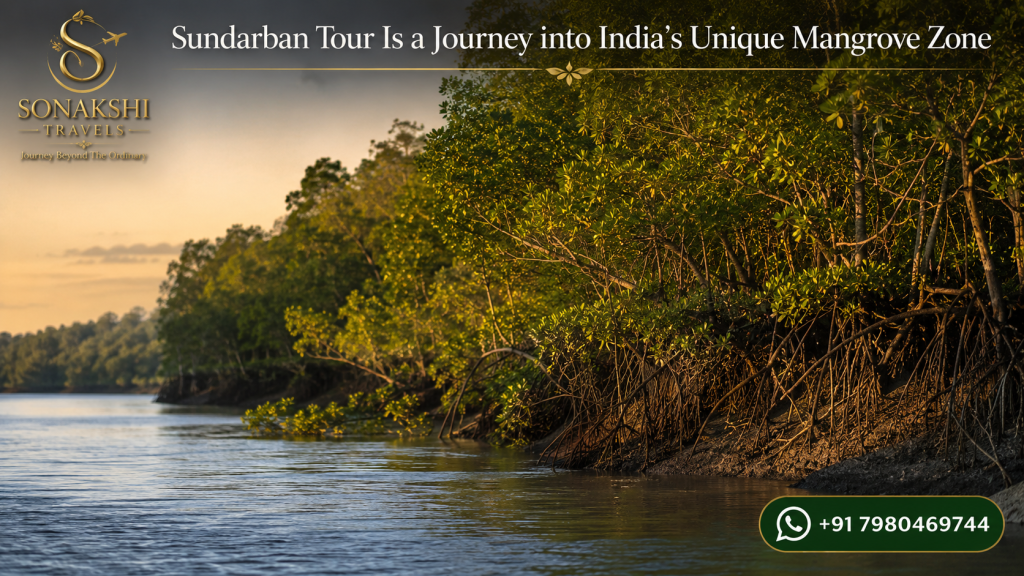
The Sundarban landscape cannot be understood from a single viewpoint. It reveals itself gradually while a boat passes through broad rivers and narrower channels. Mangrove roots, exposed mudbanks, fishing activity, distant village settlements, water birds, and changing river patterns together create the identity of the region.
Visitors often arrive with expectations shaped mainly by photographs of the Royal Bengal tiger. The tiger is an important part of the ecosystem, but no responsible organiser should present a sighting as certain. The forest is not a controlled wildlife display. Animals move according to their own natural behaviour, and sightings depend on many factors beyond the control of a guide or boat crew.
A realistic traveller learns to appreciate the wider experience. Deer near the forest edge, crocodiles resting beside a channel, monitor lizards, monkeys, kingfishers, egrets, herons, raptors, mudskippers, and signs of animal movement may all contribute to a meaningful observation. Even when major wildlife remains out of sight, the structure of the mangrove forest offers valuable ecological understanding.
The article Sundarban Tour Reveals the Quiet Power of Mangrove Forests explains this quieter side of the destination, where the importance of the journey lies in observing natural systems rather than expecting continuous dramatic activity.
Travelling by boat is also essential to understanding the region. The waterways are not merely routes between attractions. They are part of the destination itself. River movement influences local livelihoods, forest access, village communication, fishing practices, and the rhythm of daily life. A properly guided journey helps visitors see these connections without disturbing them.
What Makes the Tour Comfortable and Organised
Comfort in the Sundarban does not mean separating travellers from nature. It means providing suitable arrangements so that physical inconvenience does not dominate the experience. A comfortable journey requires attention to boat condition, seating, shade, drinking water, meal timing, room cleanliness, guest assistance, and communication.
Suitable Boat Arrangements
The boat is one of the most important parts of the tour because guests may spend several hours on the water. Adequate seating, covered areas, open viewing space, life-saving equipment, a clean service area, and a responsible crew all affect the quality of the journey.
A boat should be selected according to group size rather than simply filled to its maximum capacity. Overcrowding reduces visibility, movement, comfort, and personal space. Families and senior citizens may also need assistance while boarding or moving between the upper and lower sections of a vessel.
The experience of seeing the forest from the water is explored further in Sundarban Tour Lets You Experience Forest Life from a Boat. The river perspective helps travellers understand why boat quality and crew coordination are not minor package details.
Well-Timed Food Service
Meal coordination is particularly important because guests may not have easy access to independent restaurants while travelling through the river zone. Food needs to be prepared, carried, stored, and served at appropriate times. Hygiene, drinking water, dietary preferences, and the needs of children or older travellers should be discussed before the journey.
Good food service does not require an unnecessarily large menu. Fresh, properly cooked, familiar meals are often more suitable during a river journey. Guests should be informed whether food will be served on the boat, at the accommodation, or at another arranged location. This avoids misunderstanding and helps people prepare for the day comfortably.
Appropriate Stay Coordination
Accommodation quality influences rest, especially after several hours of boat travel. A room should match what was confirmed during booking. Air-conditioning, room category, bed arrangement, power backup, meal inclusion, accessibility, and distance from the jetty should be communicated clearly.
Travellers choosing premium accommodation should also understand that a higher room category does not automatically control every part of the forest journey. Resort comfort and boat experience are separate service elements. A balanced package must coordinate both instead of concentrating only on the hotel name.
Clear Guest Handling
Guests feel more secure when one responsible person is available to guide them through the different stages of the journey. They should not have to contact separate drivers, boat owners, cooks, guides, and resort staff whenever a question arises. Central coordination improves accountability and reduces repeated communication.
Clear guest handling includes confirming names, group size, room requirements, food preferences, identification needs, pickup understanding, boat arrangements, and emergency contact information. It also means informing travellers honestly when a local adjustment becomes necessary.
The Role of a Reliable Travel Agency or Tour Operator
A dependable Sundarban travel agency does more than accept a booking. Its main responsibility is to connect multiple services into one organised experience. This includes communication before the journey, coordination during the tour, and support when an unexpected operational issue arises.
A knowledgeable Sundarban tour operator should understand the practical limits of the destination. The operator should not promise impossible wildlife results, misrepresent room standards, hide important exclusions, or provide a plan that does not suit the group.
Local operational knowledge is especially valuable in a river-based destination. The organiser should understand jetty procedures, boat movement, forest-related formalities, meal logistics, accommodation locations, and the amount of physical movement expected from guests. This knowledge helps prevent unrealistic scheduling and unsuitable service combinations.
There is also an important difference between making a general reservation and receiving organised travel support. A basic booking may cover only a room or boat. Complete support brings the individual services together and defines responsibility for the entire experience. Travellers know whom to contact, what is included, and how the different parts of the tour connect.
Before confirming a booking, guests should ask for written information. The document should explain the service scope, accommodation category, boat arrangement, meal coverage, guide support, permit inclusion, and applicable cancellation terms. Written clarity protects both the traveller and the organiser.
How Package Quality Shapes the Experience
A Sundarban tour package should be evaluated as a complete service plan rather than only by its price. Two packages may appear similar in duration but differ greatly in boat space, room quality, meal organisation, guide support, staff response, and the degree of privacy provided.
The lowest quotation may not always include the same level of service. A traveller should examine what is actually being provided. Important questions include whether the boat is shared or reserved, whether the room category is clearly named, whether meals cover the full service period, whether permits are included, and whether a local coordinator will remain available.
An affordable Sundarban tour can still be well organised. Affordability should mean sensible service selection, not the removal of essential safety or hygiene measures. A clean room, suitable boat, safe food, clear communication, and responsible crew are basic requirements at every reasonable service level.
Similarly, a best Sundarban tour is not necessarily the package with the most expensive accommodation. The most suitable choice is the one that matches the group’s needs and maintains balance between boat comfort, stay quality, meals, guidance, privacy, and assistance.
Travellers should also avoid choosing a package only because it contains a long list of services. A shorter but clearly explained inclusion list is often more reliable than vague promises. Quality becomes visible through practical details, realistic descriptions, and consistent coordination.
Suitability for Families, Couples, Senior Citizens, and Groups
The Sundarban can suit different types of travellers when the arrangements are selected carefully. The destination itself does not provide the same experience to every group. Comfort, privacy, pace, meal needs, mobility, and personal expectations should shape the booking decision.
Family Travel
A family Sundarban tour requires practical attention to children, parents, and older family members. Families may need adjoining rooms, simple food, safe boarding assistance, sufficient drinking water, and flexible service timing. Parents should also explain to children that forest travel requires patience, quiet observation, and respect for safety instructions.
For families with senior members, the boat should provide stable seating and shade. The accommodation should be reasonably accessible, and unnecessary movement between distant service points should be avoided. Medical requirements and dietary restrictions should be discussed before confirmation.
Couple Travel
Couples often value privacy, calm surroundings, clean accommodation, and less crowded boat movement. A well-arranged journey can offer long periods of quiet observation without requiring highly active sightseeing. The natural setting supports meaningful time together, provided expectations remain realistic and the service arrangement protects personal comfort.
The editorial discussion Sundarban Tour Is Ideal for Couples Seeking Peaceful Nature describes why the slower pace and river environment may appeal to couples who prefer nature and privacy over crowded entertainment.
Some travellers may consider a Sundarban honeymoon luxury package. In such cases, privacy, room quality, boat arrangement, food presentation, and service responsiveness should be more important than decorative promises. The journey should remain connected to the ecological character of the destination.
Senior Citizen Travel
Senior citizens can enjoy the region when physical needs are considered honestly. Comfortable seating, boarding support, regular meals, accessible rooms, medication planning, and sufficient rest are important. An organiser should be informed in advance about mobility limitations or health concerns that may require special attention.
The journey should not be presented as physically effortless because boarding boats and moving across jetties may require care. However, with assistance and suitable arrangements, many older travellers can comfortably appreciate the river scenery and forest atmosphere.
Private Group Travel
A private Sundarban tour is useful for families, friends, photographers, couples, and groups that prefer greater control over space and service pace. A private boat can reduce crowding and allow the group to use seating areas more comfortably. It may also simplify food handling and communication.
A Sundarban private tour package should clearly state which services are private. Travellers should confirm whether privacy applies to the boat, vehicle, accommodation, guide, dining arrangement, or only selected elements. The word “private” should never remain undefined.
A premium Sundarban private tour package may include improved accommodation, more attentive guest handling, a spacious boat, private transfers, and customised meal coordination. Its value depends on the actual delivery of these services rather than the label used in advertising.
Understanding Luxury Without Losing the Natural Character
A Sundarban luxury tour package should improve comfort while respecting the landscape. Luxury in this destination is not about turning the mangrove forest into an urban entertainment space. It is about providing better rooms, greater privacy, cleaner facilities, smoother transfers, spacious boat arrangements, reliable meals, and attentive support.
A properly managed Sundarban luxury tour allows guests to experience the natural surroundings without avoidable service stress. The journey should still remain quiet, observant, and sensitive to the environment. Loud entertainment, wasteful service, and disturbance to wildlife are not signs of quality.
Travellers considering a Sundarban luxury stay package with Sonar Bangla or another premium property should review the full package rather than focusing only on the resort. Room category, meal policy, boat quality, forest coordination, and local assistance must all match the expected standard.
The same principle applies to a Sundarban luxury tour Sonarbangla stay. A premium hotel can improve rest and room comfort, but it cannot replace good river arrangements. The boat remains central to the mangrove experience, and weak boat coordination can reduce the value of an otherwise expensive booking.
Safety and Responsible Coordination
Safety begins with realistic planning. Travellers should follow crew instructions during boarding, avoid unnecessary movement while the boat is navigating narrow channels, supervise children, and use life-saving equipment whenever advised. They should not lean dangerously over railings or attempt to attract wildlife.
The boat crew must understand the waterways and maintain responsible movement. Basic equipment, communication arrangements, suitable seating, and controlled passenger numbers are important. Guests should also inform the organiser about significant medical conditions before travelling.
Food and drinking water safety deserve equal attention. Clean water should remain available throughout the river journey. Meals need to be stored and served carefully, particularly when the boat remains away from permanent facilities for several hours.
Responsible coordination also includes honest decisions. If local conditions require an operational change, the organiser should explain the reason instead of placing guests at unnecessary risk. Safety should never be compromised merely to maintain an unrealistic promise.
Ecological Responsibility During the Journey
The Sundarban is an environmentally sensitive mangrove region, not simply a background for leisure photography. Every visitor shares responsibility for reducing disturbance. Plastic waste, food packets, bottles, and other materials should never be thrown into the river or forest area.
Noise should remain controlled near wildlife zones. Loud music and shouting can disturb animals, reduce the quality of observation, and affect other visitors. Quiet travel is not only respectful; it also improves the chance of noticing birds, movement near the banks, and natural sounds.
Guests should not demand that a boat move dangerously close to animals or enter restricted channels. A responsible guide or crew member may refuse such requests, and that decision should be respected. Wildlife observation must remain non-invasive.
Local communities are also part of responsible travel. Visitors should behave respectfully in village areas, avoid intrusive photography, and purchase local products without aggressive bargaining. Tourism becomes more meaningful when local people benefit without losing dignity or control over their surroundings.
An organised travel provider should encourage waste control, legal forest access, responsible boat behaviour, and respectful guest conduct. Ecological responsibility is not an optional addition to the package. It is central to the long-term quality of tourism in the mangrove zone.
Setting Realistic Expectations
A satisfying journey begins with accurate expectations. Travellers should understand that the Sundarban is a living tidal landscape. Wildlife does not appear on demand, river movement may require patience, and natural surroundings cannot be controlled like a managed attraction.
The absence of a tiger sighting does not mean that the tour has failed. The forest supports many forms of life, and much of its importance lies in ecological relationships that may not appear dramatic. Tidal changes, mangrove adaptation, bird behaviour, mudflat activity, and local river dependence are all important parts of the experience.
Guests should also expect differences between urban service systems and island-based operations. Good organisers can maintain cleanliness, comfort, communication, and punctual coordination, but travellers should remain patient with genuine local limitations.
Responsible marketing should present the destination honestly. Words such as guaranteed, certain, or assured should not be used for wildlife sightings. A trustworthy organiser explains possibilities without creating false expectations.
How to Choose the Right Tour Arrangement
Choosing the right package begins with identifying the group’s actual needs. Travellers should consider group size, age range, desired privacy, room preference, food requirements, mobility concerns, and expected level of assistance.
Before booking, the following points should be checked:
- Whether the boat is shared or private
- Whether the room category is clearly confirmed
- Which meals are included during the service period
- Whether guide and forest-related permissions are included
- Whether the package provides one responsible coordinator
- Whether the service is suitable for children or senior citizens
- Whether exclusions and cancellation conditions are provided in writing
- Whether the organiser makes realistic wildlife claims
A Sundarban tour from Kolkata usually involves coordination across more than one service stage before guests enter the river zone. Therefore, travellers should confirm where the organiser’s responsibility begins and ends. A low price may appear attractive but can create difficulty if essential connecting services are unclear.
People should also examine whether the organiser understands their questions. Clear, direct answers usually indicate better operational awareness. Vague replies, changing package descriptions, unexplained room categories, and pressure for immediate payment should be treated carefully.
Those planning to book Sundarban travel should keep copies of written confirmations, payment records, guest details, and the final inclusion list. This simple step reduces misunderstanding and creates a common reference for both sides.
Why Organised Support Improves the Overall Journey
The real strength of an organised journey lies in continuity. A traveller should move from one service stage to the next without repeatedly solving operational problems. The organiser should already know the guest count, room plan, food requirement, boat allocation, and service responsibilities.
Good coordination is often noticed through small details. Meals arrive at reasonable times. Staff know which rooms are assigned. The boat has enough space for the group. Senior travellers receive help while boarding. Questions are answered by one responsible contact. Changes are communicated before they become serious problems.
These details may not appear dramatic in photographs, but they determine whether guests feel relaxed or confused. In a destination dependent on rivers and multiple local services, organised support becomes part of the travel experience itself.
The most effective service is often quiet and unobtrusive. Guests do not need constant interference, but they should feel that support is available. This balance allows them to observe the forest independently while remaining protected by a well-managed system.
A Sundarban Tour Is More Than a Forest Visit
A Sundarban tour is a journey into one of India’s most distinctive natural environments, but its value depends greatly on how it is planned and managed. The mangrove zone requires coordination because movement is river-based, services are interconnected, forest access is regulated, and guest needs can vary widely.
A good journey brings together a suitable boat, clean accommodation, safe food, responsible guidance, clear communication, and realistic expectations. It respects families, couples, senior citizens, private groups, local communities, and the ecological sensitivity of the forest.
The purpose is not to promise constant wildlife sightings or exaggerated adventure. It is to help travellers understand the quiet complexity of the mangrove landscape while providing the comfort and support needed to experience it properly.
When travellers choose carefully, read the inclusions, ask practical questions, and select responsible coordination, the Sundarban tour becomes more than a booking. It becomes a thoughtful journey through rivers, forests, communities, and one of the country’s most unusual ecological regions.