A Comprehensive Botanical and Ecological Study of a Mangrove-Associated Climber
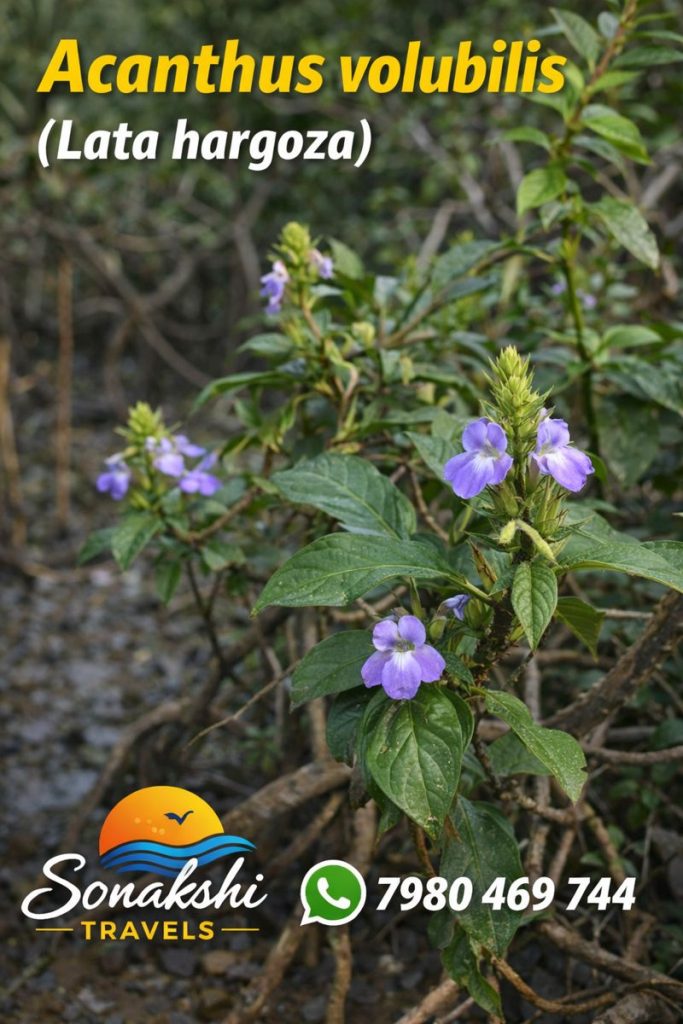
Acanthus volubilis, locally known as Lata Hargoza, is a distinctive climbing shrub belonging to the family Acanthaceae. This species is closely associated with coastal wetlands, estuarine margins, and mangrove ecosystems, where it thrives under conditions of fluctuating salinity, tidal inundation, and high humidity. Unlike many other members of the genus Acanthus, which are erect shrubs, Acanthus volubilis is characterized by its twining and climbing growth habit, enabling it to sprawl over mangrove associates and wetland vegetation.
The plant holds ecological importance within tropical deltaic systems, particularly in the Sundarbans, where it contributes to habitat complexity and shoreline stabilization. This article presents an in-depth, research-based account of Acanthus volubilis, detailing its taxonomy, morphology, distribution, ecological role, and conservation relevance, with special emphasis on its presence in the Sundarbans mangrove landscape.
Taxonomy & Classification
Acanthus volubilis is a well-recognized species within the diverse family Acanthaceae, a group that includes numerous herbs, shrubs, and climbers adapted to tropical and subtropical environments.
Kingdom: Plantae
Clade: Angiosperms
Clade: Eudicots
Order: Lamiales
Family: Acanthaceae
Genus: Acanthus
Species:Acanthus volubilis Wall.
The genus Acanthus is best known for its spiny-leaved shrubs commonly found in coastal zones. Acanthus volubilis stands apart due to its climbing nature, flexible stems, and comparatively reduced spines, reflecting evolutionary adaptation to a scrambling life form in dense vegetation.
Morphology & Field Identification
Growth Habit and Stem
Acanthus volubilis is a perennial climber or scandent shrub with long, flexible stems that can extend several meters in length. The stems are green to light brown, glabrous or sparsely pubescent, and capable of twining around nearby vegetation for mechanical support. Nodes are prominent and may root when in prolonged contact with moist soil.
This climbing habit allows the plant to exploit vertical space within mangrove and wetland thickets, enhancing its access to sunlight while remaining anchored in saturated substrates.
Leaves
The leaves are opposite, ovate to elliptic, and relatively large, with a leathery texture. Leaf margins are entire to slightly lobed, lacking the pronounced spines seen in some other Acanthus species. The upper surface is deep green and glossy, while the underside is paler.
The thick cuticle and robust mesophyll tissues help reduce water loss and protect the leaf from saline spray and intense sunlight common in coastal habitats.
Flowers
The flowers are large, showy, and borne singly or in small clusters from the leaf axils. Corolla color ranges from pale lavender to bluish-purple, often marked with darker veins that guide pollinators. The tubular, bilabiate structure is typical of the Acanthaceae family.
Flowering generally occurs during the post-monsoon and early winter months, coinciding with reduced salinity and moderate temperatures.
Fruit and Seeds
The fruit is an ovoid capsule containing two to four flattened seeds. Upon maturity, the capsule dehisces explosively, dispersing seeds into the surrounding wetland. The seeds are capable of short-distance dispersal by tidal water, aiding local colonization.
Habitat & Distribution
Global Range
Acanthus volubilis is distributed across tropical South and Southeast Asia. Its native range includes eastern India, Bangladesh, Myanmar, Thailand, and parts of Malaysia. The species is largely confined to coastal and estuarine regions, where mangrove ecosystems dominate.
Its distribution closely mirrors areas influenced by tidal freshwater and low to moderate salinity, highlighting its sensitivity to extreme saline conditions.
Preferred Habitat
The species prefers muddy, waterlogged soils rich in organic matter. Typical habitats include mangrove fringes, estuarine creek banks, tidal flats, and backwater margins. It thrives under partial shade provided by mangrove canopies but can tolerate open conditions where moisture remains high.
Regular tidal inundation and seasonal freshwater influx are critical factors maintaining suitable habitat conditions.
Occurrence
The occurrence of Acanthus volubilis is generally patchy, reflecting the fragmented nature of suitable coastal habitats. Populations often form localized clusters along creek margins and elevated mangrove banks where soil salinity is moderated by freshwater inputs.
Vegetative growth intensifies during the monsoon season, while flowering and fruiting peak in the post-monsoon period. The plant exhibits strong resilience to periodic flooding but declines sharply in areas experiencing prolonged hypersalinity.
Preferred Habitat in the Sundarbans Region
In the Sundarbans, Acanthus volubilis is predominantly found in the less saline eastern and central sectors, where freshwater discharge from upstream rivers moderates salt concentrations. It commonly grows along estuarine creek embankments, inner mangrove zones, and transitional areas between mangroves and freshwater wetlands.
The species often associates with mangrove plants such as Heritiera fomes, Excoecaria agallocha, and Acanthus ilicifolius. Its climbing habit allows it to weave through mangrove roots and branches, adding structural complexity to the vegetation layer.
To observe climbers and mangrove vegetation in their natural setting, consider joining a curated Sundarban Tour Package designed for nature enthusiasts.
Ecological Role
Acanthus volubilis plays a meaningful ecological role in mangrove-associated ecosystems. Its extensive root system helps bind soft, unstable soils, reducing erosion along creek banks. By climbing over other vegetation, it contributes to vertical stratification, creating microhabitats for insects, reptiles, and small birds.
The flowers attract pollinators such as bees and butterflies, while the dense foliage offers shelter for invertebrates. As leaves and stems senesce, they add organic matter to the detrital food web, supporting microbial and invertebrate communities.
Habitat Alteration
Habitat alteration poses a growing threat to Acanthus volubilis. Coastal development, embankment construction, aquaculture expansion, and reduction of freshwater inflow have significantly altered estuarine habitats. Increased salinity intrusion, driven by climate change and sea-level rise, further restricts the species to shrinking freshwater-influenced zones.
Fragmentation of mangrove habitats reduces connectivity between populations, limiting gene flow and long-term resilience.
Conservation Efforts
While Acanthus volubilis is not currently listed as globally threatened, its dependence on healthy mangrove ecosystems makes it vulnerable to ongoing environmental change. Conservation of mangroves, maintenance of freshwater inflow, and regulation of coastal land use are essential for the species’ persistence.
In the Sundarbans, ecosystem-based management approaches that integrate biodiversity conservation with sustainable livelihoods provide the most effective framework for protecting climbers such as Acanthus volubilis.
Experience the diversity of mangrove flora responsibly with a customized Sundarban Private Tour led by local experts.
Did You Know?
Acanthus volubilis is one of the few climbing species within the genus Acanthus.
The plant’s flexible stems allow it to survive strong tidal currents.
It is an indicator of moderately low salinity within mangrove ecosystems.
Its flowers are adapted for insect pollination despite the challenging coastal environment.