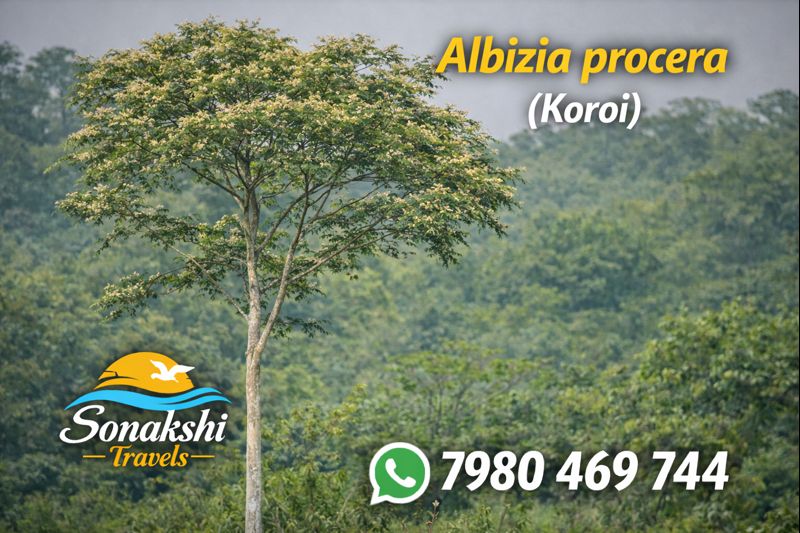
Albizia procera, locally known as Koroi, White Siris, or Tall Albizia, is a fast-growing deciduous tree widely distributed across tropical and subtropical Asia. Renowned for its elegant form, feathery foliage, and ecological adaptability, the species plays a vital role in forest ecosystems, agroforestry systems, and landscape restoration projects. In eastern India and the lower Gangetic plains, Albizia procera is a familiar presence along roadsides, village commons, forest margins, and transitional zones adjoining the Sundarbans.
Beyond its economic value as a timber and fuelwood species, Albizia procera contributes significantly to soil improvement, microclimate regulation, and biodiversity support. Its ability to thrive in degraded soils and disturbed habitats makes it an important species for ecological rehabilitation. This article provides a detailed, research-based examination of Albizia procera, highlighting its taxonomy, morphology, habitat preferences, ecological role, and relevance to the Sundarbans region.
Taxonomy & Classification
Systematic Position
Albizia procera belongs to the family Fabaceae, a plant family of immense ecological and economic importance due to its nitrogen-fixing capability and adaptability to diverse habitats. The genus Albizia includes several species known for their bipinnate leaves and ornamental flowers.
Kingdom: Plantae
Clade: Angiosperms
Clade: Eudicots
Order: Fabales
Family: Fabaceae
Subfamily: Caesalpinioideae
Genus: Albizia
Species: Albizia procera (Roxb.) Benth.
The species is taxonomically distinct for its tall, straight bole, pale bark, and elongated inflorescences with numerous stamens.
Morphology & Field Identification
Growth Habit and Size
Albizia procera is a large, fast-growing deciduous tree that can reach heights of 25 to 30 meters under favorable conditions. It typically develops a straight cylindrical trunk with a high branching point, making it well suited for timber production and avenue planting.
Bark and Stem
The bark is smooth to slightly fissured, pale grey to whitish in color, a feature that gives rise to the common name “White Siris.” Young branches are greenish and glabrous, gradually becoming woody as the tree matures.
Leaves
Leaves are bipinnately compound, large, and feathery in appearance. Each leaf consists of several pairs of pinnae, bearing numerous small, oblong leaflets. The foliage is light green and sensitive to light and moisture changes, contributing to reduced transpiration during dry periods.
Flowers
The flowers are creamy white to pale yellow, borne in elongated axillary or terminal panicles. Each flower is characterized by numerous long stamens that give the inflorescence a soft, brush-like appearance. Flowering generally occurs during the warm season and attracts a variety of insect pollinators.
Fruits and Seeds
The fruit is a flat, elongated pod containing several seeds. Pods turn brown upon maturity and may persist on the tree for some time before dehiscing or falling, aiding seed dispersal through wind and gravity.
Habitat & Distribution
Natural Habitat
Albizia procera naturally occurs in tropical moist deciduous forests, dry deciduous forests, and open woodlands. It is commonly found along riverbanks, forest edges, and lowland plains, where seasonal flooding and sediment deposition support rapid growth.
Human-Modified Landscapes
The species adapts well to disturbed habitats, including agricultural boundaries, fallow lands, and roadside plantations. Its tolerance to poor soils and exposure has encouraged widespread planting outside natural forests.
Global Range
Albizia procera is native to South and Southeast Asia, including India, Bangladesh, Nepal, Myanmar, Thailand, and parts of southern China. It has also been introduced to other tropical regions for forestry and land reclamation purposes.
Within India, the species is widely distributed across the plains and foothills, particularly in eastern and northeastern states.
Preferred Habitat
Soil and Moisture Requirements
The tree prefers deep, well-drained alluvial or loamy soils but can tolerate sandy, lateritic, and moderately degraded substrates. It shows moderate tolerance to seasonal waterlogging but performs poorly in prolonged saline conditions.
Climate and Light
Albizia procera thrives in warm climates with moderate to high rainfall and abundant sunlight. As a light-demanding species, it establishes best in open areas rather than dense forest understories.
Occurrence
In eastern India, Koroi is commonly observed along highways, embankments, village outskirts, and forest buffer zones. It is also planted in social forestry programs due to its rapid growth and multipurpose utility.
Exploring green corridors and village landscapes adds depth to nature travel. Discover immersive itineraries with our
Sundarban Tour Package options designed for ecological exploration.
Preferred Habitat in the Sundarbans Region
Role in Deltaic Buffer Zones
Within the Sundarbans region, Albizia procera is primarily confined to non-saline inland zones, village settlements, embankments, and forest fringes. It does not grow in core mangrove ecosystems but serves as an important species in transitional terrestrial habitats.
Its fast growth and extensive root system help stabilize embankments and reclaimed lands, contributing to erosion control in deltaic environments.
Ecological Role
Soil Improvement and Nitrogen Fixation
As a member of the Fabaceae, Albizia procera forms symbiotic associations with nitrogen-fixing bacteria, enhancing soil fertility. Leaf litter decomposition further contributes organic matter to impoverished soils.
Habitat and Biodiversity Support
The tree provides shade, nesting sites for birds, and habitat for insects. Its flowers support pollinators, while the canopy moderates temperature extremes in open landscapes.
Habitat Alteration
Anthropogenic Pressures
Deforestation, land conversion, and infrastructure development have reduced natural populations in some regions. However, plantation and social forestry initiatives have compensated for these losses to an extent.
In deltaic areas, increasing soil salinity and hydrological changes influence suitable planting zones.
Conservation Efforts
Sustainable Forestry Practices
Albizia procera is not globally threatened. Conservation strategies emphasize sustainable harvesting, protection of mature seed trees, and integration into agroforestry and afforestation programs.
Maintaining mixed-species plantations helps preserve ecological balance and genetic diversity.
For a personalized journey through delta villages and forest fringes, consider our
Sundarban Private Tour experiences curated for nature-focused travelers.
Did You Know?
Traditional and Practical Uses
The timber of Albizia procera is used for furniture, plywood, and light construction. In traditional practices, the tree is valued for shade and as a soil-improving species in crop rotations.
Its rapid juvenile growth makes it a preferred choice for reforestation and land rehabilitation projects.