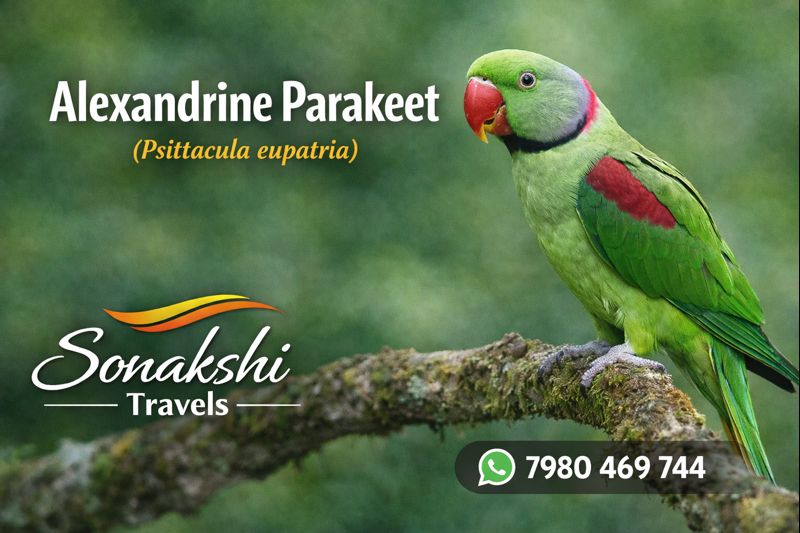
The Alexandrine Parakeet (Psittacula eupatria) is among the largest and most striking members of the parakeet family, admired for its powerful build, elongated tail feathers, and remarkable adaptability to diverse ecological landscapes. Widely distributed across South and Southeast Asia, this species occupies a unique position in both natural ecosystems and human-dominated environments. Its presence in forest edges, agricultural belts, and mangrove-adjacent habitats highlights its ecological flexibility and evolutionary success.
Named after Alexander the Great, who is believed to have introduced the species to parts of Europe, the Alexandrine Parakeet has a long historical association with human civilization. Beyond its cultural symbolism, the species plays a significant ecological role as a seed disperser and a consumer of forest produce. This article presents a comprehensive, research-oriented examination of its taxonomy, morphology, habitat preferences, feeding ecology, reproductive biology, and conservation status, with particular emphasis on its relevance to eastern India and the Sundarbans region.
Taxonomy & Classification
Systematic Position
The Alexandrine Parakeet belongs to the order Psittaciformes, a group characterized by strong curved beaks, zygodactyl feet, and advanced cognitive abilities. Within this order, it is placed in the family Psittaculidae, which comprises Old World parrots.
The genus Psittacula includes several Asian parakeets, many of which exhibit overlapping ranges. However, P. eupatria is readily distinguished by its large size and distinctive shoulder patch.
Morphology & Field Identification
General Appearance
The Alexandrine Parakeet is a robust, long-tailed parrot with predominantly green plumage. A maroon-red patch on the shoulder (lesser wing coverts) is a defining feature visible during both rest and flight. The bill is massive and deep red, adapted for cracking hard seeds and fruits.
Male Features
Adult males display a prominent black and rose-pink neck ring, which becomes fully developed after sexual maturity. The black band runs from the chin to the sides of the neck, bordered posteriorly by a rose-colored collar. This feature plays a role in mate recognition and sexual signaling.
Female Features
Females lack the distinct neck ring, exhibiting a uniformly green neck and throat. Their plumage is otherwise similar to males, though slightly duller in tone. Juveniles resemble females until they reach maturity.
Size & Wingspan
This species is one of the largest parakeets, measuring approximately 56–62 cm in total length, including the long tapering tail. The wingspan typically ranges between 20–24 cm per wing, enabling sustained and efficient flight.
Flight Characteristics
Flight is strong, direct, and purposeful, with rapid wingbeats interspersed with brief glides. The elongated tail acts as a stabilizer, allowing precise maneuvering through forest canopies and open landscapes.
Habitat & Distribution
Global Range
The Alexandrine Parakeet is distributed across the Indian subcontinent, Sri Lanka, Myanmar, Thailand, Laos, Cambodia, Vietnam, and parts of southern China. Isolated populations occur due to historical introductions outside its native range.
Preferred Habitat
This species inhabits a wide array of environments, including tropical deciduous forests, riverine woodlands, mangrove fringes, cultivated fields, orchards, and urban green spaces. Its adaptability to modified landscapes has contributed to its extensive range.
Diet & Feeding Ecology
Diet Composition
The Alexandrine Parakeet is primarily herbivorous, feeding on seeds, grains, fruits, nuts, flower buds, and leaf shoots. It readily exploits agricultural crops such as maize, rice, sunflower, and millet.
Foraging Technique
Foraging occurs both in trees and on the ground. The bird uses its strong bill to husk seeds and its dexterous tongue to manipulate food. Flocks often forage communally, enhancing vigilance against predators.
Breeding & Reproduction
Breeding Season
Breeding generally takes place between November and April, varying slightly across regions depending on climatic conditions and food availability.
Nesting Sites
Nests are established in natural tree cavities, often at considerable heights. Old woodpecker holes or naturally hollow trunks are preferred. Minimal nesting material is used, relying on the cavity for protection.
The female lays 2–4 white eggs, which are incubated for approximately 23–28 days. The male provides food to the female during incubation.
Unique Adaptations & Behavioral Ecology
Speed & Agility
The species demonstrates impressive aerial agility, capable of rapid directional changes to evade predators. Its muscular wings support long-distance flights between feeding and roosting sites.
Camouflage and Nesting Strategy
The green plumage provides effective camouflage within foliage, reducing detection by predators. Nesting in deep cavities further enhances reproductive success.
Social Behavior
Alexandrine Parakeets are highly social, often forming flocks outside the breeding season. Vocal communication plays a key role in maintaining group cohesion and coordinating movements.
Occurrence & Seasonal Movement
While largely resident, local seasonal movements occur in response to food availability. Post-breeding dispersal often results in larger flocks in agricultural zones.
Preferred Habitat in the Sundarbans Region
In and around the Sundarbans, the Alexandrine Parakeet is observed along forest edges, village groves, and mangrove-adjacent agricultural areas. Tall trees bordering tidal creeks provide roosting and nesting opportunities, while nearby croplands offer abundant food resources.
Exploring the biodiverse mangrove landscape offers opportunities to observe such avian species. Plan your journey with a guided Sundarban Tour and experience wildlife in its natural setting.
Ecological Role
The Alexandrine Parakeet contributes significantly to seed dispersal, aiding forest regeneration. By consuming fruits and seeds across wide areas, it facilitates plant diversity and ecosystem resilience.
Habitat Alteration
Deforestation, agricultural intensification, and urban expansion have altered large portions of its habitat. Although adaptable, the species remains vulnerable to the loss of mature trees essential for nesting.
Conservation Efforts
Conservation measures include habitat protection, regulation of the pet trade, and awareness programs promoting coexistence. Protection of old-growth trees is particularly critical for sustaining breeding populations.
Nature-based travel supports conservation awareness. Discover responsible wildlife experiences through a curated Sundarban Tour and learn about the region’s avian diversity.
Did You Know?
The Alexandrine Parakeet can live for over 30 years in the wild under favorable conditions. Its powerful bill is capable of cracking some of the hardest nuts found in tropical forests.