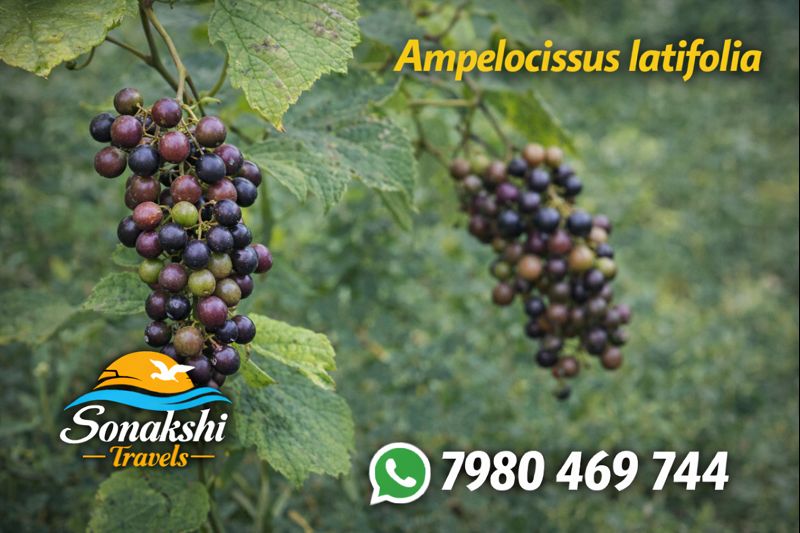
Ampelocissus latifolia is a robust woody climber belonging to the grape family, widely distributed across tropical South and Southeast Asia. Often overlooked due to its non-cultivated status, this species plays an important ecological role in forest margins, scrublands, and transitional vegetation zones. With its large leaves, vigorous climbing habit, and grape-like fruits, Ampelocissus latifolia contributes significantly to habitat structure, wildlife nutrition, and soil stability.
Within the Indian subcontinent, the species is commonly encountered in deciduous forests, village outskirts, and riverine landscapes. In eastern India, including areas adjoining the Sundarbans, it forms part of the climber assemblage that links terrestrial forests with human-modified landscapes. This article presents a detailed, research-based exploration of Ampelocissus latifolia, covering its taxonomy, morphology, habitat preferences, distribution, ecological functions, and conservation considerations.
Taxonomy & Classification
Systematic Position
Ampelocissus latifolia belongs to the family Vitaceae, a family best known for grapevines and woody climbers. Members of this family are characterized by tendrils, compound or lobed leaves, and berry-like fruits.
Kingdom: Plantae
Clade: Angiosperms
Clade: Eudicots
Order: Vitales
Family: Vitaceae
Genus: Ampelocissus
Species: Ampelocissus latifolia (Roxb.) Planch.
The genus Ampelocissus differs from Vitis (true grapes) in having thicker stems, often larger leaves, and fruits that are less suitable for human consumption but vital for wildlife.
Morphology & Field Identification
Growth Habit
Ampelocissus latifolia is a vigorous, woody climber or liana that uses surrounding trees and shrubs for support. The stems are thick, sometimes corky with age, and capable of extending over large areas of forest canopy and scrub vegetation.
Stems and Tendrils
The stems are stout, initially green and flexible, becoming woody and rough with maturity. Tendrils arise opposite the leaves and are branched, enabling the plant to anchor itself firmly to host vegetation. These tendrils are a key diagnostic feature in the field.
Leaves
Leaves are large, broadly ovate to cordate, often measuring 15–25 cm across. They may be entire or shallowly lobed, with a rough or slightly pubescent surface. The prominent venation and broad leaf base give the plant a distinctive appearance, justifying the epithet “latifolia,” meaning broad-leaved.
Inflorescence and Flowers
The flowers are small, greenish, and borne in branched cymes. They are not visually striking but play an important role in supporting insect diversity. Flowering typically coincides with the onset of the monsoon season.
Fruits
The fruits are spherical berries, initially green and later turning reddish to purplish-black upon ripening. Each berry contains several seeds embedded in pulpy flesh. Although not commonly eaten by humans, the fruits are an important food source for birds and small mammals.
Habitat & Distribution
Natural Habitat
Ampelocissus latifolia thrives in dry deciduous forests, moist deciduous forests, forest edges, scrublands, and riverine thickets. It prefers semi-open habitats where sufficient sunlight penetrates the canopy.
Association with Other Vegetation
The species frequently climbs over trees, shrubs, and hedgerows, forming dense vegetative cover. It is commonly associated with secondary forests and regenerating landscapes.
Global Range
Ampelocissus latifolia is distributed across South and Southeast Asia, including India, Bangladesh, Nepal, Myanmar, Thailand, and parts of southern China. Its broad distribution reflects high ecological adaptability to varied climatic conditions.
Within India, the species is widespread in the plains and foothills, particularly in eastern, central, and northeastern regions.
Preferred Habitat
Soil Requirements
The plant prefers well-drained loamy or alluvial soils rich in organic matter. It tolerates moderately poor soils but does not thrive in waterlogged or highly saline conditions.
Climate and Light
Ampelocissus latifolia favors warm tropical to subtropical climates with seasonal rainfall. Partial to full sunlight supports vigorous growth, especially along forest margins and open scrub.
Occurrence
In eastern India, Ampelocissus latifolia is commonly observed along village boundaries, forest fringes, riverbanks, and fallow lands. It often persists in semi-natural habitats influenced by human activity.
Discovering climbers and forest-edge plants adds a new layer to nature travel. Explore immersive journeys with our
Sundarban Tour Package options curated for ecological exploration.
Preferred Habitat in the Sundarbans Region
Role in Transitional Landscapes
In the Sundarbans region, Ampelocissus latifolia does not occur in core mangrove forests but is present in inland buffer zones, village woodlands, embankments, and elevated non-saline areas. These habitats provide suitable support vegetation and soil conditions.
Such transitional zones act as ecological bridges between mangrove ecosystems and terrestrial forests, enhancing overall landscape connectivity.
Ecological Role
Wildlife Support
The fruits of Ampelocissus latifolia are consumed by birds, bats, and small mammals, aiding seed dispersal. The dense foliage offers shelter and nesting opportunities for various fauna.
Structural Diversity
As a large climber, the species contributes to vertical stratification within vegetation, increasing habitat complexity and supporting diverse microfauna.
Habitat Alteration
Impact of Land-Use Change
Deforestation, agricultural expansion, and removal of hedgerows reduce suitable habitats for Ampelocissus latifolia. However, its resilience allows persistence in disturbed landscapes.
In delta-adjacent regions, increasing soil salinity and infrastructure development limit its distribution.
Conservation Efforts
Habitat-Based Conservation
Ampelocissus latifolia is not globally threatened, but conservation of forest edges, village woodlands, and climber-rich habitats is essential for maintaining healthy populations.
Inclusion of climbers in biodiversity assessments and restoration planning improves ecosystem resilience.
For a deeper, personalized understanding of delta flora and forest margins, consider our
Sundarban Private Tour experiences designed for nature-focused travelers.
Did You Know?
Interesting Botanical Notes
The fruits of Ampelocissus latifolia resemble wild grapes and are an important seasonal food source for forest wildlife, even though they are rarely consumed by humans.
Climbers like Ampelocissus play a crucial role in forest regeneration by protecting young trees from excessive sunlight and grazing pressure.
External Reference
For additional botanical and taxonomic information: