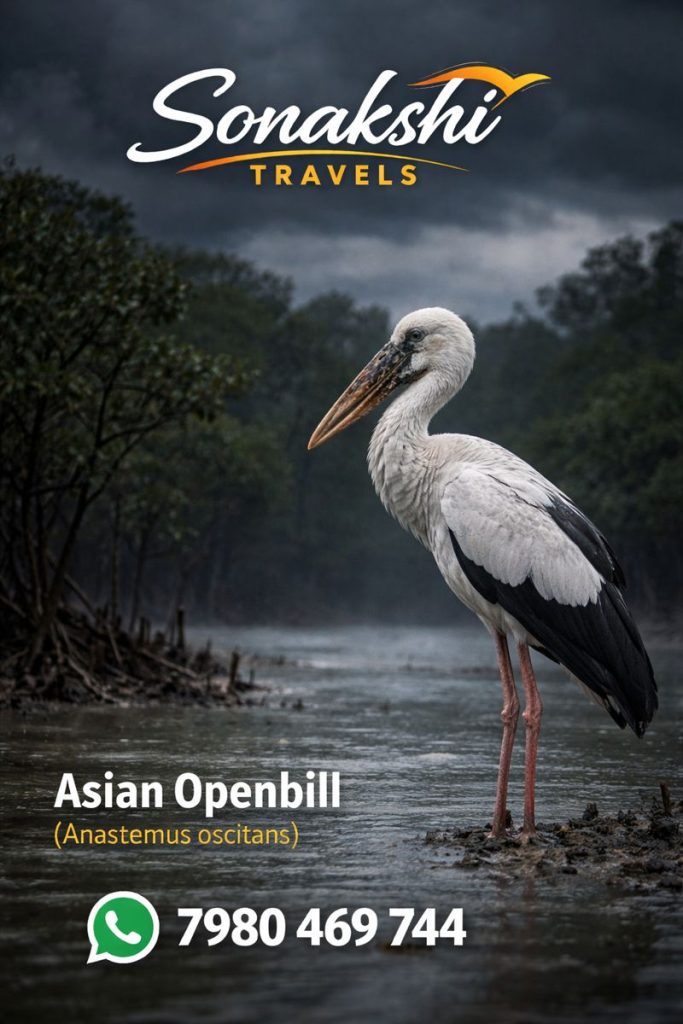
The Asian Openbill (Anastomus oscitans) is one of the most distinctive members of the stork family, instantly recognizable by the peculiar gap between its upper and lower mandibles. This medium-sized wading bird is widely distributed across South and Southeast Asia and is especially well known in the wetlands, floodplains, and rice-growing landscapes of the Indian subcontinent. Its unusual bill structure, highly specialized feeding habits, and strong association with freshwater ecosystems make it an important subject of ecological and ornithological research. In regions such as eastern India and Bangladesh, the Asian Openbill is not only a familiar sight but also an indicator of wetland health and seasonal hydrological cycles.
Taxonomy & Classification
Systematic Position
The Asian Openbill belongs to the order Ciconiiformes and the family Ciconiidae, which includes all true storks. Within this family, the genus Anastomus is characterized by the unique bill morphology that differentiates openbills from other storks.
Kingdom: Animalia
Phylum: Chordata
Class: Aves
Order: Ciconiiformes
Family: Ciconiidae
Genus: Anastomus
Species: Anastomus oscitans
The genus contains only two recognized species globally, the Asian Openbill and the African Openbill, both of which exhibit similar feeding specializations but occur in different biogeographic realms.
Morphology & Field Identification
General Appearance
The Asian Openbill is a robust, long-legged wading bird with a predominantly greyish-white body, glossy black flight feathers, and a conspicuous heavy bill. In the field, it is most easily identified by the open gap in the center of the bill, which is clearly visible even at moderate distances when the bird is at rest.
Male Features
Males and females are largely similar in plumage, but males tend to be slightly larger and heavier. Adult males exhibit a thicker bill base and a marginally broader gape, which may provide an advantage during intense feeding bouts, particularly when handling large freshwater snails.
Female Features
Females are marginally smaller and lighter than males, with a slightly more slender bill. During the breeding season, females may show subtle soft-part color intensification, particularly around the facial skin and bill base.
Size & Wingspan
An adult Asian Openbill typically measures between 68 and 81 cm in length. The wingspan ranges from approximately 140 to 160 cm, allowing the bird to soar efficiently over wetlands and agricultural fields. Body weight usually falls between 1.2 and 1.8 kilograms, depending on age, sex, and seasonal condition.
Flight Characteristics
In flight, the Asian Openbill displays broad wings with black primaries and secondaries contrasting against paler wing coverts. Like other storks, it flies with the neck outstretched and legs trailing straight behind. Soaring flight is commonly observed during thermal conditions, particularly during migration and daily commuting between feeding and roosting sites.
Habitat & Distribution
Global Range
The Asian Openbill is widely distributed across South Asia and Southeast Asia. Its range extends from India, Sri Lanka, and Nepal through Bangladesh and Myanmar to Thailand, Laos, Cambodia, and Vietnam. In many parts of its range, it is considered locally common to abundant, particularly in regions with extensive wetland networks.
Preferred Habitat
This species shows a strong preference for freshwater habitats, including marshes, lakes, ponds, river floodplains, irrigation canals, and rice paddies. Seasonal wetlands formed during monsoon flooding are especially important, as they provide abundant food resources and suitable foraging conditions.
Diet & Feeding Ecology
Primary Diet
The Asian Openbill is a highly specialized feeder, with freshwater snails forming the bulk of its diet. Species of apple snails and other gastropods are particularly favored. In addition to snails, the bird may occasionally consume frogs, small reptiles, aquatic insects, and fish, especially when snail populations are temporarily reduced.
Foraging Technique
The distinctive open bill is an adaptation that allows the bird to extract snail flesh efficiently. The openbill inserts the tip of its bill into the shell aperture, uses precise lateral movements to sever the snail’s operculum muscle, and then removes the soft body. This technique minimizes handling time and allows the bird to exploit a food resource that is less accessible to other waders.
Breeding & Reproduction
Breeding Season
Breeding typically coincides with or follows the monsoon season, when wetlands are at their most productive. The exact timing varies across the range but generally occurs between July and October in eastern India and Bangladesh.
Nesting Sites
Asian Openbills are colonial nesters, often forming large breeding colonies in trees located near wetlands. Nests are constructed from sticks and twigs and placed on sturdy branches. Colonies may include hundreds of pairs and are sometimes shared with other waterbirds such as herons and egrets.
Unique Adaptations & Behavioral Ecology
Speed & Agility
Although not particularly fast in flight compared to raptors, the Asian Openbill is agile in shallow water, where it moves deliberately and efficiently while foraging. Its long legs allow it to wade through variable water depths with ease.
Camouflage and Nesting Strategy
The pale plumage of the Asian Openbill blends well with the reflective surfaces of water and open wetlands, providing a degree of visual camouflage. Nesting in dense colonies also reduces individual predation risk through collective vigilance.
Social Behavior
This species is highly social, often seen feeding, roosting, and nesting in large groups. Social cohesion facilitates information sharing about food sources and enhances protection against predators.
Occurrence & Seasonal Movement
The Asian Openbill is largely resident across much of its range but exhibits local and regional movements in response to rainfall and water availability. During dry seasons, birds may disperse widely in search of suitable wetlands, while monsoon flooding triggers aggregation in newly formed feeding areas.
Preferred Habitat in the Sundarbans Region
Within the Sundarbans region, the Asian Openbill is most frequently observed in freshwater and slightly brackish wetlands adjacent to mangrove forests. Seasonal ponds, freshwater creeks, and agricultural wetlands on the fringes of the mangroves provide ideal feeding grounds, especially during the post-monsoon period.
Planning a guided mangrove adventure? Explore our Sundarban Tour Packages and choose the best itinerary for your dates.
Ecological Role
The Asian Openbill plays a crucial ecological role by regulating populations of freshwater snails, many of which are agricultural pests or intermediate hosts for parasitic organisms. By controlling snail abundance, the bird indirectly contributes to wetland health and agricultural productivity.
Habitat Alteration
Wetland drainage, pollution, and changes in agricultural practices pose challenges to Asian Openbill populations. The conversion of natural wetlands into intensive farmland reduces feeding opportunities, while pesticide use can indirectly affect food availability.
Conservation Efforts
Currently, the Asian Openbill is not considered globally threatened, but conservation of wetlands is essential for its long-term survival. Protected wetlands, sustainable agricultural practices, and awareness among local communities play a vital role in maintaining stable populations.
Did You Know?
The unique gap in the bill of the Asian Openbill develops gradually as the bird matures and begins feeding on snails.
Large breeding colonies can sometimes be detected from afar by the constant clattering sounds produced by bill snapping.
The species is often regarded as a natural ally of farmers due to its role in controlling pest snails.
Planning a guided mangrove adventure? Explore our Sundarban Tour Packages and choose the best itinerary for your dates.
External Reference
For further scientific and general information, readers may consult the detailed species account available on Wikipedia: Asian Openbill (Anastomus oscitans).